
How to Win a Commercial Concrete Bid Without Being the Lowest Price
Being the lowest bidder and being the safest choice aren't always the same thing. That's why many commercial concrete subcontractors are surprised when they lose projects despite submitting one of the lowest numbers, or win work at a higher price than they expected.
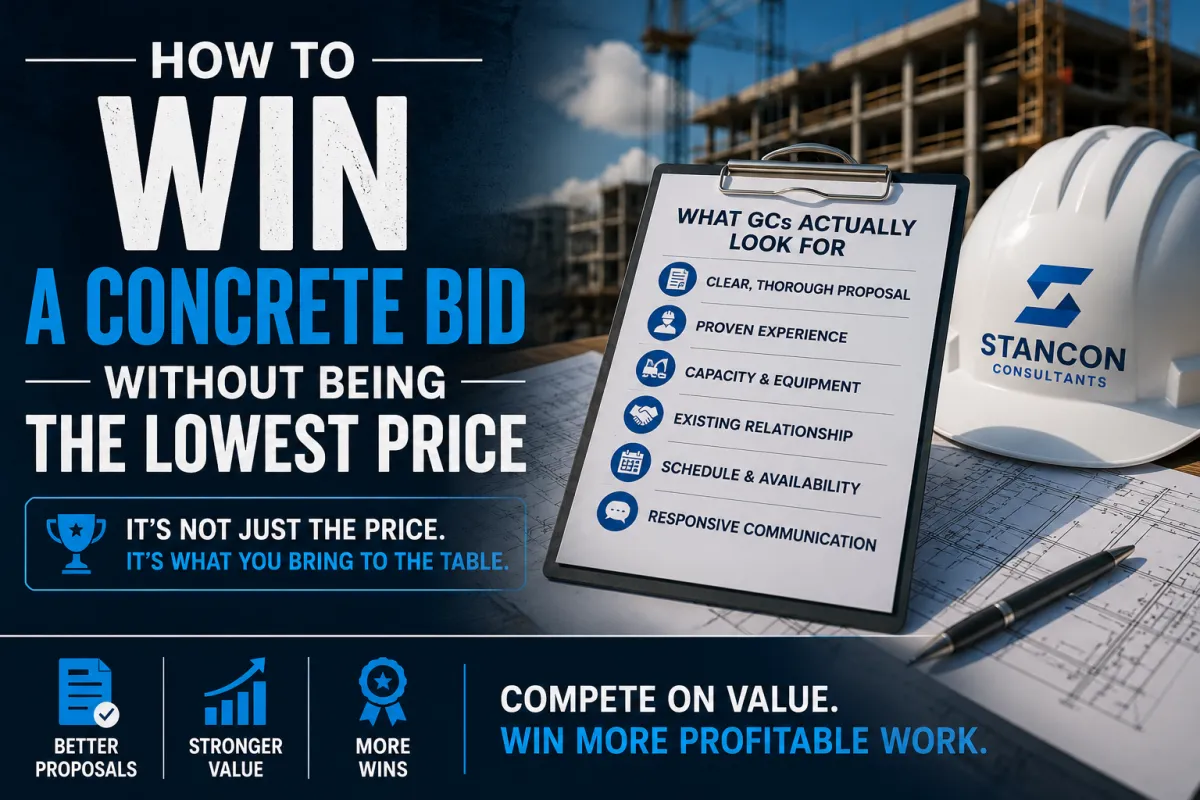
How to win a concrete bid without being the lowest price is about understanding what a GC is actually evaluating when they look at a bid spread and make an award decision. Price matters. But it rarely matters in isolation. And for concrete subcontractors who want to win more profitable work, not just more work, understanding what else goes into that decision is one of the most valuable things you can know.
This article breaks down the five factors that consistently help concrete subcontractors win bids without being the low number, based on real experience working with commercial concrete subs and the proposals that have won them work. If you want to pair this with a concrete bid strategy that helps you target the right opportunities to begin with, that's a useful read alongside this one. And our concrete estimating services are built to support every factor covered below.
Factor 1: A Proposal That Leaves the GC With No Questions
This is the factor that shows up most consistently when a concrete subcontractor wins a bid without being the lowest price.
When a GC is leveling bids, they're not just comparing numbers. They're comparing scope documents. And a bid spread where one sub's proposal is clear, thorough, and requires no follow-up clarification while another's raises questions about scope gaps, missing exclusions, or ambiguous assumptions is not an even comparison, even if the prices are close.
In bid leveling, scope gaps in one proposal can lead a GC to insert a plug number to fill in the missing pricing, which can add tens of thousands of dollars to a bid that initially looked competitive. That sub may have been the low number on paper and still lose the award because their proposal created risk the GC wasn't willing to accept.
The proposals Stancon Consultants produces for commercial concrete clients are structured around eliminating that risk for the GC. Scope of work anchored to Exhibit A so there's no ambiguity about what's included. Scope clarifications that document exactly what conditions the price is built on, earth-formed footings, subgrade within tolerance, specific mix design assumptions.
Project clarifications that define what the GC is responsible for providing, lay-down area, washout, permits, survey control, so there's no dispute about site conditions after award. Project notes that exclude items specifically and with drawing references, not vague generic language. A pricing statement that confirms all material, labor, and equipment are included and preserves the right to reprice if the design changes.
That level of documentation doesn't just protect the sub. It makes the GC's award decision easier. And easier decisions tend to go toward the sub who made them that way.
If you want to see what a proposal at that standard looks like in practice, the full breakdown of how to write a concrete bid proposal covers the structure, the language, and the documentation detail that supports winning at a number that isn't always the lowest on the spread.
Factor 2: Proven Experience and Equipment Availability
A concrete sub who has never poured a post-tensioned elevated deck and one who's done twenty of them are not interchangeable at any price. GCs know this. On projects with real scope complexity, they're not just buying a number. They're buying confidence that the work will be executed correctly the first time, without the delays and rework that come from a crew learning on the job.
The AGC's 2024 workforce survey found that 54% of firms reported project delays due to shortages in their own or subcontractors' workforces, with 80% reporting at least one project canceled, postponed, or scaled back because of workforce shortages. In that environment, a concrete sub who can demonstrate they have the crew capacity, the equipment, and the supervision depth to execute the project on schedule is offering something that a lower-priced competitor who's stretched thin cannot match.
Equipment availability is part of that story too. A GC awarding a large flatwork package wants to know you have the screeds, the ride-on trowels, and the pump truck relationships to handle the volume without scheduling gaps that push other trades. Demonstrating that capability in your proposal, even briefly, adds credibility that a number alone doesn't provide. When the bid spread is close, that credibility is often the difference.
Factor 3: An Existing Relationship With the GC

This one is honest and worth stating plainly: past experience with a GC helps. Not because commercial construction is a good-ol-boy network where relationships override everything else, but because a GC who has worked with you before has real information about how you operate that a stranger's proposal can't provide.
They know whether you show up on time. They know whether your foreman is someone their super can work with. They know whether you handle scope changes professionally or whether every change order becomes a fight. They know whether your final numbers came in close to your bid or whether you were constantly back for more. That track record, positive or negative, travels into every future bid evaluation.
A negotiated project with a GC you have worked with before might have one or two serious competitors in the room, compared to four to eight on a hard-bid public job, which means the competitive dynamic is fundamentally different when a relationship exists. Building and maintaining those relationships isn't separate from your bid strategy. It's part of it. The bid pipeline work of staying visible to the right GCs consistently is what creates the relationship capital that pays off in award decisions.
Factor 4: Schedule Availability and Fit
A concrete sub who is available to start when the GC needs them and can commit to a realistic completion schedule is offering something concrete and valuable, especially on projects with tight construction timelines or phased occupancy requirements.
GCs get burned regularly by subs who win the work and then show up two weeks late because they were finishing another job. Or who show up on time but with half a crew because they overcommitted their capacity. That experience makes schedule availability a real factor in award decisions, not just a checkbox.
When you submit a bid on a project you can realistically execute within the required timeline, say so. A brief statement in your proposal confirming your availability and anticipated start date signals that you've actually thought about the schedule, not just the price. On projects where timing is critical, that signal carries weight beyond what the number communicates on its own.
Factor 5: Responsiveness During the Bid Process
This is the factor that gets overlooked most consistently, and it's one of the clearest signals a GC picks up on before the award decision is ever made.
How you respond during the bid process tells a GC a lot about how you'll respond during the project. A sub who answers the phone, returns emails the same day, provides requested information without needing to be chased, and acknowledges addenda promptly is demonstrating something. They're showing that communication won't be a problem. That questions will get answered. That issues will surface and get addressed rather than getting buried until they become something bigger.
The GC who issues addenda promptly gets bids based on consistent information; the GC who doesn't gets bids that aren't comparable. The same logic runs in reverse. The sub who responds to addenda quickly and confirms their number is still valid based on the revised drawings is making the GC's life easier. The sub who goes silent when an addendum drops creates uncertainty that the GC has to manage before they can finalize the spread.
Responsiveness costs nothing. It requires no additional investment in your proposal quality or your crew capability. But it consistently shows up as a tiebreaker when two concrete subs are close in price and one of them made the bid process easier to manage than the other.
What This Looks Like When Everything Comes Together
The concrete subcontractors who consistently win bids without being the lowest price aren't doing one of these things well. They're doing all of them together, and the cumulative signal they send to a GC is unmistakable.
A clean, thorough proposal with no scope gaps. A track record of executing the project type being bid. Equipment and crew capacity that matches the project's demands. A relationship built over previous jobs. Availability that fits the schedule. And a communication style during the bid process that tells the GC exactly what it will be like to work with them on the job.
Price is one data point. The contractor's qualifications, experience, and track record on comparable projects are the context in which that price should be evaluated. That framing applies at every level of the bid process, including how a GC evaluates the concrete subcontractors in their spread.
The clients who win the most profitable work are the ones who make the award decision easy. And making it easy starts with a proposal that reads like it was written by someone who actually knows what they're doing, backed up by a track record that confirms it. Of course, even the best proposal depends on accurate quantities and pricing, which is why understanding the difference between a concrete takeoff and an estimate is such an important part of building reliable bids.
At Stancon Consultants, we help commercial concrete subcontractors compete on more than price. From accurate takeoffs and estimates to proposal writing and preconstruction support, we help you submit bids that give GCs confidence in both your numbers and your team. If you're looking to win more profitable commercial concrete work without racing to the bottom on price, contact Stancon Consultants to see how we can support your next bid.