
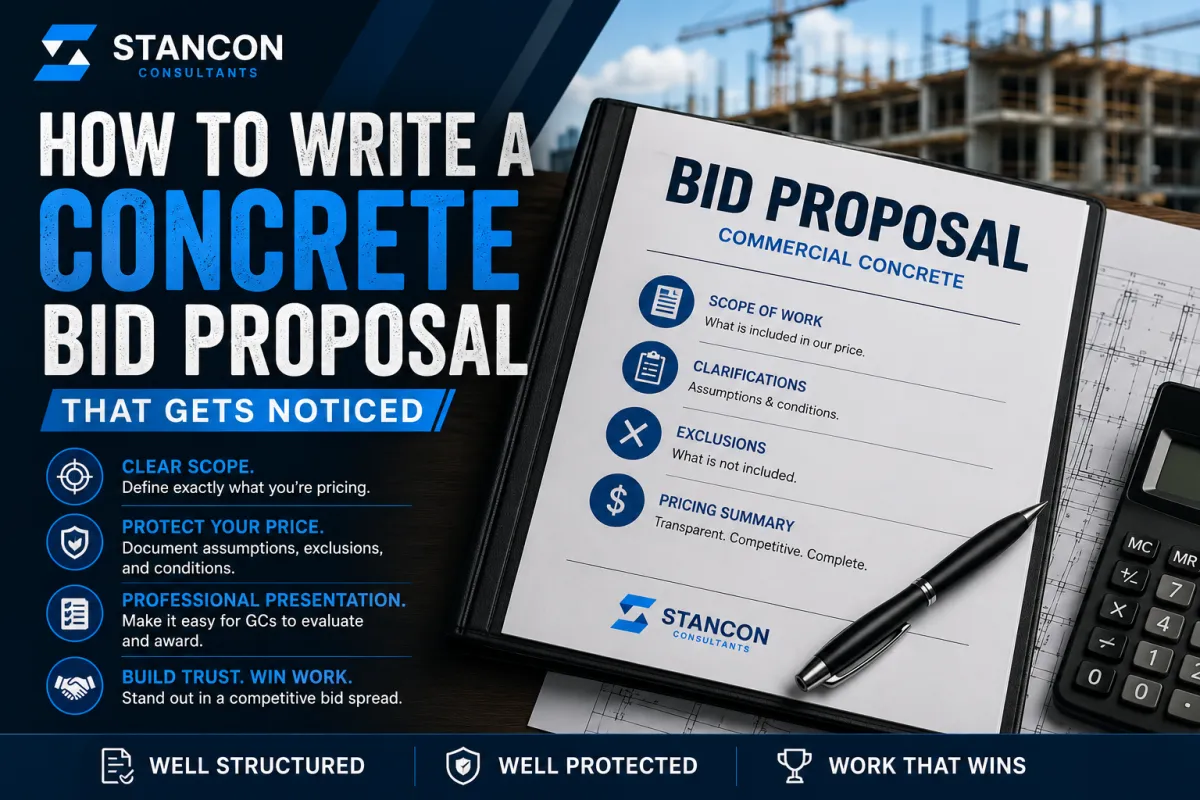
How to Write a Concrete Bid Proposal That Gets Noticed
Most concrete subcontractors spend the bulk of their preconstruction time on the estimate. The takeoff, the labor hours, the material pricing, the markup. And when that work is finally done, the proposal gets assembled in whatever time is left before the deadline, which is usually not much.
That sequencing is understandable. But it's also where a lot of well-priced bids quietly lose. Because a GC reviewing a concrete bid spread isn't just evaluating your number. They're evaluating how you presented it, how clearly you defined your scope, and whether your document gives them what they need to make a decision without picking up the phone to ask follow-up questions. A number buried in a disorganized document is a number that gets discounted, even when it's competitive.
A concrete bid proposal is not a cover sheet for your estimate. It's a preconstruction document that tells a GC exactly what you're pricing, what you're not pricing, what you need from them to do the work, and what happens if the conditions change.
Getting that document right is part of what separates a concrete subcontractor who wins consistently from one who's always competitive but rarely awarded. And if you want to understand how our concrete estimating services handle the full proposal process, that context is useful before we get into the structure.
Here's how to write a concrete bid proposal that holds up from submission through scope leveling.
What a Concrete Bid Proposal Is Actually Doing
Before getting into the components, it helps to understand what a well-written concrete bid proposal is trying to accomplish. It has three jobs running simultaneously, and most proposals only do one of them well.
The first job is communication. A GC needs to understand exactly what scope you're covering, what the price includes, what it excludes, and what conditions or assumptions your number is built on. If that information isn't in the document, they'll either call you for clarification, which costs time and signals disorganization, or they'll make assumptions on your behalf when they level the bids, which may not go in your favor.
The second job is protection. A concrete bid proposal is a written record of what you agreed to price and under what conditions. When design changes happen, when the GC asks you to do something that wasn't in the drawings, or when a scope dispute surfaces mid-project, the proposal is what you go back to. Vague language protects nobody, and it almost always costs the sub.
The third job is differentiation. In a tight bid spread where two or three concrete subs are within a few percent of each other, the one who submitted a clean, thorough, professionally formatted proposal communicates something about how they run their business. That signal matters in award decisions more than most subcontractors realize.
The Header: Identification Before Anything Else
This is the piece most concrete subcontractors either rush or skip entirely, and GCs notice.
Before a single scope item is listed, your concrete bid proposal needs to clearly identify who submitted it, what project it's for, which GC it's addressed to, and when it was submitted. Project name, project address, GC name, bid date, and your company's contact information should all be visible at the top of the first page without a GC having to search for them.
This matters because GCs are often managing bid spreads for multiple projects simultaneously. A proposal that's clearly labeled and dated is a proposal that gets sorted and filed correctly. One that buries the project name in the body text or omits the bid date entirely creates friction before the GC has even read a line of your scope. And friction, however minor, compounds when you're one of eight subs in a spread.
Scope of Work: Reference the Documents, Define the Boundaries
The scope of work section is where most concrete bid proposals either earn or lose trust with the GC's estimating team. Done well, it tells the GC exactly what your price covers. Done poorly, it invites disputes that play out long after the job is awarded.
The approach that works best for commercial concrete proposals is to anchor the scope of work to the project documents rather than writing it out in general language. Referencing Exhibit A, or the specific drawing sheets and specification sections your price is based on, ties your scope to a defined set of documents rather than a set of words that could be interpreted multiple ways. That structure keeps the scope of work section tight while pushing the detail into a separate exhibit where it can be properly organized.
Because a takeoff and an estimate are two different documents, and both feed the proposal, the scope of work section should reflect what was actually measured and priced, not a general description of what the project involves. Specificity is protection. Generality is exposure.
Scope Clarifications: What Your Price Assumes
This section is where you document the assumptions your number is built on. It's distinct from exclusions, which address what's not in your price. Scope clarifications address the conditions under which your price is valid.
In a concrete proposal, common clarifications include assumptions about subgrade elevation and condition, forming method assumptions where the drawings don't specify, mix design assumptions where the specification allows flexibility, and site access conditions that affect how your crew can work. For the Tire Center proposal Stancon Consultants produced for a client, for example, the clarifications included that all footings would be earth-formed and that subgrade would be within one inch of pre-subgrade elevation. Both of those assumptions have real cost implications if they don't hold. Documenting them protects the sub from eating costs that weren't in the original number.
These clarifications should be written in plain, specific language. Not "standard concrete assumptions apply," which means nothing, but the actual condition your price depends on, stated clearly enough that there's no room for interpretation.
Project Clarifications: What the GC Is Responsible For
This section is one of the most underused tools in a concrete bid proposal, and it's one of the most valuable for protecting your relationship with the GC after award.
Project clarifications define what the GC is providing, what they're responsible for coordinating, and what conditions need to be in place for your crew to do the work. In commercial concrete, that typically includes lay-down area and equipment access, washout area for concrete trucks, permits, temporary power and water, utility location, survey control, and any anchor bolt or embedded item installation that affects your pour sequence.
Getting these items in writing before the job starts prevents a version of a conversation that happens constantly on commercial concrete jobs: the sub assumed the GC was handling something, the GC assumed the sub was handling it, and by the time the confusion surfaces, it's a change order dispute. The proposal is where that conversation should happen, not the field.
Project Notes: Exclusions With Specificity
The project notes section is where you document what's not in your price, and the standard that matters here is specificity, not volume. A long list of vague exclusions is less useful than a short list of specific ones tied directly to what the drawings show or don't show.
The right approach is to review the drawings carefully, identify every item that could reasonably be interpreted as part of your concrete scope, and then explicitly state whether it's included or excluded and why. If the plans don't show rigid insulation anywhere, note that. If no stairs on grade were identified in the documents, state that explicitly. If the pylon sign detail was missing from the drawing set and therefore wasn't priced, document that too.
This level of specificity does two things. It shows the GC you actually read the documents, which immediately differentiates your proposal from the subs who submitted a generic exclusion list. And it creates a clear record of what was and wasn't priced based on the information available at bid time, which is your protection if someone later claims the scope should have included something you left out.
When drawings are incomplete or a scope item is unclear, the right process is to reach out to the GC for clarification before the bid goes out. Where that's not possible within the bid window, the item should either be excluded with a note explaining why, or included with a documented assumption that the client has signed off on. What it should never be is a silent assumption that doesn't appear anywhere in the proposal. Silent assumptions become undocumented disputes, and undocumented disputes rarely resolve in the sub's favor.
Pricing Statement and Total: Make the Number Easy to Find
This is a simple structural issue that more concrete proposals get wrong than you'd expect. The GC should not have to flip through pages to find your total price. It should be visible in the bid summary and restated clearly in the pricing statement section, along with a plain statement of what it includes: all material, labor, and equipment as specified, priced against the addenda and drawings provided.
The pricing statement should also address what happens if the design changes after bid submission. Your right to reprice the scope if the final design differs materially from what you priced is a standard and reasonable protection. It should be written clearly, not buried in fine print, and it should be specific enough that a GC reviewing it understands exactly what would trigger a repricing conversation.
A clean bid summary table, broken out by scope category with quantities, unit rates, and totals visible, gives the GC's estimating team everything they need to level your bid quickly against other submissions. The faster they can level your bid, the less friction your proposal creates, and the more your number gets evaluated on its actual merits rather than on the effort required to decipher it.
Exhibit A: Where the Detail Lives
The proposal cover document sets the framework. Exhibit A is where the detail lives, and the standard for what Exhibit A should contain is high.
Every scope item should be broken out by category, with quantities, specifications, dimensions, reinforcement details, and finish requirements stated explicitly. Slab on grade broken out by thickness and mix design. Footings broken out by type and size. Walls broken out by height and reinforcement. Each item tied to the spec or drawing reference it came from.
That level of detail is what allows a GC to quickly verify that you've captured the full scope, identify any items you've excluded intentionally, and level your proposal cleanly against the other subs in the spread. It's also what allows you to defend your number if a scope leveling question comes up after bid day. When your Exhibit A is thorough and well-organized, scope disputes rarely get very far because the documentation answers the question before it becomes a disagreement.
The Conclusion: Don't Waste the Last Impression
Most concrete proposals end with a generic thank-you and a signature. That's a missed opportunity. The conclusion is the last thing a GC reads, and it should do more than signal the document is over.
A strong conclusion restates the total bid price clearly, confirms the proposal is based on the addenda and documents received as of a specific date, invites the GC to reach out with any scope questions, and notes that you'll update the proposal if additional addenda are issued. That last point, proactively committing to addendum tracking, is a professional signal that not every sub sends and that GCs genuinely appreciate.
It doesn't need to be long. Four or five sentences that close the document cleanly, restate the number, and leave a clear next step. That's the standard.
The fractional estimating support Stancon Consultants provides includes proposal writing as a standard deliverable, not an add-on, which means every submission that goes to a GC on a client's behalf is structured to this standard from header to conclusion.
Frequently Asked Questions
What should a concrete bid proposal include?
A complete concrete bid proposal includes a clear project header with GC name, project name, and bid date; a scope of work section anchored to the project documents; scope clarifications documenting your pricing assumptions; project clarifications defining GC responsibilities; project notes listing specific exclusions tied to the drawings; a pricing statement with your total clearly visible; and a detailed Exhibit A breaking out quantities, specifications, and unit pricing by scope category.
How do you write a concrete bid proposal that wins?
Start with clarity. A GC leveling bids needs to understand exactly what you're pricing, what you're excluding, and what conditions your number depends on, without having to call you for clarification. Proposals that are easy to level, clearly exclusioned, and professionally formatted consistently outperform equally priced submissions that require interpretation.
What is the difference between a bid and a proposal in construction?
A bid is the price. A proposal is the document that presents, explains, and protects that price. A bid without a proper proposal is just a number. A proposal without a well-constructed estimate behind it has no foundation. Both are required for a submission that can actually be awarded and executed.
How do concrete subcontractors handle incomplete drawings in a bid proposal?
The right process is to reach out to the GC for clarification before the bid goes out. Where that's not possible within the bid window, the unclear scope item should either be explicitly excluded with a note explaining why, or included with a documented assumption noted in the proposal. What it should never be is an undocumented assumption that surfaces as a dispute after award.
How detailed should the exclusions section of a concrete proposal be?
Specific enough to tie each exclusion to something in the drawings or documents, not so long that it reads like a defensive legal document. The goal is to show the GC you read the plans carefully and to create a clear record of what was and wasn't priced based on the information available at bid time. Generic exclusion lists that don't reference the project documents provide limited protection and communicate limited thoroughness.
How should the pricing be presented in a concrete bid proposal?
The total should be visible in the bid summary table and restated clearly in the pricing statement section. A GC should not have to search for your number. The bid summary should break out scope categories with quantities, unit rates, and totals. The pricing statement should confirm what the price includes and state the sub's right to reprice if design changes occur after submission.