
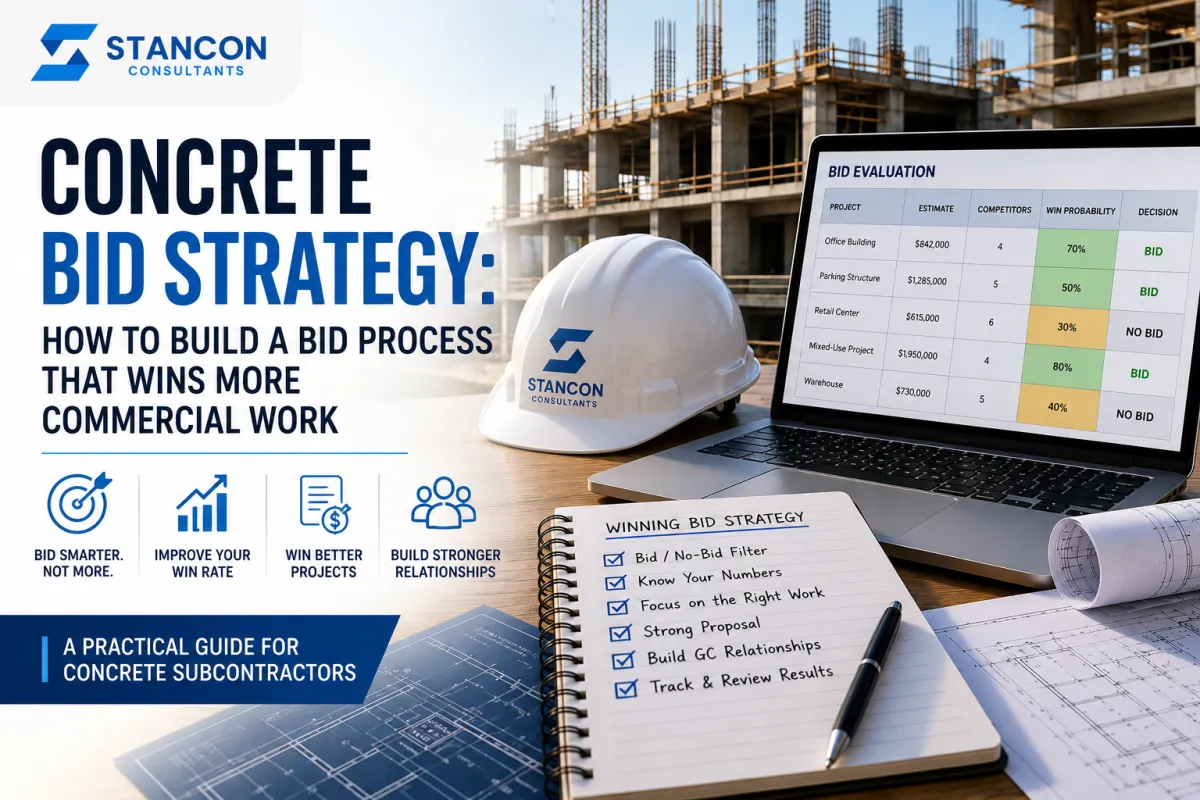
Concrete Bid Strategy: How to Build a Bid Process That Wins More Commercial Work
What most concrete subcontractors have is a bid habit rather than a bid strategy.
There’s no clear structure of what happens when an invite comes in or who is in charge of organizing or putting the numbers together. Sometimes it wins. Most of the time, it doesn't. And when it doesn't, there's rarely a structured review of why. The next invite comes in, and the cycle repeats.
That's not a concrete bid strategy but a volume bidding with no filter and no feedback loop. And it's one of the most common reasons commercial concrete subcontractors stay stuck at the same revenue level year after year, bidding constantly but never actually building momentum.
The average bid win percentage for a commercial contractor is 25%, meaning for every 10 bids submitted, they win 2 to 3 projects. That number isn't fixed. Top-performing contractors consistently achieve win rates of 35% or higher through systematic bidding strategies that transform the process from guesswork into a competitive advantage. The gap between 25% and 35% isn't talent. It's a process. And the process is fixable.
Here's how to build a concrete bidding strategy that actually moves that number.
Start With a Bid/No-Bid Filter, Not a Yes-to-Everything Habit
The first component of any effective bidding strategy for concrete subcontractors is deciding what not to bid. That sounds counterintuitive when you're trying to grow, but it's one of the highest-leverage decisions you make.
Every bid you submit costs money. Estimating time, takeoff hours, coordination with your subs and suppliers, and internal review. The majority of subcontractors aren't tracking their bid-hit rate, which means most are spending estimating resources without any data on whether those specific bid types are actually converting. You can't improve what you don't measure, and you can't improve your concrete bid strategy if you're chasing every invitation equally.
A bid/no-bid filter asks a few hard questions before a drawing set ever goes to your estimating team: Is this GC relationship worth pursuing or are we just making up numbers for their bid spread? Is this project type within our strongest scope, or are we stretching? Is the timeline realistic given our current backlog? Does the contract structure expose us to unusual risk?
Not every invite deserves a full estimate. The best concrete subcontractors know which ones to walk away from, and that discipline is part of what keeps their win rate high.
Know Your Numbers Before You Build Your Number
A commercial concrete bidding strategy lives or dies on the accuracy of your cost model. That means knowing your actual crew costs, not just what you pay your guys per hour but the full labor burden rate, including payroll contributions, benefits, and liabilities. It means knowing your equipment cost per hour, your overhead recovery requirement, and exactly what markup you need to carry to hit your profit target.
Thoroughly researching current market rates for materials, identifying cost-volatile items that may need contingencies, and demonstrating a clear cost management approach in your bid gives the GC confidence that you have a handle on controlling expenses, which matters more than being the absolute low number in a lot of award decisions.
If your cost model is built on assumptions rather than tracked actuals, your concrete bid strategy is standing on sand. The numbers you need to know before you price a single pour: your labor burden rate, your crew cost by team type, your historical productivity rates by scope category, and your overhead budget by month. If you don't have those, building them out is the first real step in improving how you bid.
If estimating capacity is preventing you from building accurate numbers consistently, fractional estimating support can help bridge that gap without adding full-time overhead.
Bid Selectively to Build a Win Rate, Not Just a Bid Volume
Here's a mindset shift that separates contractors with strong bid strategies from those who are always busy estimating but never quite growing: your goal isn't to bid more. It's to win more of what you bid.
Subcontractors known for winning and delivering quality work get invited to better projects with more reasonable timelines and budgets. That reputation builds through selective, strategic bidding rather than a scattershot approach.
For a concrete subcontractor, that means identifying your highest-probability bid categories and concentrating your estimating resources there. If your crew excels at cast-in-place foundations and your win rate on those scopes is consistently above 30%, that's where your estimating investment should be weighted. If you're winning 10% of elevated deck work and the jobs you do win are grinding your margin, that's worth examining before you keep chasing it.
Track your hit rate by scope type, by GC, and by project size. Over time, patterns emerge. And those patterns are the foundation of a concrete bidding strategy that actually compounds, because you get better at winning the work you're best at doing.
Your Proposal Is Part of Your Bid Strategy
The number matters. So does how it's presented.
GCs reviewing a concrete bid spread aren't just looking at price. They're looking at scope clarity, exclusion language, alternates, and whether they can actually level your proposal against the other subs without needing three rounds of clarification. A bid that's hard to read is a bid that gets discounted, even if the number is competitive.
A strong commercial concrete bidding strategy treats the proposal as a sales document, not just a price sheet. That means a clearly written scope of work that mirrors the GC's bid package language. Explicit exclusions so there are no surprises in scope leveling. Alternates where they add value. And a format that's clean enough that a GC estimator can process it quickly during what's often a compressed bid analysis window.
This is one of the areas where working with a professional concrete estimating service pays dividends beyond the numbers themselves. A well-formatted, professionally documented bid proposal communicates competence before you've poured a yard of concrete. For a full breakdown of what that looks like in practice, the construction bid proposal breakdown is worth reviewing before your next submission.
Build GC Relationships That Get You on the Right Bid Lists
Not all bid invitations are equal. Being invited by a GC who already respects your work and wants you on the job is fundamentally different from being added to a bid list as a pricing check. Your concrete subcontractor bid strategy should account for that difference explicitly.
The GCs who matter most to your business are the ones who award on value, not just low number. They're the ones who give you reasonable bid windows, respond to RFIs promptly, and have a track record of paying on time. Identifying those relationships and concentrating your best estimating effort on their projects is a strategy. Treating all bid invitations the same is not.
Bidding on U.S. commercial projects increased by 5% in 2024 compared to the previous year, with commercial construction expected to continue gaining momentum through 2025. More invitations in your inbox don't mean more opportunities if you're not being selective about which ones actually convert. More competition in the market makes GC relationship quality more important, not less.
Track Every Bid, Win or Lose
This is the discipline most concrete subcontractors skip, and it's the one that would improve their bid strategy faster than anything else.
Every bid you submit should be logged: the GC, the project type, the scope, the dollar amount of your bid, whether you won or lost, and, if you lost, the winning bid and why. Over 12 months of that data, you have a picture of your business that most contractors never have. You can see exactly which GCs award you work at what margins, which scope types you're over-pricing, and which ones you're leaving margin on the table.
Tracking win rates by project type, GC, and seasonal variation reveals patterns that let you refine your concrete bid strategy and focus on the most promising opportunities rather than spreading estimating resources thin across everything.
That's the feedback loop that makes every future bid sharper than the last.
The strongest contractors don't leave bidding outcomes to chance. They follow a repeatable process that improves with every project. If you're looking for additional ways to strengthen your approach, these strategies for the construction bidding process are worth reviewing.
Use the Right Estimating Support to Execute the Strategy
A bid strategy is only as good as your ability to execute it consistently. That means having the estimating capacity to pursue the right opportunities without rushing numbers or skipping review steps because the deadline is in 48 hours.
For most concrete subcontractors in the growth phase, that's where outsourcing construction estimating or a fractional estimating arrangement comes in. Not to replace your judgment on bid strategy, but to give you the preconstruction bandwidth to execute it at the level it deserves. If you're strategically targeting the right work but your estimates are rushed and soft because you don't have enough capacity, the strategy is being undermined at the execution level.
Not all estimating providers operate the same way, which is why choosing the right estimating partner is just as important as having one.
Frequently Asked Questions
What is a good bid hit ratio for concrete subcontractors?
For commercial concrete subcontractors pursuing private work, a bid hit ratio of 4:1 or better, meaning you win one in four bids, is a reasonable target. The industry average sits closer to 1 in 5. Ratios worse than 10:1 typically indicate a misalignment between what you're bidding and what you're positioned to win competitively.
How do I improve my concrete bid win rate?
Start by tracking your current win rate by scope type, GC, and project size. Most concrete subcontractors don't know their actual number. Once you have that baseline, you can identify which categories you're winning at margin, which ones you're consistently losing, and where to focus your estimating resources for the highest return.
How do I bid commercial concrete work more competitively?
Know your actual costs before you build your number. That means a current labor burden rate, tracked crew productivity by scope type, and a clear overhead recovery requirement. Competitive pricing doesn't mean pricing low. It means pricing accurately enough that you're neither leaving money on the table nor submitting numbers that aren't executable.
What should a concrete bid proposal include?
A clearly defined scope of work, explicit exclusions, material and labor assumptions, alternates where applicable, and a format the GC's estimating team can level quickly against other bids. The proposal is part of your bid strategy, not an afterthought.
How many bids should a concrete subcontractor submit per month?
There's no universal number. The right volume depends on your estimating capacity, your typical project size, and your target revenue. The more useful question is: what's your win rate on the bids you're submitting? A lower volume with a higher win rate almost always beats high volume with a poor one.
Why is a bid/no-bid filter important for concrete subcontractors?
Because every estimate costs real money in time and resources. Bidding on work where you have low probability of winning, poor GC relationships, or scope types outside your strength dilutes your estimating capacity and your focus. A bid/no-bid filter keeps your resources concentrated on the opportunities most likely to convert at a margin worth having.
How often should I review my bid performance?
At minimum, quarterly. Reviewing win rates by GC, project type, location, and contract value helps identify where your estimating resources generate the strongest return and where adjustments are needed.
The Right Estimating Support
The right bid strategy requires the right execution. If you're struggling to keep up with bid volume, rushing estimates, or lacking the preconstruction bandwidth to pursue the opportunities that matter most, the right estimating partner can make all the difference. Contact Stancon Consultants to learn how we help commercial concrete subcontractors build and execute stronger bidding processes.