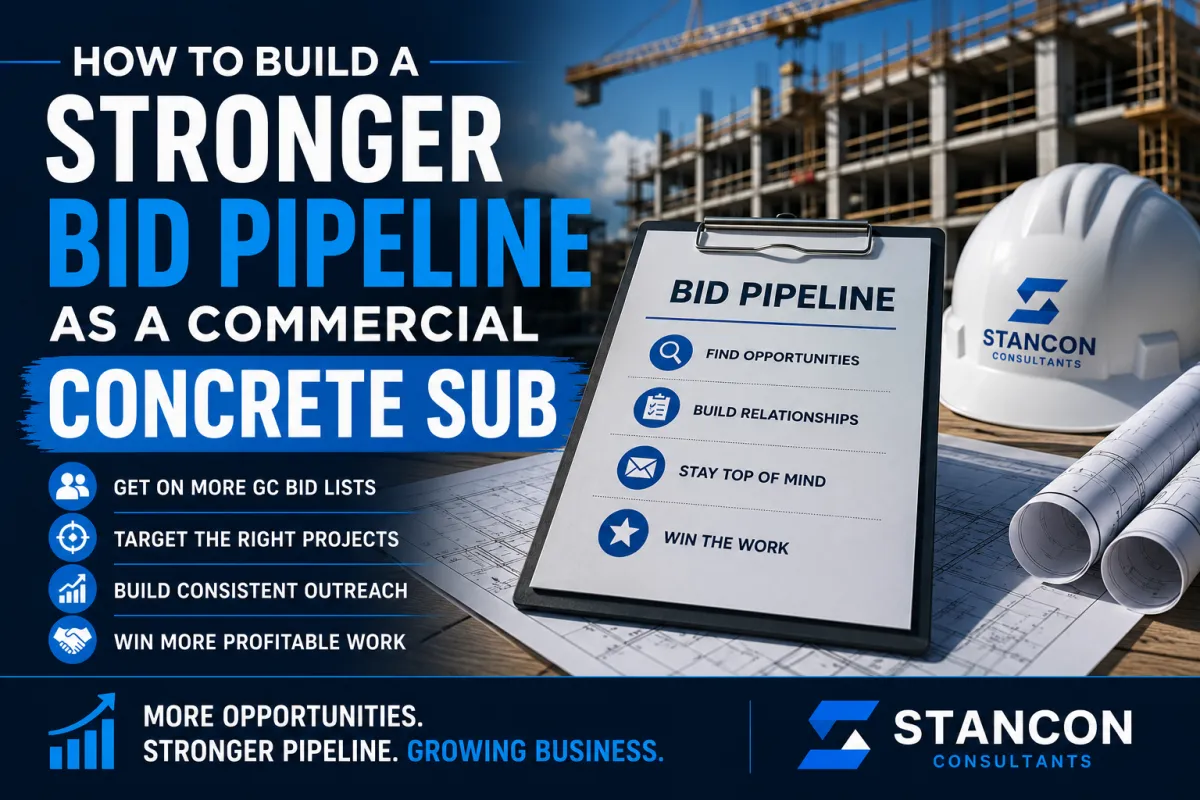
How to Build a Stronger Bid Pipeline as a Commercial Concrete Sub
The biggest obstacle to growth for many commercial concrete subcontractors isn't winning more bids. It's getting enough opportunities to bid in the first place. Even with competitive pricing, experienced crews, and a solid estimating process, revenue eventually plateaus if the pipeline isn't consistently bringing new invitations through the door.
A thin concrete subcontractor bid pipeline means you're winning roughly the same percentage of what you're bidding, but the total number of opportunities is too small to generate the revenue growth you're after. You can have a solid bid strategy, a capable estimating process, and strong execution on the jobs you win, and still hit a ceiling if the volume of incoming opportunities isn't there to build on. That ceiling is invisible until you start counting the invitations that didn't come.
The good news is that a thin pipeline is one of the more fixable problems in commercial concrete subcontracting. It doesn't require a technology overhaul or a marketing budget. It requires a systematic approach to getting in front of the right GCs, being visible on the right platforms, and making outreach a consistent part of how the business operates, not a one-time push when work gets slow. Our concrete estimating and pipeline growth services are built around exactly this problem, and what follows is the framework we use with clients who are trying to move from a reactive pipeline to a proactive one.
Understand Why Your Pipeline Is Thin Before You Try to Fix It
Not every thin pipeline has the same root cause, and the fix depends on the diagnosis. Before jumping into tactics, it's worth being honest about where the gap actually is.
The most common reason commercial concrete subcontractors aren't getting enough invitations is simply that they're not on enough GC bid lists. They may have strong relationships with two or three GCs they've worked with before, but their visibility beyond that circle is limited. When those GCs don't have active concrete work, the pipeline dries up. That dependency on a small number of GC relationships creates a fragile pipeline that feels strong when those relationships are active and feels empty when they're not.
The second most common reason is that the sub is on bid lists but not being invited to the right projects. They're getting calls for work outside their sweet spot, wrong project type, wrong size, wrong geography, while the GCs awarding the kind of work they actually want to pursue don't know they exist. In that case, the volume problem is also a targeting problem.
Knowing which one you're dealing with shapes everything that comes next.
Warm Outreach Is the Fastest Way to Get on More Bid Lists
When a concrete subcontractor comes to Stancon Consultants with a thin pipeline, the first thing we typically focus on isn't platforms or software. It's warm outreach. And it produces results faster than most subs expect, usually within a few weeks of consistent effort.
Warm outreach means reaching out to GCs you already have some connection to, whether through past work, a mutual contact, a pre-bid meeting, or simply because you've submitted a number to them before, even if you didn't win. It's not cold outreach, where you're introducing yourself entirely from scratch. And it's not passive visibility, where you simply create a platform profile and hope GCs find you. It's a direct, personal conversation with someone who has some context for who you are and what you do.
The approach is straightforward. Call the GC's estimating team directly. Introduce your company, mention your concrete scope, and ask specifically to be added to their bid list for upcoming commercial concrete opportunities. Follow that call with a brief email so there's a written record. Then follow up. Most concrete subs make one outreach attempt and move on. The GCs who add you to their active list are usually the ones who've heard from you more than once.
Use the Planholder List on Public Projects as a Pipeline-Building Tool
This is one of the highest-leverage moves available for building a commercial concrete bid pipeline quickly.
When a public project goes out to bid, the awarding authority typically maintains a planholder list: a public record of every GC and prime contractor who has pulled the bid documents. That list is accessible, and it gives you a ready-made outreach list of GCs who are actively pursuing work in your market right now.
The process Stancon uses with clients is simple. When bidding on a public concrete project, pull the planholder list and reach out to every listed GC. Introduce the client, summarize their concrete scope and capacity, and request to be added to that GC's bidders list for future concrete work. Most of those GCs are unfamiliar with the client. But they're actively bidding on a project you already know about, which gives you a natural, relevant context for the introduction that a cold call doesn't have.
Done consistently across every public bid opportunity, this process builds a GC contact list organically and adds new relationships to the pipeline without requiring any additional prospecting effort beyond the bids you're already pursuing.
How to Choose Which GCs Are Worth Pursuing
Not every GC is worth your outreach effort, and being selective about who you target makes the pipeline-building process more efficient and more likely to produce invitations that convert.
Two filters matter most when evaluating which GCs to prioritize. The first is bidding history. A GC who consistently bids commercial concrete work in your project type and geographic market is a better target than one who picks up a concrete project occasionally. You can research bidding history through ConstructConnect, BuildingConnected, and public bid records. A pattern of active bidding in your space tells you the relationship is likely to produce repeat invitation opportunities, not just a one-time ask.
The second filter is responsiveness. A GC who answers their phone, returns emails, and runs a professional bid process is worth more of your outreach investment than one who's hard to reach, slow to issue bid documents, or known for running a disorganized leveling process. Reputation travels in commercial construction. The GCs other subs talk positively about are usually the ones worth pursuing most aggressively.
Use ConstructConnect and BuildingConnected Strategically, Not Passively
Platforms like ConstructConnect and BuildingConnected are standard tools in commercial concrete subcontracting. But most subs use them passively: they create a profile, accept the invitations that come in, and treat the platform as a notification system rather than a prospecting tool.
That passive approach limits what the platforms can do for your pipeline. ConstructConnect, in particular, is built around a proactive model. ConstructConnect lets subcontractors receive and manage bid invitations from GCs across North America through Bid Center, a free digital bid board that keeps all active opportunities organized in one place. But beyond receiving invitations, ConstructConnect lets subcontractors search a database of 825,000 or more active public and private commercial projects, identify who's active on them, and reach out directly without waiting for an invitation. That's a fundamentally different capability from a passive invite-based platform.
BuildingConnected works differently. BuildingConnected is invite-based, meaning subcontractors only see projects when a GC on the platform chooses to reach out. That makes it a strong tool for staying visible to GCs already in your network, but a limited one for finding GCs you don't yet have a relationship with.
The two platforms complement each other rather than compete: ConstructConnect for proactive project discovery and new GC outreach, BuildingConnected for managing relationships with GCs who are already using Autodesk tools.
Using both actively, rather than treating either one as a passive inbox, gives a commercial concrete subcontractor meaningful pipeline coverage across both known and new GC relationships. Our pipeline growth program helps clients set up and work both platforms as part of a structured outreach system rather than an afterthought.
Complete Your Platform Profiles Thoroughly Before You Do Anything Else
This is the step most concrete subcontractors either skip or do halfway, and it quietly undermines every other pipeline-building effort.
GCs using ConstructConnect, BuildingConnected, and similar platforms filter their subcontractor searches by trade, location, license, insurance status, bonding capacity, and sometimes safety record. An incomplete profile doesn't appear in those filtered searches. Which means your outreach efforts, your planholder follow-ups, and your warm calls can all go well, a GC can express genuine interest, and then they search for you on the platform and find a half-finished profile with no insurance certificate on file. That friction is enough for many GCs to move on.
Before any outreach, verify that your profile on every platform you're using is complete. Trade categories accurate and specific. Service area defined. License and insurance documentation current. Bonding capacity listed if applicable. A professional company description that's specific to your concrete scope, not a generic contractor blurb. A complete, accurate profile is the infrastructure that makes every other pipeline effort work.
Build the Pipeline Consistently, Not Just When Work Gets Slow
The most common mistake concrete subcontractors make with pipeline development is treating it as a reactive activity. When the bid calendar is full, outreach stops. When things slow down, they start making calls, sending emails, and updating platform profiles. But the nature of commercial concrete work means the jobs won today were bid 60 to 90 days ago, and the pipeline three months from now is being built right now.
Consistent pipeline activity, even a few hours a week of targeted outreach and platform management, compounds over time in ways that reactive bursts never do. The GC who hears from you three times in a quarter is the one who thinks of you first when a concrete package drops. The one who hears from you once every six months when you're desperate for work is the one who figures you don't have capacity when things are busy.
Building a stronger concrete subcontractor bid pipeline isn't about making more calls when work is thin. It's about maintaining enough activity when work is good that the pipeline stays full regardless of what any single GC relationship is doing at a given moment. And pairing that pipeline discipline with a strong bid strategy and outsourced estimating capacity that can absorb more volume without degrading quality is how concrete subcontractors turn a better pipeline into better revenue, not just more bids.
Frequently Asked Questions
What is a bid pipeline for a concrete subcontractor?
A bid pipeline is the total volume of active bid opportunities a concrete subcontractor is currently pursuing or expects to pursue within a defined time window. A healthy pipeline has enough volume and variety that winning or losing any single bid doesn't materially affect the business's revenue trajectory for the quarter.
How do concrete subcontractors get on GC bid lists?
The most effective approach is direct warm outreach: calling GC estimating teams, introducing your concrete scope and capacity, and specifically requesting to be added to their bidders list. Maintaining complete, accurate profiles on platforms like ConstructConnect and BuildingConnected ensures GCs can find and verify you when they're building their bid lists for upcoming projects.
How long does it take to build a concrete subcontractor bid pipeline?
With consistent warm outreach, most concrete subcontractors start seeing meaningful new invitation volume within a few weeks. Building a reliable, diverse pipeline that isn't dependent on one or two GC relationships typically takes two to three months of sustained effort, though the timeline depends on how actively the outreach is maintained.
What is the planholder list and how can a concrete sub use it?
A planholder list is a public record of every GC and prime contractor who has pulled bid documents on a public project. For concrete subcontractors, it's a ready-made outreach list of GCs actively pursuing work in your market. Reaching out to every listed GC on public projects you're already bidding introduces your company in a relevant context and builds new GC relationships without additional prospecting effort.
What's the difference between ConstructConnect and BuildingConnected for concrete subcontractors?
ConstructConnect allows proactive project discovery: subcontractors can search a database of public and private commercial projects and reach out to GCs independently. BuildingConnected is invite-based: subcontractors see projects when a GC chooses to invite them. Both are useful, but for a concrete sub trying to grow beyond their existing GC relationships, ConstructConnect's proactive model provides more pipeline-building capability.
How do I know which GCs are worth pursuing for my pipeline?
Prioritize GCs with a consistent history of bidding commercial concrete work in your project type and geographic market, and GCs known for responsive communication and a professional bid process. Both factors are researchable through platform data and industry reputation before you invest significant outreach effort.
A Stronger Pipeline Starts With a Consistent Process
A healthy bid pipeline isn't built by waiting for invitations to appear. It's built through consistent outreach, stronger GC relationships, complete platform profiles, and a disciplined approach to pursuing the right opportunities. The contractors with the fullest pipelines aren't necessarily the biggest. They're the ones who treat pipeline growth as an ongoing part of their business, not something they do only when work slows down.
At Stancon Consultants, we help commercial concrete subcontractors build stronger bid pipelines through targeted outreach, platform optimization, and estimating support that gives them the capacity to pursue more of the right work. If you're ready to grow your pipeline and put more qualified opportunities in front of your team, contact us to learn how our Pipeline Growth Program can help.