
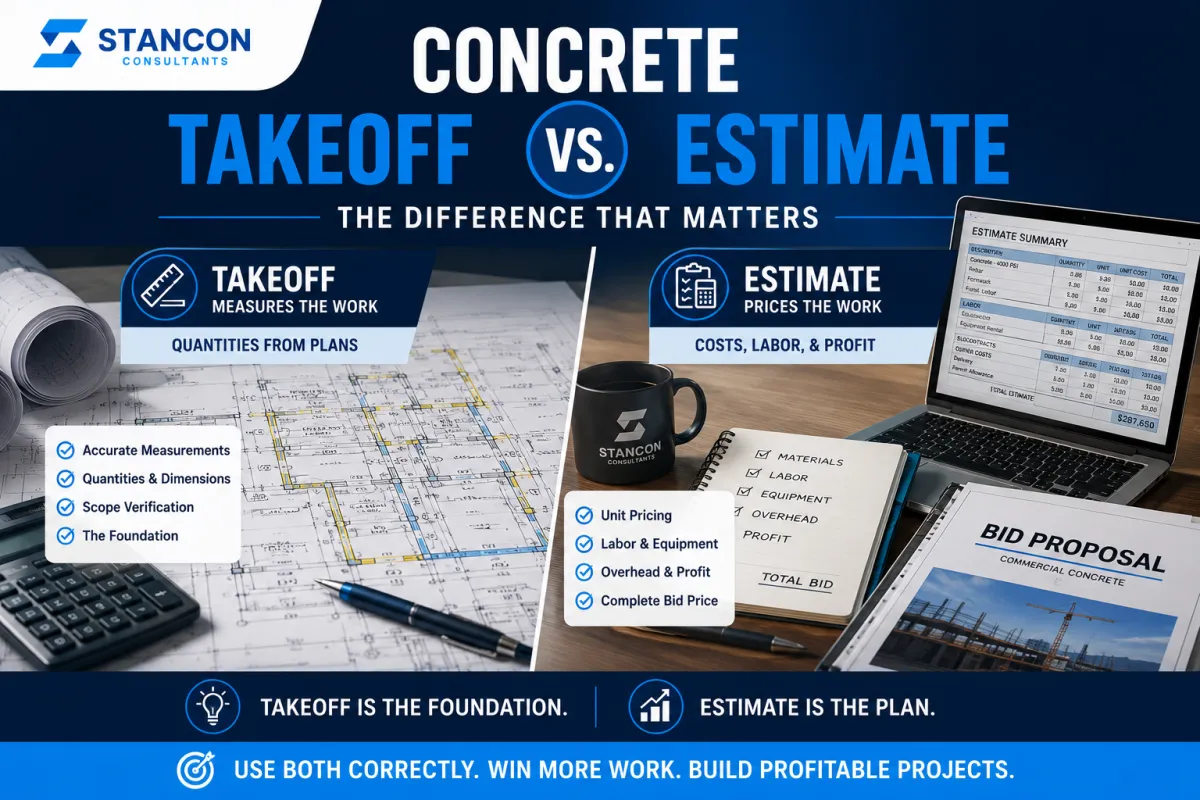
Takeoff vs. Estimate: The Difference Every Commercial Concrete Sub Must Know
Takeoff. Estimate. Price. These words are used interchangeably. They get swapped in the same sentence, used to mean the same thing, and nobody corrects it until something goes wrong.
And something usually does go wrong.
The confusion isn't trivial. Submitting a takeoff to a GC when they asked for a bid is like handing someone a shopping list when they asked for a receipt. The quantities are there. But the cost isn't. And without the cost, you don't have a bid. You have a document that looks like one.
Understanding the concrete takeoff vs. estimate distinction is foundational to how you pursue commercial work, how you communicate with GCs, and how you evaluate the preconstruction support you're paying for. If you've ever asked someone to "give you a price" without sending drawings, or received a "bid" that was really just a quantity list, this article is going to clarify exactly what went wrong and how to avoid it going forward.
Our concrete estimating services cover both functions, and the distinction between them is something we walk new clients through regularly before any estimating work begins.
What a Concrete Takeoff Actually Is
A takeoff, sometimes called a quantity takeoff or material takeoff, is the process of measuring and quantifying everything a project requires based on the drawings, specifications, and project documents. Nothing more. Nothing less.
For a commercial concrete scope, that means pulling cubic yards of concrete broken out by pour location, linear footage of formwork by system type, square footage of slab on grade versus elevated deck, rebar tonnage by bar size and spacing, and any other measurable scope item that appears in the drawing set. It's a detailed inventory of what the project contains. And it's built entirely from reading documents, measuring dimensions, and organizing quantities in a way that can be priced.
Critically, a takeoff contains no costs. No labor rates. No markup. No overhead. It tells you what you need. It doesn't tell you what it's going to cost you to get it. That's a separate step entirely, and confusing the two is where a lot of concrete subcontractors get into trouble.
Think of it this way. A takeoff is a detailed reading of the drawings translated into measurable quantities. Without it, any pricing that follows is a guess. But a takeoff alone is not something you submit to a GC. It's the foundation you build a bid on.
What a Construction Estimate Actually Is
An estimate takes the quantities from the takeoff and assigns cost to them. That includes material pricing, labor hours and rates, equipment burden, subcontractor allowances, overhead allocation, and your markup. The result is a number you can put in front of a GC with the documentation to back it up.
A takeoff is a detailed list of quantities and materials needed, while an estimate includes those quantities plus labor, overhead, and profit to calculate the total project cost. That sequence matters. One feeds the other. You can't price accurately without measuring first, and measuring without pricing produces nothing you can submit.
For a commercial concrete subcontractor, a complete estimate includes labor hours broken out by activity, forming labor separate from placement and finishing separate from curing and protection work. It includes your actual burden rate applied to those hours, not a rough multiplier. It includes material costs sourced from current supplier pricing, not a database from 18 months ago. And it includes a scope statement, a written breakdown of what's in and what's out, that holds up in a GC's scope leveling meeting without requiring a follow-up call to clarify.
That's what a bid is. That's what a GC is asking for when they send you an invitation. Not a quantity list. A priced, documented, defensible number with the backup to support it.
Why the Confusion Costs Concrete Subs Real Money
Here's the situation that plays out more often than it should. A concrete subcontractor gets an ITB, doesn't have drawings organized, and calls to ask for "a price." The estimating service asks for complete project documents before they can begin. The sub pushes back because they expected a faster turnaround. The relationship starts on the wrong foot, and the bid either goes out late or goes out without the detail a GC's estimating team needs to actually use it.
The reason Stancon Consultants asks for complete project documents, drawings, specs, addenda, bid forms, photos, everything, before an estimate is that an estimate without a proper takeoff isn't an estimate. It's a number someone made up with professional-sounding language around it. And a number with no takeoff behind it isn't something you can defend when a GC pushes back on your scope.
According to the Associated Builders and Contractors, average hourly earnings across the construction industry rose 4.4% over the past 12 months, outpacing wage growth across all other industries, which means any labor database that hasn't been updated recently is likely understating your true crew cost before a single bid goes out.
Stale data on a solid takeoff still produces a bad estimate. Both steps have to be done right. And both steps require the full project documents to do them right.
The Takeoff Comes First. Always.
The takeoff is the foundation. It's the step that anchors every cost that follows. If the quantity of concrete is wrong, the material cost is wrong. If the forming square footage is wrong, the labor hours are wrong. And if the labor hours are wrong, every dollar figure built on top of them is wrong. Getting the takeoff accurate is not a preliminary step. It's the most important step in the entire preconstruction process.
This is also why, when someone asks for "just a price" without organized drawings, the honest answer from any credible estimating service is that it can't be done responsibly without them. Pricing without measuring isn't estimating. It's guessing with confidence, which is arguably worse than admitting you don't have a number yet, because it goes into a GC's bid spread as if it were real.
Before you engage any estimating partner, understanding what questions to ask upfront will help you evaluate whether they're doing both steps properly or skipping the one that makes the other meaningful.
What a Concrete Takeoff Looks Like in Practice
For a commercial concrete scope on a mid-size project, a properly executed takeoff should show the following at minimum.
Concrete quantities broken out by pour, with location references tied to drawing sheet numbers. Forming quantities organized by system type, whether that's conventional wall forming, slab edge form, or engineered forming systems for a structural application. Rebar tonnage broken down by bar size, with placement area identified. Slab on grade separated from elevated slab, with each noted by thickness and spec reference. Any embedded items, anchor bolts, blockouts, sleeves, that show up in the structural drawings.
That level of detail is what makes the estimate that follows accurate and defensible. A takeoff that rolls everything into one line item doesn't give you enough information to price labor correctly, identify scope gaps, or flag conflicts between the architectural and structural sheets before they become field problems.
At World of Concrete 2025, the clear theme was that the bottleneck in most preconstruction teams isn't labor or supply chains. It's the hours wasted on takeoffs. The investment in getting the takeoff right, whether you're doing it internally or outsourcing it, pays for itself in the accuracy of everything that follows and the time saved on every future bid when you have a reliable process behind it.
How They Work Together in a Complete Bid
A complete concrete bid is neither the takeoff alone nor the estimate alone. It's the two combined, with a proposal layer on top that presents the number clearly and documents the scope in a way a GC can actually use.
The sequence is straightforward. The takeoff establishes quantities from the drawings. The estimate applies costs to those quantities using current labor rates, material pricing, equipment burden, and your overhead and markup model. The proposal wraps both into a formatted submission that the GC can read, level against other bids, and award from.
Skip the takeoff and the estimate has no foundation. Skip the estimate and the takeoff has no value. Present both without a clear proposal and you've done the hard work without the packaging that makes it usable.
This is the full preconstruction process that a capable concrete estimating service should be delivering. Not one piece of it. All three. And the best place to understand what that looks like across different engagement models, from per-project support to ongoing fractional estimating, is in our guide to choosing the right estimating service.
What This Means for How You Engage an Estimating Service
Understanding the concrete takeoff vs. estimate distinction changes how you evaluate the services you pay for and the deliverables you accept.
When you receive something labeled an estimate, ask whether a proper takeoff was performed first. Can the quantities be traced back to the drawings? Are the cubic yards broken out by pour? Is the forming labor tied to specific square footage from the takeoff? If the answer to any of those is no, what you received is priced without being properly measured, and the accuracy of that number is questionable regardless of how professional the document looks.
When you're engaging a new estimating partner for the first time, one of the first things to establish is whether they perform the full takeoff before pricing or whether they price from approximations and fill in quantities later. That distinction separates services that protect your margin from ones that create exposure while appearing to help. Your bid strategy is only as strong as the preconstruction process that feeds it. And that process starts with an accurate takeoff, every time.
If you're evaluating what level of estimating support your concrete operation actually needs, our fractional estimating plans are built around delivering both the takeoff and the estimate as a complete package, not one without the other.
Frequently Asked Questions
What is the difference between a takeoff and an estimate in construction?
A takeoff is the process of measuring and quantifying everything a project requires from the drawings: cubic yards of concrete, square footage of formwork, rebar tonnage, and so on. An estimate takes those quantities and assigns cost to them, including labor, materials, equipment, overhead, and markup. One measures. The other prices. Both are required for a complete bid.
Can I submit a takeoff as a bid to a GC?
No. A takeoff contains quantities but no costs. A GC needs a priced estimate with a scope statement to evaluate your submission against other subs. Sending a quantity list when a bid is requested tells the GC you haven't completed the preconstruction process.
Do I need a full takeoff before I can get an estimate?
Yes, if you want an accurate one. Pricing without measuring produces a guess, not an estimate. Any estimating service that gives you a number without performing a proper takeoff first is working from approximations, and the accuracy of that number reflects it.
What does a concrete estimate include beyond the takeoff quantities?
A complete concrete estimate includes labor hours broken out by activity, crew composition assumptions, material pricing from current sources, equipment burden, subcontractor allowances where applicable, overhead allocation, markup, and a written scope statement covering inclusions and exclusions. The takeoff quantities are the input. The estimate is the output.
How long does a concrete takeoff take for a commercial project?
It depends on the scope and drawing set complexity. A straightforward slab-on-grade package might take four to eight hours. A complex cast-in-place structural scope with multiple pour locations, elevated decks, and post-tension elements can take 20 hours or more. That time investment is why rushing the takeoff to hit a deadline typically produces a weaker estimate than the one that follows a thorough measurement process.
What happens if my takeoff has errors before the estimate is built?
Any error in the takeoff flows directly into the estimate. If your concrete quantity is understated by 15%, your material cost is understated by the same percentage, and your labor hours built from that quantity are also off. Takeoff accuracy is not a preliminary concern. It's the single most important variable in the accuracy of everything that follows.