
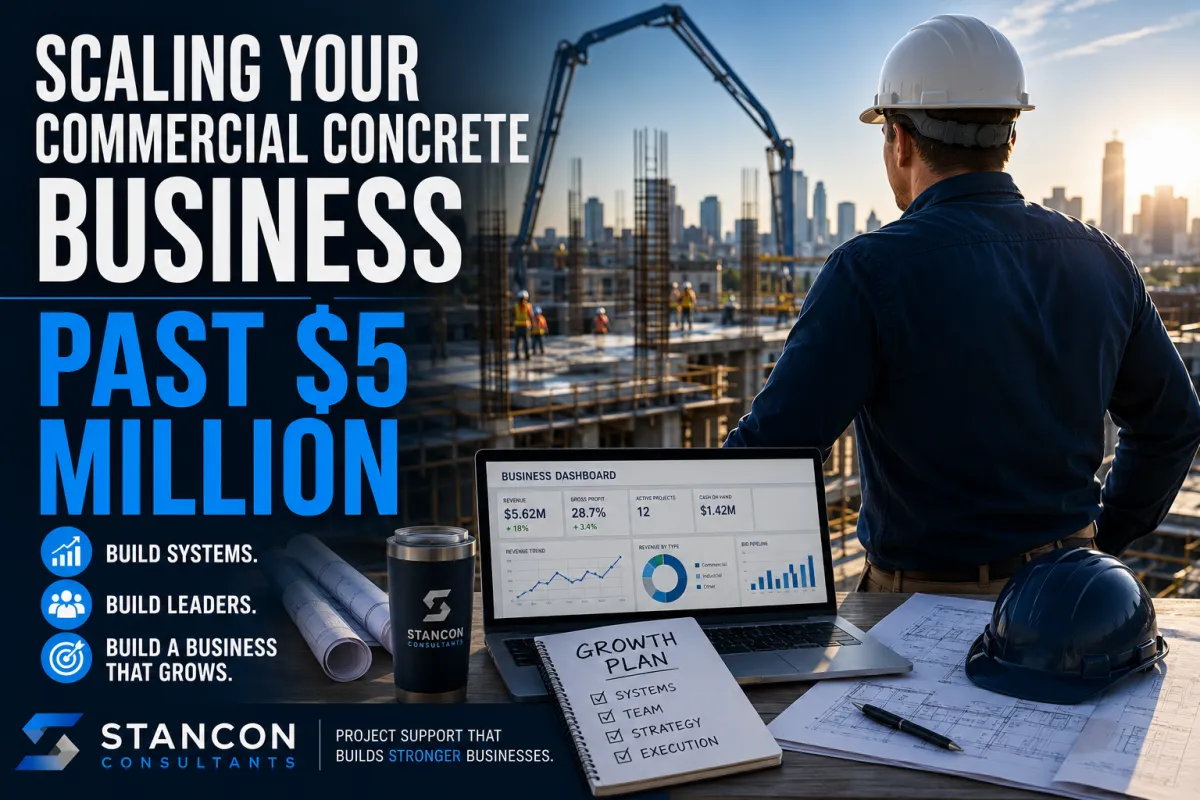
How to Scale Your Commercial Concrete Business Past $5 Million
At some point in Joseph Toppi's career, founder of Stancon Consultants, a mentor sat him down and asked a question that changed everything. Joseph was 27, running a construction business, doing good work, making reasonable money, and thinking of himself as a skilled tradesman who happened to have employees. The mentor asked: are you a tradesman operating a company, or a businessman who chose to own one?
It took a few days for that question to land properly. But when it did, it reoriented everything. Joseph stepped back from the tools, stopped thinking about the work and started thinking about the business, hired people who were better at the craft than he was, and focused his attention on cash flow, finance, strategy, systems, and leadership. Within five years of that shift, he built a commercial concrete operation to 46 employees in an industry he had no prior experience in, and reached a 54% gross profit margin that most concrete subcontractors would consider impossible.
That story matters for this article because it describes the exact transition every concrete subcontractor has to make to scale past $5 million. And it's a harder transition than most expect, not because the business problems are more complex, but because the owner has to change before the business can.
Why the Model That Got You to $5 Million Won't Get You Past It
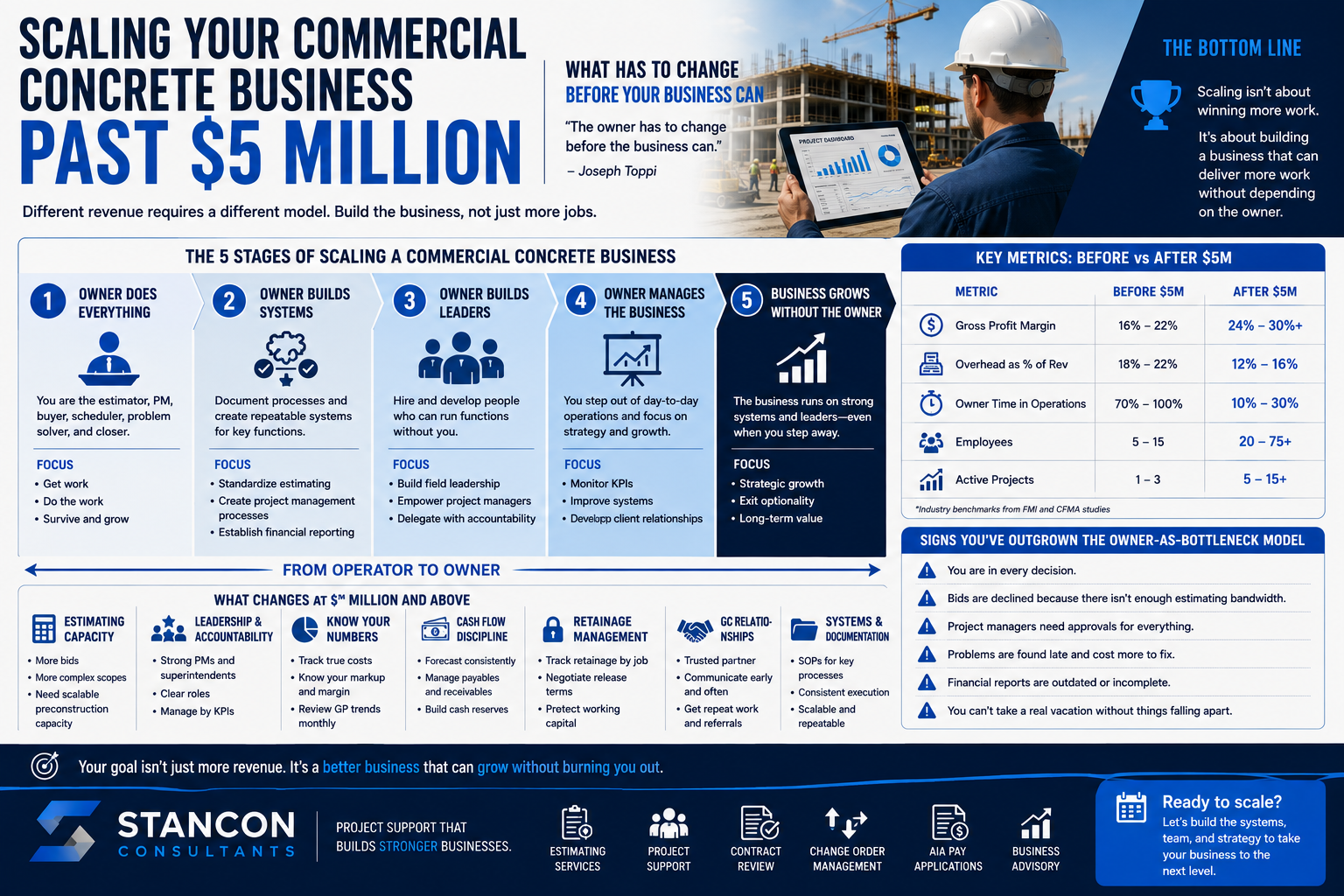
Scaling a construction company requires three distinct structural phases, each with completely different organizational needs. The phase most commercial concrete subcontractors are stuck in when they hit a revenue ceiling is the one where every critical decision still flows through the owner. Every estimate. Every hire. Every GC conversation. Every change order negotiation. Every problem in the field.
That model works at $1 million to $3 million because the owner can genuinely see everything that's happening. But by $5 million, a commercial concrete operation has enough active projects, enough crew members, and enough bid volume that the owner as the operational center isn't a management style anymore. It's a bottleneck. Every decision the business needs to make waits for the owner to be available, and the owner is never fully available because they're everywhere at once.
The business model and structure that got you from zero to $5 million will actively prevent you from reaching $10 million or beyond. This is the ceiling most concrete subcontractors hit and don't understand, because the symptoms look like a capacity problem or a hiring problem or a bid volume problem, when the actual constraint is organizational. The owner is still running the company the way they ran it when they had five employees. And the company now has thirty.
The Estimating Bottleneck Is Usually the First Ceiling
For most commercial concrete subcontractors approaching $5 million in revenue, the earliest and most limiting growth constraint isn't crew capacity, equipment, or GC relationships. It's preconstruction bandwidth.
You're getting more bid invitations than you can price competitively. The drawing sets are more complex. The deadlines are tighter. And the person doing the estimates, very often the owner or a PM who's already managing active jobs, is stretched thin enough that bid quality is suffering. Some invitations get declined because there's no time to price them. Others go out rushed, and the numbers reflect it.
This is the moment where the in-house estimator vs. outsourcing decision becomes a scaling decision, not just an operational one. Adding a full-time estimator adds fixed overhead that the revenue needs to support before the hire makes financial sense. A fractional estimating model gives you the preconstruction capacity to pursue more work without the overhead commitment, scaling with your bid volume rather than running at full cost through slow seasons.
What changes at $5 million and above is that you're no longer just trying to win the next bid. You're trying to build a pipeline disciplined enough to produce consistent revenue across a full year, targeting the right GCs with the right scopes, and building the kind of bid submission quality that wins work without always being the lowest number. The concrete bid strategy and bid pipeline discipline that drives that consistency are preconstruction infrastructure investments, not just tactical moves.
You Have to Stop Being the Bottleneck in the Field Too
Estimating is one half of the owner-as-bottleneck problem. Field execution is the other.
At $5 million, a commercial concrete subcontractor typically has multiple active jobs running simultaneously. If the owner is still the primary person managing field issues, handling GC relationships on active projects, resolving crew problems, and making decisions about pour sequencing and schedule adjustments, they're carrying a load that prevents the business from scaling past what one person can personally manage.
The transition that unlocks the next level of growth is building field leadership that can own project execution without the owner in the loop on every decision. That means a project manager or superintendent capable of running jobs independently, managing the GC relationship day to day, tracking cost-to-complete against the estimate, and flagging problems early enough that they can be solved before they become expensive. Firms that developed internal leadership capacity at the $5 million stage consistently reported faster and more sustainable growth than those who continued running all operations through the owner.
This is hard for concrete subcontractors who built their business on their own field competence, because delegating execution means trusting someone else to maintain the standard that built the reputation. But the alternative, keeping the owner at the center of every project decision, caps the business at whatever one person can personally oversee. And at commercial concrete project sizes and complexities, that cap is lower than most owners realize.
Know Your Numbers at a Business Level, Not Just a Job Level
Joseph's path to 54% gross profit margin didn't come from better field execution or smarter bidding alone. It came from knowing the actual cost structure of the business in enough detail to price jobs accurately, manage overhead deliberately, and understand in real time whether the business was performing at the level the numbers required.
Most commercial concrete subcontractors know their job costs reasonably well. They know what materials cost, roughly what their crews cost per day, and what the GC paid them for the scope. What fewer know with precision is their fully loaded overhead rate, the real monthly cost of running the business independent of any specific project; their required markup to hit a target net profit after overhead is recovered; and their actual gross profit margin across the full year compared to what their estimates assumed.
Specialty contractors who maintain gross profit margins above 25% consistently outperform industry averages and sustain growth past $5 million. The average for specialty contractors sits just above 16%. The gap between average and above-average performance almost always traces back to pricing discipline: knowing what the business needs to make on every job and holding that number rather than shaving margin to win work. Understanding the difference between markup and margin and the financial metrics that actually drive business performance is the financial foundation that scaling requires.
Build Systems Before You Add People
This is where a lot of concrete subcontractors get the growth sequence wrong. They hire to solve capacity problems before the systems exist to support the new headcount. A new estimator who doesn't have a documented estimating process to follow produces inconsistent estimates. A new foreman who doesn't have a clear job administration framework loses track of change orders and schedule documentation. A new project manager who doesn't know how you expect progress to be tracked and reported ends up managing jobs the way they managed them at their last employer, not the way your business needs them managed.
The business model that produces consistent results at scale is built on documented processes that produce consistent output regardless of who is executing them. That means an estimating process that produces deliverables to a consistent standard. A job startup checklist that covers submittal requirements, billing setup, safety documentation, and GC communication protocol. A change order process that field personnel can execute in real time. A billing process that hits every cutoff date without the owner having to chase it.
Stancon Consultants is developing HR support infrastructure for commercial concrete subcontractors, including hiring process design, training manuals, and employee handbooks, because this is precisely where growing concrete businesses consistently break down. The systems that allow you to hire successfully and scale without losing quality are the same systems that make the business less dependent on the owner for day-to-day decisions.
Cash Flow Has to Be Managed as Aggressively as Revenue
Revenue growth without cash flow management creates a specific kind of company that feels successful from the outside and is constantly stressed on the inside. More work means more materials purchased upfront, more payroll to cover weekly, more mobilization cost before the first pay application is submitted. If the billing cycle isn't disciplined, if change orders aren't getting incorporated into the Schedule of Values, if retainage isn't being tracked and pursued at closeout, the cash position deteriorates exactly when the business is growing the fastest.
Commercial concrete subcontractors who account for the cost of working capital in their bids achieve 24% average profit margins compared to 17% for those who don't. That 7-point difference compounds significantly across $5 million in annual revenue. The discipline of cash flow management specific to commercial concrete operations isn't a financial management detail at this stage. It's a survival requirement.
Retainage management deserves specific attention as you scale. A concrete subcontractor doing $5 million in annual revenue with average 10% retainage on projects has $500,000 or more in earned but uncollected retainage sitting across their active project portfolio at any given time. Managing retainage release proactively, confirming closeout requirements before the job ends, submitting lien waivers on schedule, and following up relentlessly on outstanding retainage balances is cash flow management as much as it is project administration.
The GC Relationship Quality Has to Scale With the Business
At $2 million in revenue, a concrete subcontractor can sustain the business on a small number of solid GC relationships. At $5 million and above, the diversity and quality of those relationships become a strategic constraint on further growth. Dependence on two or three GCs for the majority of your revenue creates a fragile pipeline that doesn't support consistent growth, because if any one of those relationships slows, the impact on your bid volume and backlog is immediate.
Scaling past $5 million requires deliberately expanding the GC relationship base, targeting GCs who award commercial concrete work consistently in your project type, and building the kind of preconstruction reputation that gets you invited to bid before the public notice goes out. That reputation is built bid by bid through proposal quality, responsiveness, and execution. What GCs want to see in a concrete submission changes at larger project sizes, and the subcontractors who win work at that level consistently are the ones whose submissions reflect a professional preconstruction operation.
The business development discipline that drives GC relationship growth at scale isn't a marketing function. It's a daily operational habit: following up on submitted bids, maintaining contact with GC estimating teams between bid cycles, showing up at pre-bid meetings, and delivering on every project at a standard that makes the GC want you back on the next one.
What Stancon Consultants Provides at This Stage
Stancon Consultants works with commercial concrete subcontractors across the full growth curve, from getting the estimating process right at $2 million to building the preconstruction infrastructure that supports growth past $5 million and beyond. Our commercial concrete estimating services and fractional estimating plans are designed specifically for the capacity and quality problems that show up at this stage of growth.
Beyond estimating, Joseph's background running a concrete operation to 46 employees and achieving results that most in the industry would consider exceptional informs the business advisory work we do with clients who are trying to make the transition from tradesman-as-owner to businessman-as-owner. That transition is the hardest part of scaling a concrete business. And it's the one that matters most.
If the revenue ceiling feels like a capacity problem but the real constraint is organizational, that's worth a direct conversation. The question Joseph's mentor asked him at 27 is still the right starting point: are you running a business, or are you still the business?