
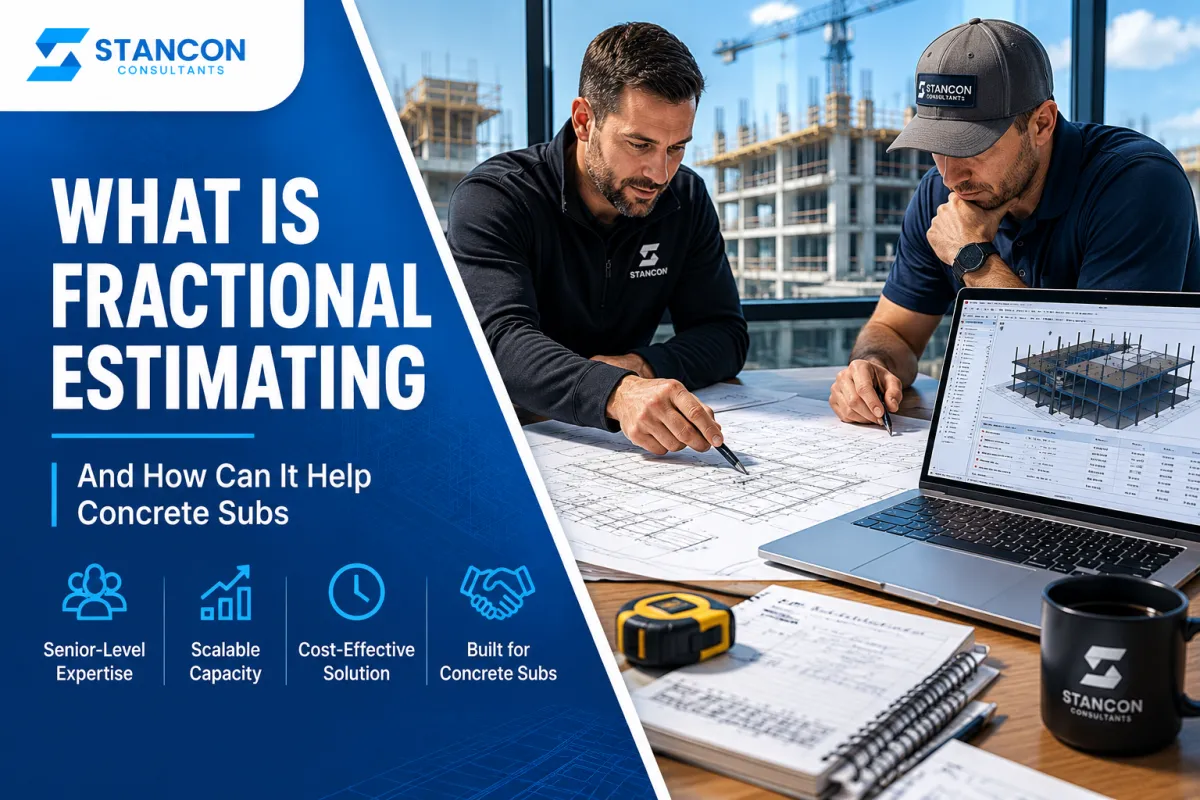
What Is Fractional Estimating and How Can It Help Concrete Subcontractors
Most commercial concrete subcontractors reach a point where the estimating bottleneck becomes the ceiling on growth. You've got the crews, the relationships with GCs and you're getting invites to bid on work you actually want. But you can't get competitive numbers out the door fast enough, or consistently enough, to capitalize on all of it.
The default answer used to be “hire an estimator”. But a fully loaded in-house estimator, salary, benefits, software licenses, and the overhead of managing that position, runs anywhere from $150,000 to $250,000 annually before they've touched a single drawing set.
For a concrete subcontractor doing $3M to $10M in annual revenue, that's a high fixed cost to carry through slow bid seasons, project gaps, and the natural lulls that come with commercial construction cycles.
Fractional estimating is a different answer to the same problem. And for a growing segment of commercial concrete subcontractors, it's proving to be the smarter one.
What Fractional Estimating Actually Means
The term borrows from a model that's been gaining traction across professional services for years. A fractional professional provides the same high level of expertise as a full-time hire but works across multiple organizations on a part-time or contract basis, which significantly reduces costs for each client while giving them access to senior-level skill they couldn't justify hiring full-time.
Applied to estimating, it works the same way. Instead of bringing on a full-time estimator, you engage a fractional estimating service that functions as your dedicated preconstruction support. They learn your cost structure, your markup model, your typical project types, and how you like your deliverables organized. Then they're available on an ongoing basis, handling your bid volume as it comes in, scaling up when you're chasing a lot of work and pulling back when things are slower.
It's not per-project outsourcing, where you send drawings to a company cold and get a PDF back. It's a structured, ongoing relationship with an estimating partner who functions as an extension of your own preconstruction team. The difference matters more than it sounds.
How It Differs From Per-Project Estimating
Both fractional estimating and per-project outsourced estimating have their place. But they serve different needs, and confusing one for the other leads to the wrong decision.
Per-project estimating is transactional. You have a bid opportunity, you send drawings to an estimating service, they price it and hand it back. There's no ongoing relationship, no institutional knowledge of your company, and no continuity between bids. That model works well when your volume is low or unpredictable, or when you need a specialist for a one-off scope that's outside your usual range.
Fractional estimating is relational. The service provider gets embedded in your preconstruction workflow. They know your crew costs. They know which GCs you're trying to win work with and what those GCs' scope expectations look like. They know how you like your bid proposals formatted before they go out. Over time, that accumulated knowledge makes every estimate sharper and faster because the ramp-up work has already been done.
The fractional model is particularly valuable during periods of rapid growth, where the need for senior-level expertise is real but the revenue base doesn't yet justify the overhead of a full-time hire. For concrete subcontractors trying to move from $5M to $15M, that description fits almost perfectly.
What a Fractional Estimating Engagement Looks Like in Practice
The specifics vary by provider, but a well-structured fractional estimating arrangement for a commercial concrete subcontractor typically includes a few core components.
Dedicated capacity. A set number of hours or bids per month reserved for your work. You're not competing with other clients for turnaround time when bid season heats up.
Ongoing access. The ability to reach your estimating partner for questions, scope reviews, drawing clarifications, and strategy conversations outside of active bid work. That's the preconstruction leadership function that most concrete subs don't have at all.
Institutional knowledge. Your partner builds a working understanding of your cost structure, your labor rates, your subcontractor relationships, and your market positioning over time. That knowledge compounds. The tenth estimate is faster and more accurate than the first because the groundwork is already laid.
Scalable capacity. Fractional arrangements allow businesses to scale the engagement up or down based on current needs, which is especially useful for operations with fluctuating workloads or seasonal bid cycles. During heavy bid seasons you lean on them more. During slower stretches you're not carrying the full cost of a seat you're not using.
At Stancon Consultants, our fractional estimating support is built specifically for commercial concrete subcontractors on that growth trajectory. The structure is designed to feel like an in-house estimator without the fixed overhead of one.
Who It Makes the Most Sense For
Fractional estimating isn't for everyone. Here's an honest breakdown of where it tends to fit and where it doesn't.
It fits well if you're a concrete subcontractor with growing bid volume but not enough consistent work to justify a full-time estimating hire.
You're getting more invites than you can handle internally, you're turning down opportunities or rushing bids to hit deadlines, and you know the quality of your numbers is suffering for it. That's the profile where fractional estimating delivers the clearest return.It fits well if you have an owner or PM doing estimating on top of everything else. This is one of the most common situations in concrete subcontracting.
The person running jobs is also running bids, which means one of those things is always getting shortchanged. Fractional estimating takes the preconstruction load off the person who needs to be focused on execution.It fits well if your current estimating is inconsistent. Some bids are tight and defensible. Others are soft and you know it when you submit them.
That inconsistency usually points to a process problem, not a people problem. A fractional estimating partner brings a repeatable process and applies it to every bid, which tightens variance over time.
It's probably not the right fit if your bid volume is very low, say fewer than one or two bids per month. At that level, per-project outsourcing likely makes more financial sense. You're not generating enough volume to benefit from the institutional knowledge a fractional relationship builds, and the retainer structure may not pencil out.
The Business Case: What It Actually Costs vs. What You Get
The math on fractional estimating is worth working through clearly because it's often better than contractors expect.
A full-time CFO, or in this case an equivalent senior estimating hire, costs $200,000 or more annually in total compensation. For estimating specifically, a senior commercial concrete estimator with meaningful trade experience commands $90,000 to $130,000 in base salary in most U.S. markets, plus benefits and software costs that push the total closer to $120,000 to $160,000 annually. And that's before factoring in the management overhead of running that position.
A fractional estimating arrangement for a concrete subcontractor bidding moderate volume typically runs well below that, often at 30% to 50% of the cost of a full-time hire, while delivering senior-level output and a process that doesn't walk out the door when the estimator does.
The real business case isn't just cost savings though. It's what better estimating enables. Contractors working with professional outsourced estimating see 22% more bids accepted on average, with error rates dropping significantly when specialized teams handle trade-specific scopes. Win more bids at better margins, and the cost of the fractional arrangement becomes a footnote in the P&L rather than a line item you're defending.
Common Questions Before Getting Started
Do I have to commit to a long-term contract?
It depends on the provider. The better ones will offer a trial period or a short initial engagement so you can evaluate fit before committing to an ongoing arrangement. If a fractional estimating service won't let you see how they work before locking you into a long contract, that's worth noting.
What happens to my institutional knowledge if I end the engagement?
This is an important question to ask upfront. A well-run fractional estimating relationship should produce deliverables and documentation that stays with you: your cost models, your historical project data, your markup structure. That information shouldn't live only in the service provider's system.
How do I know the estimates are accurate if I'm not doing them myself?
The same way you'd evaluate any external deliverable: by reviewing it. Part of transitioning to a fractional estimating model is building an internal review step, even a quick one, before any number goes to a GC. Your PM or superintendent reviewing the key quantities is a valuable check, and a good fractional estimating partner will encourage it rather than resist it.
Frequently Asked Questions
What is fractional estimating in construction?
Fractional estimating is an ongoing engagement with an external estimating service that functions like a part-time in-house estimator. Unlike per-project outsourcing, a fractional arrangement is continuous, with the provider building institutional knowledge of your cost structure, project types, and bid process over time.
How is fractional estimating different from just outsourcing my bids?
Per-project outsourcing is transactional: you send drawings, you get an estimate back. Fractional estimating is relational: your provider is embedded in your preconstruction workflow on an ongoing basis, learning your business and applying that knowledge to every bid. The outputs get better the longer the relationship runs.
How much does fractional estimating cost for a concrete subcontractor?
Pricing varies by provider and bid volume, but fractional arrangements typically run at 30% to 50% of the cost of a full-time in-house estimator when you account for salary, benefits, and software overhead. The exact cost depends on the scope of support and the number of bids you're running per month.
When does fractional estimating make more sense than hiring in-house?
When your bid volume is growing but not yet consistent enough to justify a full-time salary. When the person doing your estimating is also running your projects. When your numbers are inconsistent and you need a repeatable process more than you need another body. Those are the three most common triggers.
Can I try fractional estimating before committing to it long-term?
Most credible providers will offer a trial period or short initial engagement. If they won't, ask why. The answer will tell you something about how confident they are in their own work.
Does fractional estimating replace my internal team?
No. The best fractional estimating relationships support your internal team rather than replace it entirely. Many commercial concrete subcontractors use fractional estimating to extend the capacity of project managers, owners, or junior estimators without immediately hiring another full-time employee.
The Bigger Picture
Fractional estimating isn't a workaround. For the right concrete subcontractor at the right stage of growth, it's a better model than full-time hiring, combining the expertise and consistency of a dedicated estimator with the flexibility and cost structure of an outsourced service.
If you want to understand how fractional estimating compares to other outsourcing models in more detail, the full breakdown is in our guide to choosing the right estimating service. And if you're just starting to evaluate whether outsourcing makes sense at all, the warning signs of the wrong estimating partner are worth reading before you make any decisions.
If you want to talk through whether fractional estimating fits where your concrete business is right now, let's have that conversation.