
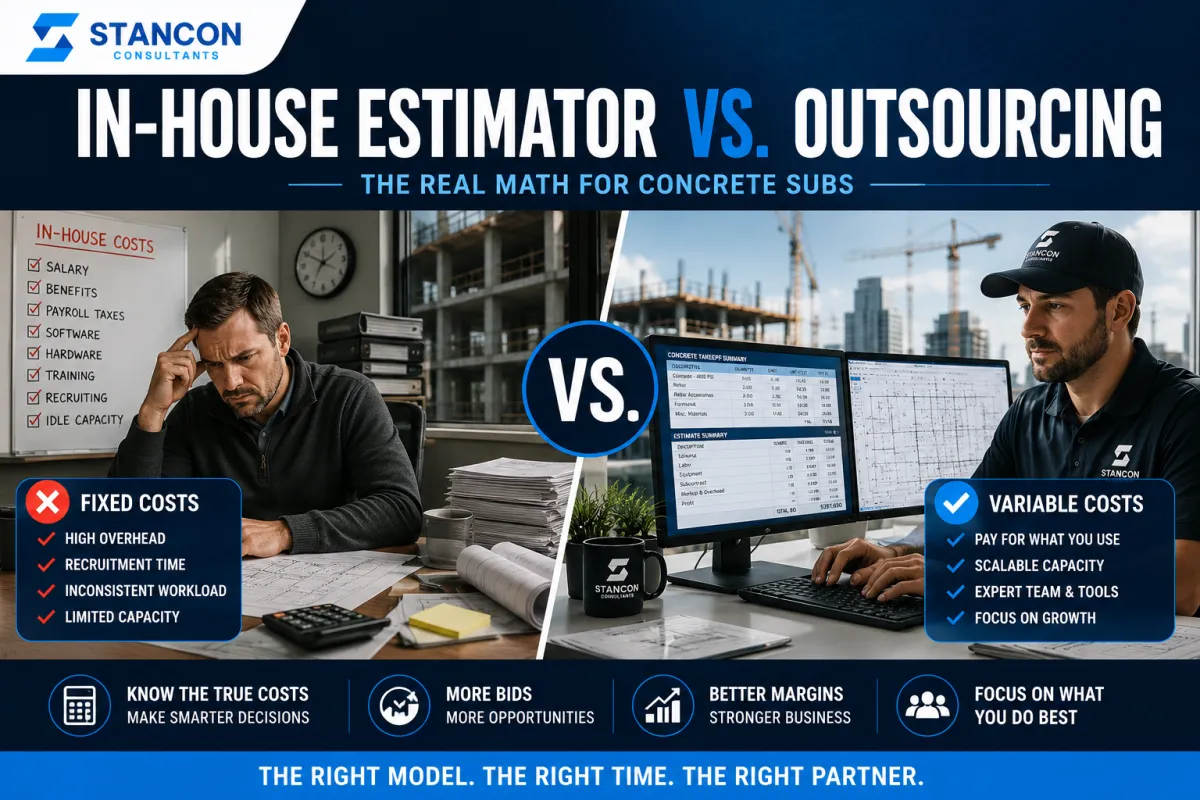
Should You Hire an In-House Estimator or Outsource? The Real Math for Concrete Subs
At some point, nearly every growing commercial concrete subcontractor faces the same decision. The bid volume is climbing. The person handling estimates is stretched thin. Something has to change. And the two obvious options sitting in front of you are hiring someone full-time or outsourcing to a professional commercial concrete estimating service.
Most contractors make this decision on gut feel and salary range alone. They compare a salary to an outsourcing quote and assume that's the whole equation. But the in-house estimator vs. outsourcing decision is almost never as straightforward as a salary comparison, and making it without the full picture is how concrete subs end up with a $140,000 annual commitment they didn't see coming.
This article breaks down the real math. Not the number on the offer letter. The actual fully loaded cost of keeping estimating in-house, what that buys you versus what outsourcing delivers, and how to think through which model fits where your concrete business actually is right now. If you've already read through the benefits of outsourcing construction estimating, this goes deeper into the cost side of that decision specifically.
What an In-House Estimator Actually Costs: Beyond the Salary
This is where most concrete subcontractors get the math wrong. They budget for salary and stop there. But a full-time estimating hire carries costs that extend well beyond the base pay, and when you add them all up, the number is consistently higher than most contractors expect.
Start with salary. For a commercial concrete estimator with meaningful trade experience in the U.S. market, base pay runs between $75,000 and $110,000 depending on the market, the candidate's experience level, and whether the work is union or open shop. In high-cost states like California, Washington, and New York, experienced estimator base salaries push past $95,000 before a single dollar of overhead is added.
Then add benefits. This is the cost that surprises contractors most, because benefits are rarely modeled correctly upfront. Employer-side payroll taxes alone add roughly 7.65% to every dollar of salary. Health insurance for a single employee runs $6,000 to $8,000 annually in employer contributions, more if dependents are covered. Paid time off, which averages 15 days per year for a salaried employee, represents another 5.8% of salary in idle cost. Retirement contributions, life insurance, short-term disability, and any other benefits stack on top of that.
By the time you account for benefits fully, a $90,000 estimator is running between $115,000 and $130,000 in total annual compensation cost before you've bought a single piece of software or set up a workstation. And according to the Birmingham Group's 2025-2026 Construction Salary Benchmark, the average time-to-hire for a senior estimator in competitive markets stretches three to six months, which means you're carrying declined bids and missed opportunities for half a year before the hire is even productive.
The Hidden Costs Nobody Puts in the Model
Beyond compensation, three cost categories routinely get left out of the in-house estimator vs. outsourcing comparison and consistently tip the math.
Software. A professional estimating setup isn't cheap. Bluebeam runs $240 to $400 per year per license. PlanSwift runs approximately $1,999 per year. RSMeans, which estimators need for current cost data, runs $1,200 to $2,500 annually depending on the subscription tier. Add a computer, a monitor setup suited to plan review, and any other tools your estimator needs to work efficiently, and you're adding $4,000 to $7,000 per year in tooling costs on top of compensation.
Idle capacity. This one is harder to see but very real. An in-house estimator is a fixed cost. They draw the same salary and benefits in January when two bids are coming in as they do in May when twelve are. During slow bid seasons, project gaps, or the natural lulls that commercial concrete subcontracting cycles through, you're paying full freight for capacity you're not using. That idle cost doesn't show up as a line item. But it shows up in your margin.
Availability and quality gaps. When concrete subcontractors who already have an in-house estimator come to Stancon Consultants for support, the two most common reasons are availability and quality. The estimator is buried. Deadlines are overlapping. Or the numbers are coming out inconsistently, and the owner has started second-guessing every submission without quite knowing why. These aren't character failures. They're structural limitations of a single-person estimating function inside a growing business. And they're costs too, even though nobody puts them in a spreadsheet.
What Outsourcing Construction Estimating Actually Costs
Here's the number that typically resets the conversation. For most commercial concrete subcontractors, outsourcing estimating through a per-project or fractional model costs significantly less in real annual spend than maintaining an in-house seat, especially at bid volumes below 15 to 20 projects per month.
Per-project pricing for commercial concrete scopes typically runs based on project size and complexity. A straightforward slab-on-grade package might run $300 to $600. A complex cast-in-place structural scope with multiple pour locations and post-tension elements sits higher, reflecting the hours of careful takeoff and documentation the scope requires. For most growing concrete subs bidding six to twelve projects per month, annual outsourcing spend lands well below the fully loaded cost of a single in-house hire, often by 40 to 60 percent.
And the cost structure is variable, not fixed. Slow month? Your outsourcing spend drops with your bid volume. Busy season where you need to chase fifteen opportunities in four weeks? The service absorbs the volume without you adding headcount. That flexibility has real dollar value for a concrete subcontractor whose pipeline ebbs and flows with commercial construction cycles.
The fractional estimating plans Stancon Consultants offers are built around exactly this model: ongoing estimating support that scales with your bid volume rather than sitting as a fixed overhead commitment regardless of what's coming through the door.
The Parallel Model: How Smart Concrete Subs Test Before Deciding
Here's an approach that comes up in practice and rarely gets discussed in the in-house vs. outsourced estimating conversation: running both in parallel on a per-project basis before making a permanent decision.
Some of the concrete subcontractors who come to Stancon Consultants already have an in-house estimator. They don't start by replacing that person. They bring in outsourced support on specific projects, complex scopes outside their estimator's strongest lane, overflow bids during heavy deadline weeks, or new project types they want to pursue without stretching internal capacity. Over time, that parallel run produces real comparison data. They can see the quality difference in the deliverables side by side. They can measure the turnaround. They can evaluate what the in-house estimator's time is genuinely worth relative to what outsourcing costs for the same scope.
That comparison is far more useful than any spreadsheet model built on assumptions. And for concrete subs who are genuinely on the fence about the in-house estimator vs. outsourcing decision, running a parallel test on a few real projects is often the most honest way to get an answer that reflects their specific operation rather than industry averages.
When Hiring In-House Actually Makes Sense
This article isn't arguing that outsourcing is always the right answer. It isn't. There are concrete subcontracting businesses for whom an in-house estimator is the clearly correct call, and it's worth being specific about what that looks like.
The in-house model makes the most sense when bid volume is genuinely high and consistent, not occasionally high but consistently running 20 or more projects per month, every month, across a predictable annual cycle. At that volume, the per-project cost of outsourcing approaches or exceeds the fully loaded cost of a dedicated hire, and the institutional knowledge an in-house estimator builds over time becomes a real competitive asset.
It also makes sense when your project pipeline is concentrated in a narrow scope type that requires deep, specialized knowledge of your specific operational model, your crew productivity rates, your supplier relationships, and your historical cost data. An estimator who's been inside your business for two or three years knows things about how your concrete operation runs that an outside service has to be told. That embedded knowledge has genuine value when the business is stable and the volume justifies the investment.
But for concrete subcontractors in the $1M to $12M revenue range who are still building their bid pipeline and growing their GC relationships, most honest cost comparisons put outsourcing ahead. And pairing that with a clear bid strategy that targets the right opportunities is usually more effective than adding fixed overhead and hoping the volume catches up.
Running the Math for Your Business
Here's a simple framework for making this decision with numbers rather than instinct.
Start by estimating your annual bid volume: how many projects do you realistically bid per month on average across the full year, including slow periods. Multiply that by a realistic per-project outsourcing cost for your typical scope complexity. That's your annual outsourcing spend.
Now build the in-house cost model honestly. Start with base salary at the experience level you'd actually need. Add employer payroll taxes at 7.65%. Add health insurance at $6,000 to $8,000. Add paid time off at roughly 5.8% of salary. Add software at $4,000 to $7,000 per year. Add a realistic ramp-up period of three to six months where the hire is not yet fully productive but is being paid in full.
Compare those two numbers. If the gap is significant and your bid volume is variable or still growing, outsourcing is almost certainly the better financial decision for where you are right now. If the fully loaded in-house cost is within 15 to 20 percent of your annual outsourcing spend at your current volume, and the volume is consistent, the in-house model starts to make sense, especially if control and institutional knowledge are priorities.
Most concrete subcontractors who run this calculation honestly are surprised by how wide the gap is. For a deeper look at how the fractional estimating model specifically fits growing concrete businesses, that's worth reading alongside this before making any final decisions.
Frequently Asked Questions
How much does an in-house construction estimator cost fully loaded?
A commercial concrete estimator with meaningful trade experience typically costs $115,000 to $150,000 annually in total fully loaded cost once salary, employer payroll taxes, health insurance, paid time off, software licenses, and equipment are properly accounted for. The salary line alone understates the real number by 25 to 40 percent in most cases.
When should a concrete subcontractor hire an in-house estimator?
When bid volume is consistently high, typically 20 or more projects per month across a stable annual cycle, and the project pipeline is concentrated enough that deep institutional knowledge of your specific cost structure and operations creates a measurable competitive advantage. Below that volume threshold, outsourcing almost always wins the cost comparison.
Is outsourcing estimating cheaper than hiring in-house for concrete subs?
For most commercial concrete subcontractors in the $2M to $12M revenue range, yes. The fully loaded cost of an in-house estimating hire typically runs $115,000 to $150,000 annually. Outsourcing at comparable bid volumes usually lands 40 to 60 percent below that, with the added advantage of a variable cost structure that scales with actual bid volume rather than running at full cost during slow periods.
What are the biggest hidden costs of an in-house estimator?
Benefits are typically the biggest surprise, since most contractors budget for salary only and underestimate the employer contribution to health insurance, payroll taxes, and paid time off. Software costs and idle capacity during slow bid seasons are the other two costs that rarely make it into the initial model but show up clearly in the annual P&L.
Can I run an in-house estimator and outsource at the same time?
Yes, and it's often the smartest way to evaluate both models before making a permanent decision. Many concrete subcontractors use their in-house estimator for core scopes they know well and bring in outsourced support for overflow volume, complex scope types, or new project categories they're trying to break into. That hybrid approach keeps fixed costs lower while covering the gaps internal capacity can't reach.
How long does it take an in-house estimator to become fully productive?
The average time-to-hire for a senior estimator in competitive U.S. markets runs three to six months. Once hired, a new estimator typically needs another two to three months to fully understand your cost structure, supplier relationships, and operational model before their estimates reflect your business accurately. That ramp-up period represents four to nine months of near-full compensation cost before the hire is delivering at the level you hired them for.