
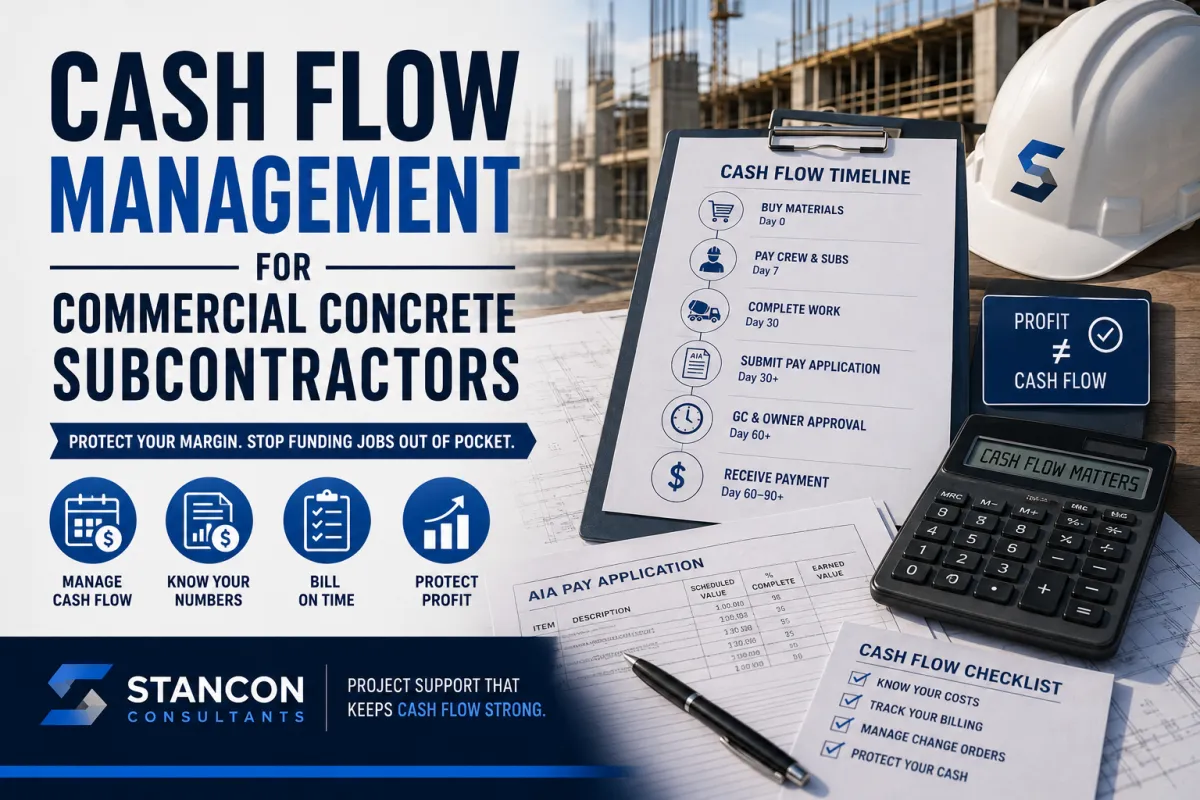
Cash Flow Management for Commercial Concrete Subcontractors
There's a version of success in commercial concrete subcontracting that looks completely wrong from the outside. The jobs are there. The crew is working. The GC relationships are solid. The revenue line looks healthy. And yet the bank account is constantly stressed, payroll feels tight every other week, and the owner is quietly wondering how a business doing this much work can feel this financially fragile.
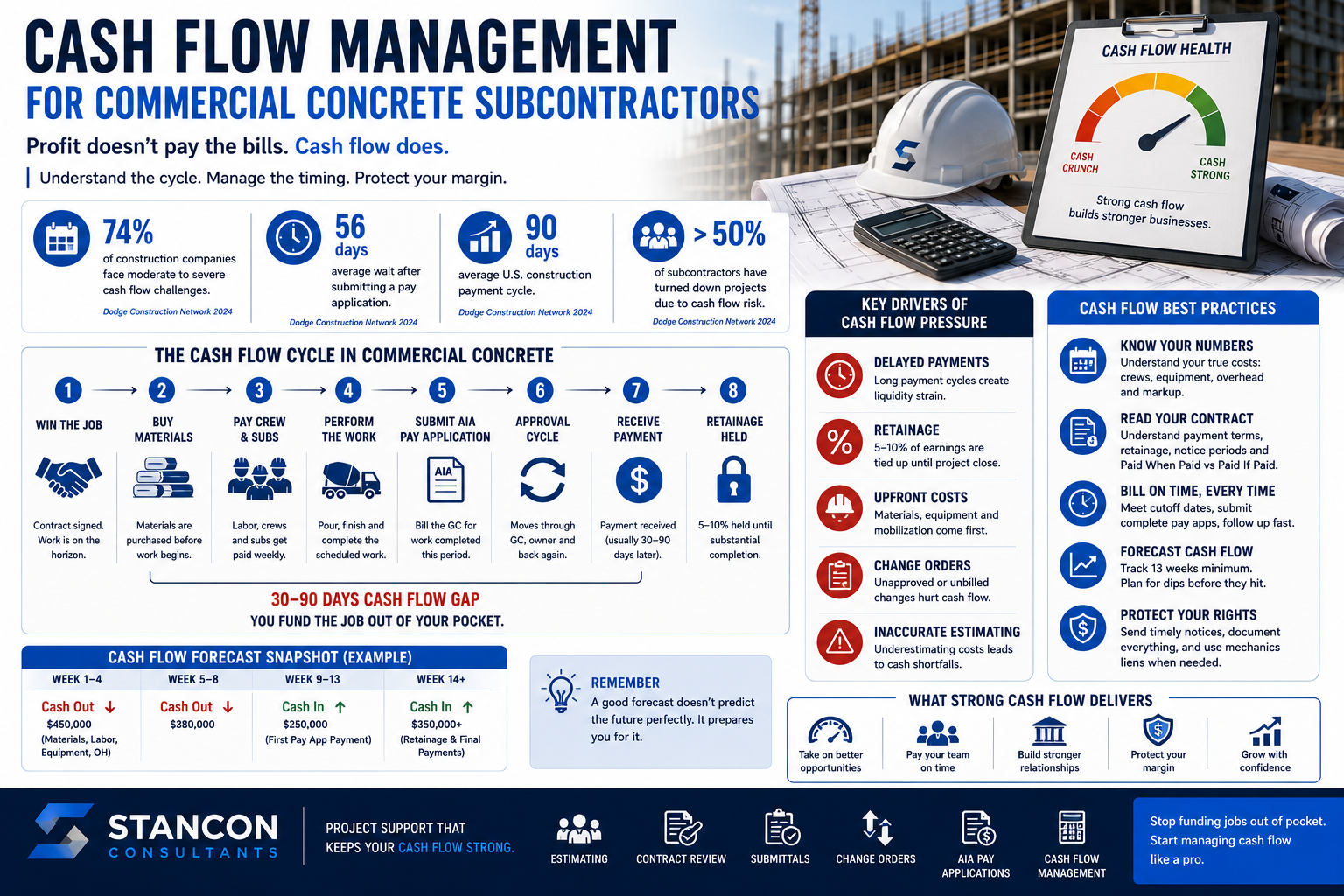
This is the cash flow paradox in commercial concrete, and it's not a sign that something is being mismanaged. It's the structural reality of the industry. You buy materials before the work gets done. You pay your crew weekly. You wait 30, 60, sometimes 90 days to get paid for work that's already poured and finished. And every day that payment sits in an approval cycle somewhere between the owner and the GC, your business is funding the gap out of its own pocket.
According to the Dodge Construction Network's 2024 report, 74% of construction companies experienced moderate to severe cash flow challenges, with delayed payments cited as the primary driver. Subcontractors wait an average of 56 days after submitting a pay application before receiving payment, and more than half report having turned down projects because of cash flow or payment risk. For a commercial concrete subcontractor trying to grow, turning down work because you can't fund the mobilization isn't a strategy problem. It's a cash flow problem.
Joseph Toppi, founder of Stancon Consultants, built a commercial concrete operation to 46 employees before transitioning to consulting. One of the clearest memories from those years is the kitchen table disappearing under blueprints and paperwork while the family ate on the floor. Revenue was there. The work was there. But the cash flow management discipline that eventually took that business to a 54% gross profit margin didn't come from working harder. It came from understanding exactly what the business cost to run, what it needed to survive, and how to structure the financial side so it wasn't constantly operating at the edge of a liquidity problem.
This article is built on that foundation, supplemented by the patterns Stancon Consultants sees working with commercial concrete subcontractors across the country through our project support and advisory work. Here's how to manage cash flow as a concrete subcontractor without funding your jobs out of your own reserves every month.
Understand Why Concrete Subcontractors Have a Structural Cash Flow Problem
The cash flow problem in commercial concrete subcontracting isn't a management failure. It's structural, and understanding that distinction changes how you approach fixing it.
The fundamental issue is timing. Materials have to be purchased before the work is done. Labor has to be paid weekly regardless of where you are in the billing cycle. But payment from the GC, which depends on the GC getting paid by the owner, can lag your actual costs by 30 to 90 days on a typical commercial project. The average U.S. construction payment cycle is 90 days, twice the 45-day threshold that financial analysts consider healthy. That gap, between when money goes out and when it comes in, is the cash flow problem. It exists on profitable jobs. It exists when the work is being executed correctly. It's not a symptom of a troubled business. It's the baseline condition every commercial concrete sub is operating against.
Retainage makes it worse. Standard commercial subcontracts hold back 5 to 10 percent of every billing until project completion or substantial completion. On a $600,000 concrete package, that's $30,000 to $60,000 of earned revenue that isn't available as cash until the job closes, which could be 12 to 18 months from when you started. Understanding the payment terms in your subcontract before you sign, specifically the retainage percentage, the payment cycle, and whether the structure is Paid When Paid or Paid If Paid, is the first financial management decision on every job, not an afterthought once the work is underway.
Know Your Numbers Before You Know Your Cash Position
This is where most concrete subcontractors start going wrong. They look at the bank account and use the balance as their measure of financial health. But cash on hand is not the same as cash flow, and a bank balance that looks fine today can look catastrophic in three weeks when payroll, material invoices, and equipment payments all land simultaneously.
Joseph's approach when running his concrete operation, and the approach we work through with clients at Stancon Consultants, starts with knowing the actual cost structure of the business before making any cash flow projections. What do your crews cost you per hour, fully loaded with burden? What does your equipment cost per operating hour? What is your monthly overhead figure, the fixed costs that run regardless of how many projects you're working? What markup do you need to apply to your direct costs to recover that overhead and reach your target profit margin?
Without those numbers, you can't forecast cash flow accurately because you don't know what the business needs to survive each month. The financial management fundamentals that every concrete subcontractor should have are not complicated, but they require actually doing the work of building out your cost model rather than estimating from feel. And understanding the difference between markup and margin matters directly here: a concrete sub who thinks they're making a 20% margin when they're actually making a 20% markup is working with a number that understates their actual overhead exposure and overstates their available cash.
Bill Correctly, Bill on Time, and Bill for Everything
This is the single most controllable lever in concrete subcontractor cash flow management, and it's the one most subs handle inconsistently.
Your billing cycle on a commercial concrete project runs through the AIA pay application process. The GC sets a billing cutoff date, typically somewhere between the 20th and 25th of each month. Your G702/G703 pay application has to be in before that cutoff to be included in that month's draw. Miss the cutoff by a day and you wait another 30 days. On a project billing $80,000 per month, that's a $80,000 delay in cash you've already earned. The AIA pay application process and the discipline of hitting every billing cutoff, every month, without exception, is the most direct control you have over when money comes in.
Billing correctly means billing for every dollar of completed work, at the percentage of completion that's actually accurate, with approved change orders already incorporated into the Schedule of Values. Change orders that haven't been added to the Schedule of Values don't appear on the pay app, which means you did the work, got the change approved, and still didn't bill for it. That's a cash flow gap that's entirely preventable.
Billing for everything also means not leaving retainage on the table at project closeout. Final retainage release requires submitting the correct closeout documentation, including lien waivers, as-built drawings where required, operation and maintenance manuals where specified, and confirmation that all punch list items are resolved. Concrete subcontractors who complete their scope, move on to the next job, and forget to chase final retainage are leaving real money uncollected. On a $600,000 project at 10% retainage, that's $60,000 sitting in someone else's account.
Understand the Billing Cycle on Every Project Before Work Starts
One of the clearest cash flow management improvements a concrete subcontractor can make has nothing to do with the field work. It's establishing the billing mechanics of every project before the first pour.
Before mobilizing, confirm the GC's billing cutoff date, the typical payment turnaround after the pay app is approved, and whether the GC's payment to you is contingent on their receipt of funds from the owner. That last point is the Paid If Paid vs. Paid When Paid distinction. As covered in the subcontract review framework Stancon uses with clients, a Paid If Paid clause makes the owner's payment to the GC a condition of your payment. In markets where these clauses are enforced, you can complete a job correctly, bill properly, and still not get paid if the owner and GC have a dispute that has nothing to do with your work. Knowing that before you sign gives you the ability to negotiate, price for the risk, or walk away if the exposure isn't acceptable.
Also confirm the retainage structure upfront. Some contracts allow for retainage reduction after substantial completion or after a defined percentage of the work is complete. Negotiating retainage reduction language before you sign is far more effective than requesting it mid-project after the work is mostly done. Firms that updated their contract language in 2024 experienced a 22% reduction in average payment delays, which confirms that the contract is a legitimate cash flow management tool, not just a legal formality.
Build a Cash Flow Forecast, Not Just a Budget
A budget tells you what you plan to spend. A cash flow forecast tells you when money comes in and when it goes out, which is a fundamentally different and more useful document for a concrete subcontractor managing multiple active projects.
A basic cash flow forecast for a commercial concrete operation maps out, by week or by month, the expected inflows from pay applications and the expected outflows for payroll, material invoices, equipment payments, and overhead. The gap between the two in any given period is your cash position, and seeing that gap in advance is what allows you to manage it rather than react to it.
The key business metrics that feed a useful cash flow forecast include your days sales outstanding, the average time between billing and collection on your projects; your overhead burn rate by month; your material payment terms with your ready-mix and rebar suppliers; and your weekly labor cost by crew. With those numbers in hand, you can look 60 to 90 days ahead on your cash position rather than reacting to what the bank account shows today.
Subcontractors who account for working capital costs in their bids achieve a 24% profit margin on average, compared to 17% for those who don't. That 7-point margin difference comes directly from understanding the real cost of carrying a project financially, the cost of the cash gap between when you spend and when you collect, and building that cost into your pricing rather than absorbing it as a silent reduction to your margin.
Manage Your Overhead Structure Against Your Revenue Cycle
One of the most common cash flow problems in commercial concrete isn't slow payment. It's fixed overhead that doesn't flex with revenue. A business that adds a full-time estimator, expands its office footprint, or takes on equipment payments during a busy stretch and then watches revenue slow down for a season has created a cost structure that outpaces its cash inflows. The overhead keeps running. The billing slows. The gap opens.
The overhead cost planning discipline that protects cash flow means knowing exactly what your fixed monthly overhead is, understanding what revenue level is required to cover it, and being conservative about adding fixed costs before the revenue to support them is established and consistent. Variable cost models, including outsourced estimating support rather than full-time hires, are part of why the fractional estimating model makes financial sense for concrete subcontractors in the growth phase. The cost scales with activity rather than running at full rate during slow periods.
This is also why the question of whether to hire an in-house estimator or outsource is partly a cash flow question, not just a cost question. A fixed salary adds to your overhead burn regardless of bid volume. A variable cost structure tied to actual production keeps more cash available during the inevitable lulls in commercial construction cycles.
Use Lien Rights as a Cash Flow Protection Tool
Commercial concrete subcontractors in most U.S. states have the right to file a mechanics lien against a property if they perform work and don't get paid. That right is a legitimate and important financial protection, but it's also time-sensitive. Most states require preliminary notice to be filed within a defined period of starting work, and the lien itself must be filed within a defined period after the last day of work.
Mechanics lien rights don't replace good billing practices or sound contract terms. But they're a backstop that gives concrete subcontractors real leverage when payment disputes arise, particularly on private commercial projects where the GC's financial position isn't always transparent. Only 5% of subcontractors consistently get paid on time, which means having the documentation, the preliminary notices, and the awareness of your lien rights before a payment problem develops is basic financial self-protection.
Know your state's lien laws before each project starts. Preliminary notice requirements, lien deadlines, and the process for enforcing a lien vary significantly by state. Getting that information upfront is far less expensive than discovering you've missed a filing deadline when a GC stops returning calls after substantial completion.
The Connection Between Estimating Accuracy and Cash Flow
This connection is less obvious than billing timing or contract terms, but it's just as important. An estimate that understates your true costs, whether because the labor burden rate is wrong, the overhead allocation is incomplete, or productivity assumptions don't reflect reality, creates a cash flow problem that begins the moment the job is awarded.
You mobilize thinking you have a certain margin. Material and labor costs come in where the estimate said they would, but the overhead isn't being recovered correctly. Or the labor runs long because the productivity assumption was off. By the time you realize the job is underperforming, the work is done and there's nothing to recover. The cash gap that results isn't from slow payment. It's from systematic underpricing, and it compounds across every job that follows the same estimating pattern.
This is the foundational connection between preconstruction and financial management in commercial concrete. The estimate is where cash flow is set up to succeed or fail, long before the first pour. Our commercial concrete estimating services are built around producing numbers that reflect your actual cost structure, not generic assumptions, because an accurate estimate is the first and most important cash flow management tool a concrete subcontractor has.
For concrete subcontractors who want to understand whether a fractional CFO or an estimating partner is the more urgent financial management need right now, the fractional estimator vs. CFO comparison is worth reading before making that decision.