
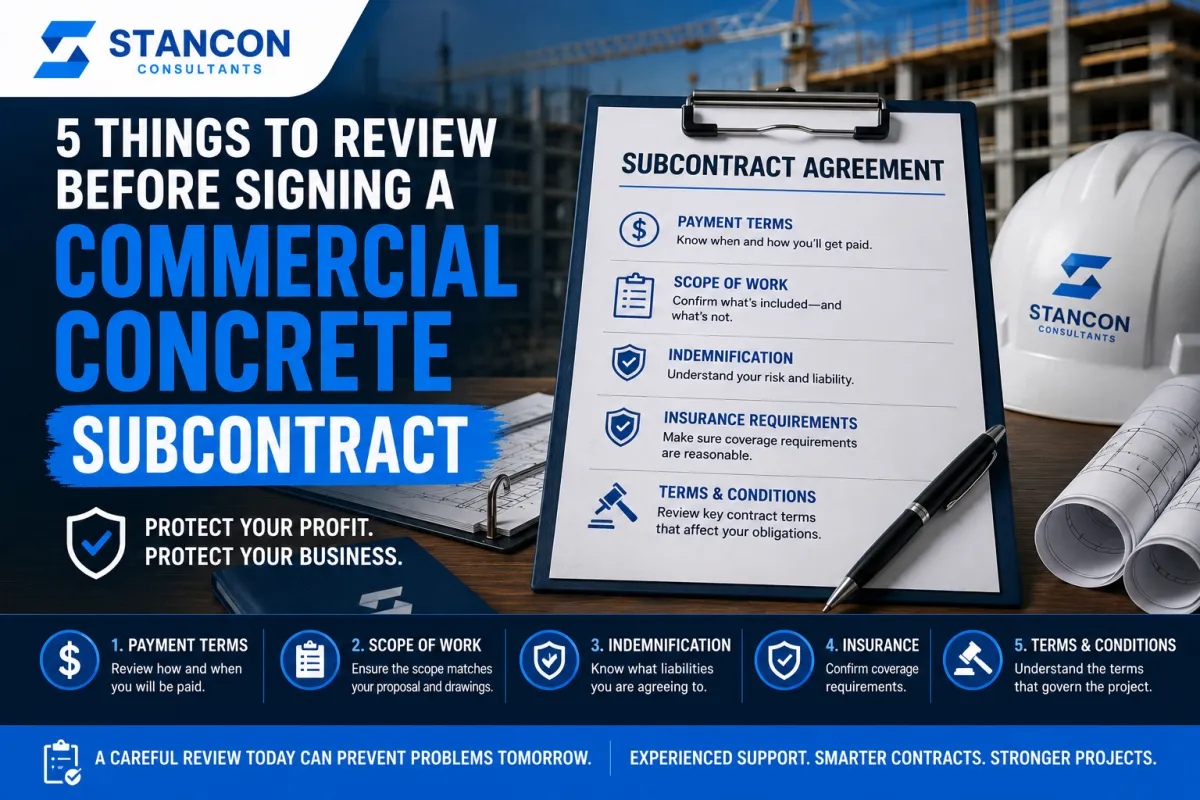
5 Things to Review Before Signing a Commercial Concrete Subcontract
Winning the project isn't the finish line. It's the point where the real risk begins.
By the time a commercial concrete subcontract lands in your inbox, you've already invested hours into takeoffs, estimates, proposal writing, and follow-up. It's tempting to skim the contract, sign it, and move on to mobilizing the job.
That's exactly where many subcontractors create problems they could have avoided.
A commercial concrete subcontract isn't just paperwork. It defines how and when you'll get paid, what work you're actually responsible for, who carries the risk when something goes wrong, and what happens if the project changes halfway through. If those terms don't match what you priced or what you expected, you may not discover the problem until the job is underway, when fixing it becomes far more difficult and expensive.
At Stancon Consultants, reviewing subcontracts is part of the project support we provide to commercial concrete subcontractors. Over time, we've found that the same issues surface again and again, from payment clauses that shift financial risk to boilerplate language that quietly expands a subcontractor's responsibilities beyond their original bid.
Before you sign, review these five areas carefully. A few extra minutes at the contract stage can prevent disputes, protect your margins, and save you from costly surprises once work begins.
1. Understand the Four-Part Structure of the Subcontract First
Before you can review a commercial concrete subcontract effectively, you need to understand how it's organized. Most GC subcontracts follow the same basic structure, and knowing where different types of information live in the document changes how you read it and what you look for in each section.
The typical commercial subcontract has four components. The first is the cover page or Article 1, which identifies the parties, the project, the contract value, and the execution date.
The second is the main contract body, which covers the bulk of the legal terms across multiple articles: payment terms, dispute resolution, indemnification, insurance requirements, termination rights, and similar provisions.
The third is the scope of work exhibit, which defines specifically what work you're contracted to perform.
The fourth is the remaining exhibits, which might include the project drawings, specifications, the prime contract, insurance certificates, or other referenced documents.
This structure matters because the main contract body is almost always boilerplate. It's a standard form the GC uses across all their subcontractors and all their project types. Which means it frequently contains language that has nothing to do with commercial concrete work specifically, and applying it to your scope without adjustment can create obligations you didn't intend to accept. Knowing the boilerplate is the first step in reviewing it intelligently.
2. Read the Payment Terms and Know the Difference Between Paid When Paid and Paid If Paid
This is the section that carries the most direct financial risk for a concrete subcontractor, and it's the one most subs skim past because the language looks similar to language they've seen before. It isn't always.
There are two fundamentally different payment structures in commercial subcontracts, and they look nearly identical until you understand what each one actually means.
A Paid When Paid clause is a timing mechanism. The GC commits to paying you within a defined period after they receive payment from the owner. The obligation to pay you is unconditional. The clause only governs when that payment arrives, not whether it arrives. Even if the owner delays or disputes payment to the GC, the GC still owes you the money. The timeline might stretch, but the obligation doesn't disappear.
A Paid If Paid clause is something else entirely. Under this structure, the GC's receipt of payment from the owner is a condition precedent to their obligation to pay you. Which means if the owner never pays the GC, the GC may have no legal obligation to pay you either, for work you've already completed. The subcontractor, not the contractor, assumes the risk of the owner's nonpayment under a Paid If Paid provision, and in most states where these clauses are enforced, that risk is real and legally binding.
The language that signals a Paid If Paid structure typically includes phrases like "condition precedent," "contingent upon receipt of payment," or "the contractor's receipt of payment from the owner is an express condition to contractor's obligation to pay subcontractor." According to construction law firm Taft Law, Paid If Paid provisions remain enforceable in the majority of U.S. states, with only a handful of jurisdictions, including New York, treating them as unenforceable as a matter of public policy.
Before you sign, know which structure you're agreeing to. And if it's Paid If Paid, understand that you're accepting a meaningful financial risk that has nothing to do with whether you did the work correctly.
3. Learn the Terminology Before It Costs You
This is the issue that comes up most consistently when concrete subs sign subcontracts without fully understanding what they've agreed to. The problem isn't always dangerous clauses. Often it's standard terminology that carries real legal meaning that the sub never looked up.
Three terms in particular show up repeatedly in commercial concrete subcontracts and are routinely misunderstood.
Cure Notice.
A cure notice is a formal written notice from the GC informing you that you're in default of a specific contract obligation and giving you a defined period, typically 48 to 72 hours, to correct the deficiency before the GC takes further action, which could include withholding payment, hiring a replacement subcontractor, or terminating the subcontract.
The critical thing to understand about a cure notice is that it's not a casual complaint. It's the beginning of a formal default process. If you receive one and don't respond appropriately within the stated timeframe, the consequences can be significant. Knowing what a cure notice is before you're in the middle of a project means you understand what's actually happening if one arrives, and you respond to it correctly.
Indemnity.
An indemnification clause requires one party to defend and hold harmless the other against specified claims, losses, or liabilities. In commercial construction subcontracts, these clauses frequently require the subcontractor to indemnify the GC, and sometimes the owner, against claims arising from the subcontractor's work, including claims involving personal injury, property damage, or third-party losses.
The scope of what you're agreeing to indemnify matters enormously. Broad indemnification language can create obligations that extend beyond what your insurance policy actually covers, leaving you personally exposed on claims you assumed were covered.
Read indemnification clauses carefully, and if the language is unusually broad, it's worth a conversation with the GC or a construction attorney before you sign.
Paid If Paid.
Covered above in detail, but worth restating here: the single word "if" in place of "when" in a payment clause represents a fundamental shift in who bears the financial risk of owner nonpayment. That one word has cost subcontractors significant sums of money on otherwise well-executed projects. Knowing the difference before you sign is the entire protection.
4. Compare the Scope of Work Exhibit to Your Bid Proposal
The scope of work exhibit is where the subcontract gets specific about what you're being paid to do. It's also where misalignments between what you priced and what the GC thinks they bought tend to hide.
Before signing, compare the scope of work exhibit line by line against the proposal you submitted. Verify that the inclusions match what you priced. Verify that the exclusions you documented in your proposal are reflected in the contract scope. Look specifically for any items in the scope exhibit that weren't in your bid, and for any items in your bid exclusions that don't appear in the contract.
Where conflicts exist between your proposal and the GC's subcontract, the subcontract typically governs unless you've negotiated otherwise. So a scope item that was explicitly excluded in your concrete bid proposal but doesn't appear as an exclusion in the subcontract scope exhibit can become a disputed item after award. Getting that alignment confirmed in writing before you sign is significantly easier than resolving it mid-project when concrete has already been poured.
The concrete bid proposal you submitted is your starting point for this comparison. Every clarification, assumption, and exclusion you documented there should be traceable in the subcontract scope of work.
5. Identify the Boilerplate That Doesn't Apply to Your Concrete Scope and Address It
This is the step most concrete subcontractors skip, because they assume the main contract body is fixed and non-negotiable. That assumption is often wrong, and even when it is, there are ways to address inapplicable language without rewriting the GC's standard form.
Commercial concrete subcontracts routinely contain boilerplate provisions that were written for a general construction scope and don't apply specifically to concrete work. Common examples include requirements for the subcontractor to obtain permits, pay for testing and inspections, provide commissioning services, or perform work outside the concrete scope entirely. These provisions exist in the template because the GC uses the same form across all trades. They may or may not have intended them to apply to you.
The process for addressing this is straightforward. Read the main contract articles carefully, identify any provision that requires something outside your concrete scope or creates an obligation that wasn't part of your bid, and mark it up. Bring those items to the GC's attention as redlines, with a request that they either sign off on the changes or confirm in writing that the provision doesn't apply to your scope of work.
GCs are sometimes resistant to modifying boilerplate because it creates version control issues in their document management. When that's the case, an effective alternative is adding clarifying language to the scope of work exhibit directly. A statement in the scope exhibit noting that specific provisions in the main contract body don't apply to the concrete subcontract is often easier for the GC to accept than a redlined contract article and achieves the same protection for you.
A subcontract negotiation is not an adversarial process. A GC who wants your work and knows your concrete scope well understands that some boilerplate language doesn't fit every trade. Approaching the conversation as a practical clarification rather than a confrontation usually produces a better outcome than demanding changes or signing without raising concerns at all. Express the issue directly, explain the specific provision and why it creates a problem for your scope, and work toward a resolution that both parties can sign without reservation.
A Note on Getting Help
Construction contract review takes time and requires specific knowledge of construction law, payment mechanics, and the practical implications of standard subcontract language. Most concrete subcontractors didn't get into the business to become contract specialists, and there's no shame in getting support on this part of the process.
At Stancon Consultants, our contract review process includes identifying payment term structures, flagging inapplicable boilerplate, comparing the scope exhibit to the bid proposal, and working with the client on redlines where the language needs to be addressed before signing. If you want to understand how that fits into our broader fractional estimating and project support model, that's a useful starting point.
For the subcontracts where the stakes are high, a construction attorney familiar with your state's specific laws around payment provisions and indemnification is also worth engaging. The cost of that review is almost always less than the cost of what you didn't understand when you signed.
If you want to understand how a well-written bid proposal protects you before a subcontract is ever issued, that's worth reading alongside this: how to write a concrete bid proposal that documents your scope, your exclusions, and your assumptions in a way that carries forward into the contract review. And for the full picture of how preconstruction support fits into a growing concrete operation, the guide to choosing the right estimating service covers it in detail.
Frequently Asked Questions
What should a concrete subcontractor review before signing a subcontract?
At minimum: the payment terms to identify whether the structure is Paid When Paid or Paid If Paid; the scope of work exhibit compared against your bid proposal; any boilerplate provisions in the main contract that don't apply to your concrete scope; indemnification language and whether it aligns with your insurance coverage; and any cure notice or default provisions so you understand the formal process if a performance dispute arises.
What is the difference between Paid When Paid and Paid If Paid in a construction contract?
Paid When Paid governs the timing of payment. The GC commits to paying you within a defined period after receiving payment from the owner, but the obligation to pay you exists regardless of whether the owner pays the GC. Paid If Paid makes the owner's payment to the GC a condition precedent to your payment, meaning if the owner never pays the GC, the GC may have no legal obligation to pay you for work you've already completed.
What is a cure notice in a commercial concrete subcontract?
A cure notice is a formal written notice from the GC that you're in default of a specific contract obligation, with a defined period, typically 48 to 72 hours, to correct the issue before the GC takes further action. It's the beginning of a formal default process, not an informal complaint, and responding to it correctly and promptly is critical.
What is indemnity in a construction subcontract?
An indemnification clause requires you to defend and hold harmless the GC, and sometimes the owner, against claims, losses, or liabilities arising from your work. The scope of what you're indemnifying matters. Broad indemnification language can create obligations that exceed your insurance coverage. Review indemnification clauses carefully before signing.
Can I negotiate changes to a GC's standard subcontract?
Yes. Many concrete subcontractors assume the main contract body is non-negotiable, but GCs routinely accept redlines on provisions that don't apply to a specific trade scope. When a GC is resistant to modifying the main contract, adding clarifying language to the scope of work exhibit is often an effective alternative that achieves the same result. The conversation should be practical and direct, not adversarial.
What happens if the subcontract scope conflicts with my bid proposal?
In most cases, the subcontract governs. Which means scope items excluded in your proposal but not reflected in the contract scope of work can become disputed obligations after award. Comparing the scope exhibit to your proposal before signing and resolving any misalignments in writing is the most effective way to prevent that dispute from surfacing mid-project.
Don't Let a Signed Contract Become an Expensive Surprise
A well-negotiated subcontract protects more than your legal position. It protects your cash flow, your scope, your schedule, and the profit you worked hard to secure when you won the project.
Before signing, take the time to compare the subcontract to your proposal, review the payment terms, understand the legal language, and question anything that doesn't align with your scope or expectations. A few conversations before work begins are almost always easier and less expensive than resolving disputes after the concrete has been poured.
At Stancon Consultants, we help commercial concrete subcontractors do more than estimate projects. Our project support services include subcontract reviews, scope comparisons, proposal writing, AIA pay application support, and preconstruction guidance designed to help you protect both your margins and your client relationships from bid day through project closeout.
If you're about to sign a subcontract and want a second set of experienced eyes on the terms before you commit, contact Stancon Consultants. We'll help you identify potential risks, clarify your obligations, and make sure the contract reflects the work you actually agreed to perform.