
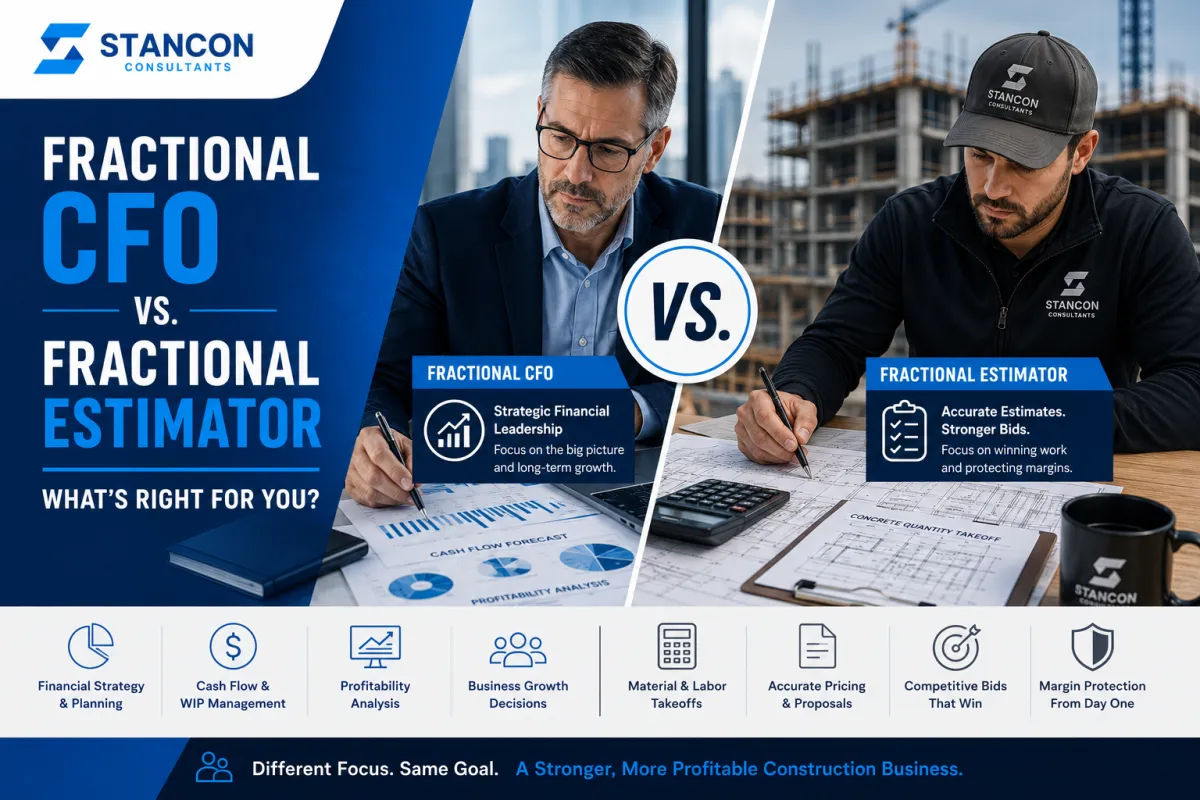
Fractional CFO vs. Fractional Estimator for Construction Companies
The terms get used almost interchangeably in conversations with concrete subcontractors, and it's easy to understand why. Both involve bringing in senior-level expertise on a part-time basis. Both promise access to skills a growing business can't yet justify hiring full-time. Both get pitched as smarter alternatives to a fixed salary. So when a contractor hears "fractional CFO" in one conversation and "fractional estimator" in another, the natural assumption is that they're roughly the same thing wearing different labels.
They're not. A fractional CFO and a fractional estimator solve two entirely different problems, and conflating them leads to a decision that doesn't actually fix what's broken in the business.
At Stancon Consultants, we provide fractional estimating support built specifically for commercial concrete subcontractors, so we'll be upfront about where our expertise sits. But this article isn't a pitch for one over the other. It's a clear breakdown of what each role actually does, where the confusion comes from, and how to think through which one your business needs, possibly both, and in what order.
Why the Confusion Happens in the First Place
The word "fractional" describes how the professional works, not what they do. Whether it's a CFO, estimator, controller, or marketing director, "fractional" simply means senior expertise provided on a part-time basis across multiple businesses. So when two services share the word "fractional," it's natural to assume they share the same scope of work too.
They don't. The fractional model describes the delivery model, not the expertise.The actual function being performed, is completely different depending on whether you're talking about financial leadership or preconstruction estimating.
What a Fractional CFO Actually Does
A fractional CFO is a senior financial strategist who manages the bigger financial picture of your business. Their work is forward-looking: cash flow forecasting, margin analysis by project or service line, financial dashboards, hiring models, rolling budgets, and strategic planning around major decisions.
For a construction business specifically, that typically includes job costing analysis, work-in-progress (WIP) reporting, percentage-of-completion accounting, and helping you understand cash flow across a portfolio of active projects rather than just one job at a time.
Construction companies have cash flow characteristics that are genuinely difficult. Revenue is lumpy, job costing requires percentage-of-completion accounting, and forecasting cash needs across multiple active projects with different billing cycles and payment terms is complex work. A fractional CFO is the person whose job is to make sense of that complexity at the company level, not the project level.
They're not estimating your next bid. They're answering a different set of questions entirely: Is this business actually profitable once overhead is properly allocated? Can we afford to add another crew? What does our cash position look like three months from now if two of our biggest receivables get delayed? Should we be bonding for larger projects, and what does the surety company need to see to approve that?
What a Fractional Estimator Actually Does
A fractional estimator, by contrast, is focused on preconstruction. Their job is producing accurate, defensible bids: material and labor takeoffs, pricing, proposal writing, and the documentation that wins work and protects your margin once that work is underway.
For commercial concrete subcontractors specifically, that means understanding forming systems, pour sequencing, labor productivity by scope type, and how to build a number that holds up against GC scrutiny in a tight bid spread. A fractional estimator isn't managing your company's overall financial health. They're making sure every individual bid that goes out the door is priced correctly, documented thoroughly, and competitive enough to win.
Read our breakdown of what fractional estimating actually means for a closer look at how the model works in practice for concrete subs specifically. Where a fractional CFO is thinking about the business as a whole, a fractional estimator is thinking about the next bid, and the one after that, and making sure each one is built on solid numbers.
A Real Example of Why This Distinction Matters
Here's a situation that illustrates the gap clearly. When a new client recently came to Stancon Consultants for estimating support, our team asked for their material and labor pricing as a starting point. They could provide the material pricing. They could not provide the labor pricing because their former estimator had handled all of that internally, and nobody else in the company had visibility into how those numbers were built.
That's not just an estimating gap. It's a financial ownership gap. The company had someone doing the math on individual bids, but nobody who actually owned the underlying cost structure at the business level: where the labor burden rate came from, how it should change as crew composition shifted, whether the markup model was actually protecting margin across the full portfolio of jobs. We had to work with them from the ground up to reestablish that pricing before we could even begin estimating accurately on their behalf.
This is a pattern that shows up more often than most contractors expect. A business can have decent individual bids and still be financially exposed because nobody owns the bigger picture. Estimating answers "what should this job cost." Financial management answers "is this business healthy, and will it stay that way." Both questions matter. Neither one answers the other.
The Real Cost Difference
Cost is often the deciding factor for concrete subcontractors trying to choose between the two, so it's worth laying out clearly.
Most fractional CFOs charge between $175 and $450 per hour, with retainer engagements typically running $2,000 to $15,000 per month depending on company size, scope, and complexity. For construction companies specifically, a typical engagement runs $5,000 to $8,000 per month for 20 to 25 hours, with deliverables including WIP schedules, job cost analysis, cash flow forecasts, and bonding company reporting. That's a meaningful monthly investment, and it's structured around ongoing financial oversight rather than per-project deliverables.
Fractional estimating, by comparison, is typically structured around your actual bid volume rather than a flat monthly retainer for strategic oversight. You're paying for the estimating work being produced, which makes it a more directly measurable return for most growing concrete subcontractors: more bids out the door, stronger win rates, and clearer documentation on every submission.
Neither model is inherently more expensive in absolute terms. They're solving different problems. A fractional CFO improves financial visibility across the business, while a fractional estimator increases your capacity to pursue and win profitable work. Comparing the two purely on price misses the reason either service exists.
When the Cash Flow Problem Is Actually a Labor Cost Problem
It's worth noting that the line between these two roles isn't always as clean in practice as it is on paper. According to a 2024 Dodge Construction Network report, 74% of construction companies experienced moderate to severe cash flow challenges, and a meaningful share of that pressure traces back to inaccurate estimating rather than purely financial mismanagement. If your labor burden rate is wrong, every bid built on it understates your true cost, and the cash flow problem that shows up six months later looks like a financial management issue when the root cause was actually an estimating gap.
This is why the two functions, while distinct, often need to talk to each other. A fractional CFO managing your cash flow forecast needs accurate job cost data flowing in from estimating. A fractional estimator needs accurate labor burden and overhead figures flowing in from the financial side. When one is missing, the other's work gets compromised, even if neither party realizes it at the time.
So Which One Do You Actually Need First?
If your business is struggling to win enough work, your bids are taking too long to produce, or your numbers feel inconsistent from one submission to the next, that's an estimating problem. A fractional estimator addresses that directly.
If your business is winning work but you don't have visibility into overall profitability, you're unsure whether you can afford to add a crew, or you're constantly surprised by your cash position despite a full pipeline, that points toward a fractional CFO. Understanding the core financial metrics that actually matter for a construction business is a good starting point if you're not sure which category you fall into.
Many concrete subcontractors genuinely need both. The honest answer for most growing businesses isn't either/or, it's sequencing. And if you can only invest in one right now, here's our honest take: as a fractional estimating team ourselves, we'd naturally lean toward saying estimating support should come first, because winning work consistently and pricing it accurately is usually the foundation everything else gets built on. But that's not a neutral recommendation; it reflects what we do.
Joseph Toppi, our founder, can also speak directly to cash flow management and financial structuring questions even outside of formal CFO services, since that financial fluency comes from two decades of running concrete operations himself. If financial visibility is your more urgent gap, a fractional CFO with construction-specific experience is worth pursuing directly, even if that's not the service we provide.
Frequently Asked Questions
What does a fractional CFO do for a construction company specifically?
A fractional CFO manages company-level financial strategy: cash flow forecasting across active projects, job costing analysis, WIP reporting, overhead allocation, and strategic decisions like whether to add crews or pursue bonding capacity. They're focused on the financial health of the business as a whole, not on pricing individual bids.
Do I need a fractional CFO or a fractional estimator?
It depends on where your actual gap is. If you're struggling to win enough work or your bids are inconsistent, you need estimating support. If you're winning work but lack visibility into overall profitability and cash flow, you need financial leadership. Many growing concrete subcontractors eventually need both, just not necessarily at the same time.
How much does a fractional CFO cost for a construction business?
Construction-specific fractional CFO engagements typically run $5,000 to $8,000 per month for 20 to 25 hours of support, covering job cost analysis, cash flow forecasting, and bonding reporting. Rates vary based on company size and the complexity of your project portfolio.
Can a fractional estimator help with financial management too?
Not in the way a fractional CFO does. A fractional estimator's expertise is in pricing and winning work accurately. That said, accurate estimating data, especially labor burden rates and overhead figures, feeds directly into healthy financial management, so the two functions are connected even though they're not interchangeable.
Should a small concrete subcontractor start with estimating or financial management support?
For most growing concrete subs, building a strong, consistent bid process tends to be the more immediate need, since winning work at the right margin is the foundation everything else depends on. But if your business already wins consistently and the real problem is not knowing where your cash is going, financial management support is the more urgent investment.