
What Is an AIA Pay Application and Do I Really Need One?
You finished the work. Now you want to get paid.
So you send the GC an invoice. Nothing fancy, just a PDF with your company name, the amount, and maybe a breakdown of what you did. A week goes by. Then two. You follow up. They tell you it came back rejected. They need it on an AIA pay application.
You've just been introduced to one of the most important documents in commercial construction billing.
If you've been doing informal invoicing your whole career and nobody's said anything, you're either lucky or working with GCs who've let it slide. On most commercial projects, the AIA pay application is not optional. And understanding how it works, and getting it right, is directly connected to how fast you get paid. If billing accuracy and cash flow are already pressure points in your business, it's worth understanding how commercial concrete estimating and project management work together to protect your margins from the first bid to the final invoice.
Here's what you need to know.
What Is an AIA Pay Application?
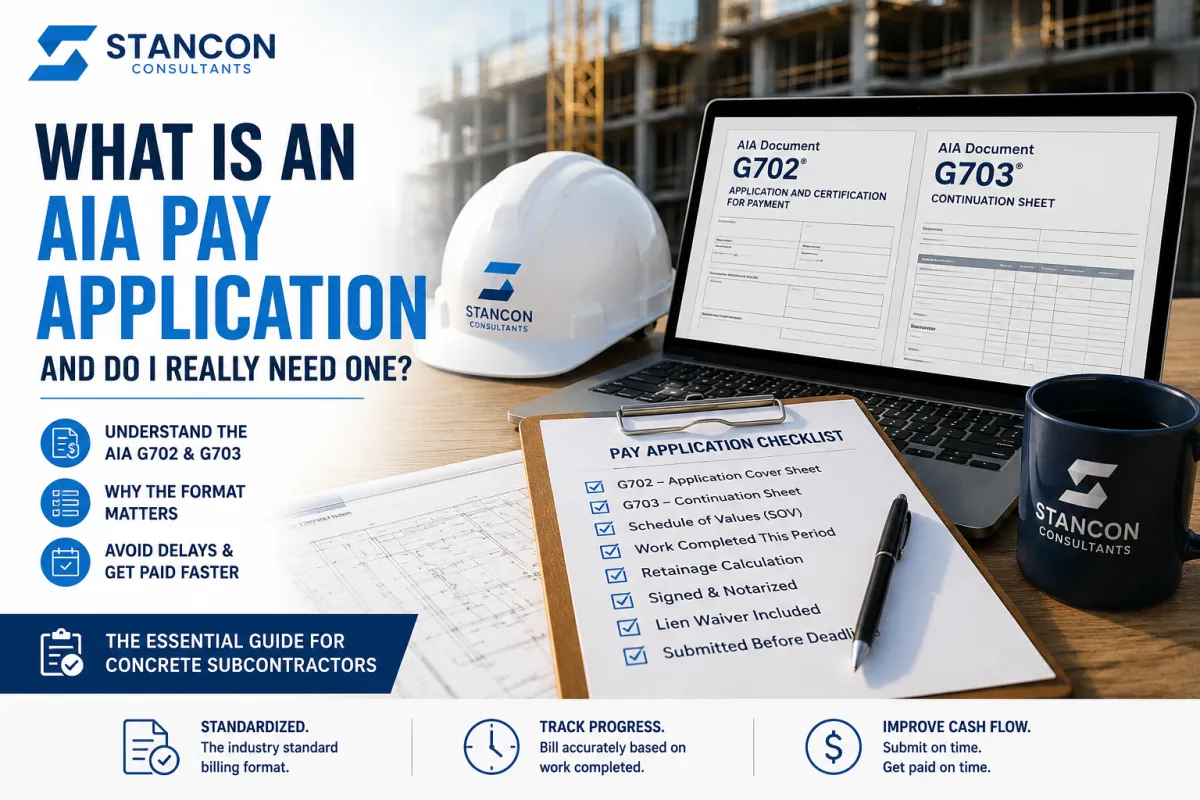
An AIA pay application is a standardized billing document used in commercial construction. AIA stands for American Institute of Architects. The forms themselves are called the G702 and G703, and they work together as a pair.
The G702 is the application cover sheet. It shows the total contract amount, how much has been billed to date, how much is being requested this period, and how much retainage the GC is holding back.
The G703 is the continuation sheet. It breaks everything down line by line against your Schedule of Values.
Both forms require a notarized signature from the subcontractor in most cases, along with a lien waiver before the GC releases payment. The official AIA instructions for the G702 make clear that the G702 serves as both the contractor's application and the architect's certification — meaning a properly completed form expedites payment and reduces the possibility of disputes.
That's the basic structure. But what makes these forms powerful isn't the format itself. It's what the format forces you to track.
What Is a Schedule of Values?
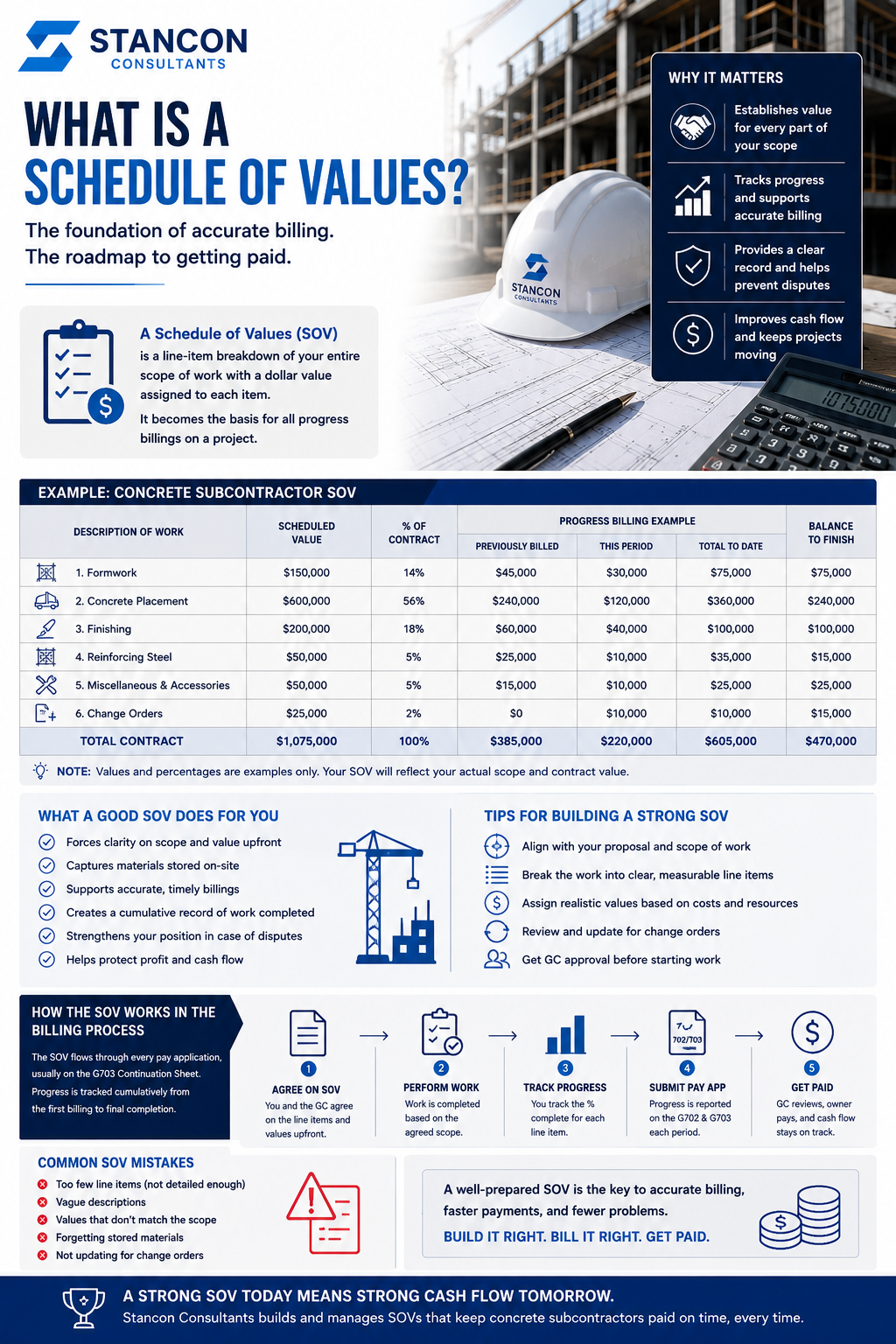
The Schedule of Values, or SOV, is the foundation of your pay application. It's a line-item breakdown of your entire scope of work, with a dollar amount assigned to each line.
Think of it as dividing your contract into pieces. Formwork is one line. Concrete placement is another. Finishing is another. Each billing cycle, you report what percentage of each line item is complete. The G703 tracks that progress cumulatively, period by period, from the first application all the way to final billing.
This matters for a few reasons.
First, it forces clarity upfront. You and the GC agree on what the work is worth before a single yard of concrete is poured.
Second, it gives you a billing mechanism for materials stored on-site but not yet installed, something a lot of subs forget to include and leave money on the table because of it.
Third, it creates a paper trail. If a dispute comes up later about how much work was done or how much has been paid, the pay app record settles it.
A poorly built SOV is one of the most common mistakes I see when subs try to do this themselves. And a missing SOV means you don't have a foundation to bill against. Everything after that is guesswork.
Why Do GCs Require AIA Format?
Because it's standardized. GC accounting departments process dozens of pay applications per project, across multiple trades. They need a consistent format they can verify quickly, route for approval, and plug into their own billing cycles with the owner.
About 90% of commercial construction contracts specify that billing must be submitted on the AIA format. If you send something else, the GC sends it back. And depending on when that happens in the billing cycle, you might be waiting an entire extra month before you can resubmit.
That's not a minor inconvenience. That's a month of cash flow sitting on the table.
I've seen subs do everything right on the job site and then hurt themselves because they didn't get the paperwork right. One missed submission date can push your payment back 30 days. And if cash is already tight, that month matters. The broader risks of disorganized project administration go well beyond billing, but billing is often where the damage starts.
What Happens If You Miss the Deadline?
This is the part most subs find out the hard way.
GCs operate on a billing schedule. They have a cut-off date each month for receiving subcontractor pay applications. If you miss it, even by one day, your application typically doesn't go into that billing cycle. You wait until the next one.
On a project where you're billing every 30 days, that means your payment just got pushed back an entire month. On a project with significant retainage, that delay compounds quickly. Retainage in commercial construction typically runs between 5% and 10% of each progress payment, accumulating until substantial completion, which means the longer your billing cycles drag, the more capital you have tied up and out of reach.
I've watched subs get so frustrated by a missed cycle that they start calling the GC, asking for something, anything, just to keep the lights on. And I've seen some of them pull off the job entirely to go find faster money elsewhere. Both of those moves damage the GC relationship. Neither of them was necessary. A timely, properly formatted pay application would have prevented all of it.
Do You Actually Need to Use AIA Format Even If the GC Doesn't Ask?
Yes. And here's my honest opinion on it.
Even if a GC doesn't explicitly require the AIA format on a given project, you should use it anyway.
A car was just noisy when a horse worked fine for transportation. When a sub truly understands how billing against a Schedule of Values works, they realize they have more control over their billing, their cash flow, and their documentation. It's actually less work in the long run, not more.
There's also a credibility factor. A sub who submits a clean, properly formatted G702/G703 from day one looks like someone who runs a serious operation. GCs notice. It puts you in a different category from the guys submitting handwritten invoices.
We recommend it on every project, regardless of contract size. The discipline it builds around tracking your work and billing it accurately pays dividends over time. It's the same discipline that separates subs who grow from those who stay stuck, a point worth reading more about in our breakdown of effective project support for concrete subcontractors.
What Does It Take to Fill One Out Correctly?
More than most people expect on the first try.
To build a proper pay application from scratch, you need to pull the following from your executed contract: your company information, the contract date, the contract number, the contract amount, the retainage percentage, the submission deadline, where it gets submitted, and any lien waiver requirements.
From there, you build the SOV from your proposal. You enter the contract data into the G702. You set up the G703 continuation sheet with your line items. And then every billing period, you track what percentage of each line is complete, carry forward the prior period amounts, calculate the current application, and run the retainage math.
You also need to get it signed, attach the lien waiver in whatever format the GC requires, and submit it by the deadline.
It's not complicated once you've done it a few times. But the first time, it's easy to miss something. And missing something can mean a delayed payment or a rejection that costs you a billing cycle.
At Stancon Consultants, we handle this entire process for our clients. We review the contract, build the SOV, set up the pay app program, send the subcontractor a simple form each billing period asking for their percent complete numbers, do the math, prepare the application, and send it for signature before submitting it to the GC on their behalf.
Our clients don't have to think about the paperwork. They focus on the project. We make sure they get paid on time.
You can learn more about our AIA pay application services here.
The Real Cost of Informal Invoicing
Here's what I've watched happen when subs stick with traditional invoicing on projects that involve multiple billing cycles.
They lose track of what they've already invoiced for. They forget to bill for change orders. They overcharge on a cycle because they weren't sure what was left, and then the GC pushes back and the relationship takes a hit. Or they undercharge, realize it late, and can't easily go back and correct it without a fight.
These aren't just billing headaches. Subs who don't have a disciplined billing system also tend to have less visibility into their overhead recovery, a problem that starts in the back office and shows up in the bank account.
If your numbers feel murky, understanding how to define and track overhead costs in construction is a related problem worth solving at the same time.
With AIA pay applications and a proper SOV, the billing fog clears. Every dollar is tied to a line item. Every period is tracked cumulatively. You always know exactly where you stand, what you've billed, what's been paid, and what's left.
That's not just cleaner billing. That's leverage. And for subcontractors operating on thin margins where retainage alone can equal an entire project's profit, controlling your billing process isn't optional.
Frequently Asked Questions
What is the difference between G702 and G703?
The G702 is the application cover sheet, showing the contract summary, current period amount, and payment due. The G703 is the continuation sheet, breaking down the billing by line item against your Schedule of Values. They are always submitted together.
Do I need an AIA pay application for small projects?
Most commercial contracts require it regardless of size. Even when they don't, using AIA format protects you. It gives you documentation, keeps your billing accurate, and signals professionalism to the GC.
What happens if I miss the AIA pay application deadline?
Your application typically doesn't get processed until the next billing cycle. That can mean waiting an additional 30 days for payment on that period's work.
What is a Schedule of Values in construction?
A Schedule of Values is a line-item breakdown of your contract scope, with a dollar amount assigned to each item. It's the document your G703 bills against, period by period, until the contract is complete.
Can I submit an AIA pay application without using a consultant?
Yes. But understanding the format, building an accurate SOV, tracking cumulative amounts correctly, and meeting the submission deadline are all points of failure if you're doing it for the first time or managing it while running a project at the same time.
Do change orders need to be included in an AIA pay application?
Yes. Approved change orders should be incorporated into the Schedule of Values and reflected in future pay applications. Failing to track them properly is one of the most common reasons subcontractors leave money unbilled.
If you're doing commercial concrete work and you're not using AIA pay applications, you're either leaving money on the table or one missed billing cycle away from a cash flow problem that didn't need to happen.
We set this up for our clients and manage every cycle from start to finish. If that's something you want off your plate, contact us to get started.