

What Is a Construction Schedule of Values? A Subcontractor's Guide
Before a concrete subcontractor submits a progress billing on many commercial projects, one document needs to be established: the Schedule of Values. Most subs know they need to submit one. Far fewer understand what it actually does, how it should be structured, or what the consequences are when it's built carelessly.
The Schedule of Values is not just a billing form. It's the financial framework that governs every payment you receive from contract start through final retainage release. Get it right at the beginning and the billing process runs cleanly through the life of the project. Get it wrong and you'll spend the next several months fighting for payments that should have been straightforward, discovering scope items that can't be billed because they weren't broken out properly, or sitting on retainage you can't release because the closeout documentation doesn't align with what the SOV promised.
This article covers what a Schedule of Values is, how it connects to the AIA pay application process, how to build one correctly as a commercial concrete subcontractor, and what to watch for throughout the billing cycle. Our AIA pay application support at Stancon Consultants includes Schedule of Values preparation and management as a standard component of the billing process, not an optional extra.
What a Schedule of Values Actually Is
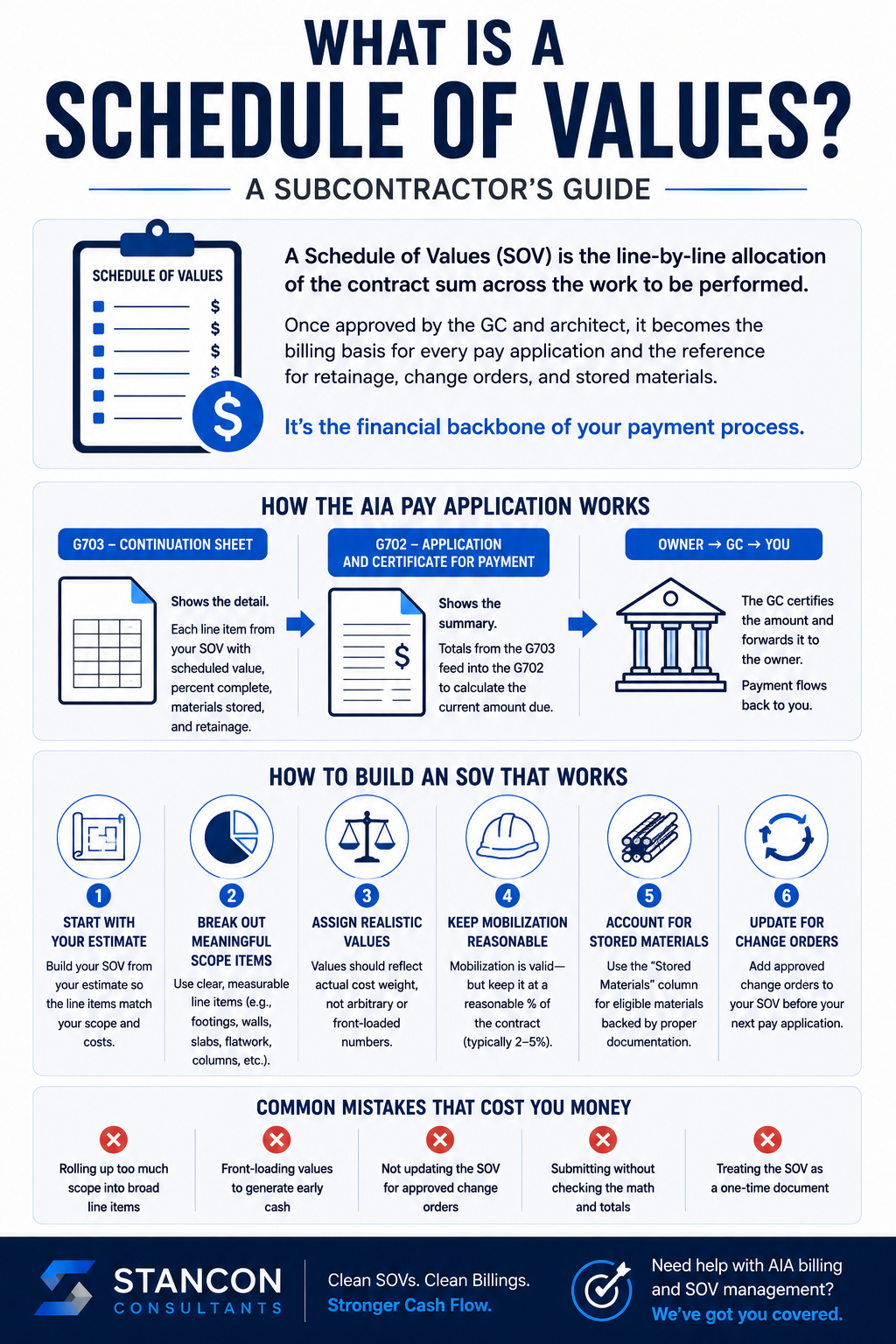
A schedule of values is the line-by-line allocation of the contract sum across the work to be performed. It breaks the total contract value into individual scope items, each assigned a dollar amount that represents that item's share of the overall price. Once approved by the GC and architect, it becomes the billing basis for every pay application submitted throughout the project and the reconciliation point for retainage, change orders, and stored materials.
It is not the same as your project budget. The budget is an internal cost tracking document. When required by the contract, the Schedule of Values is a formal billing document submitted as the basis for progress payments. Those are two different things, and conflating them leads to a billing structure that serves internal accounting but doesn't translate cleanly into AIA billing.
On projects using the AIA G702/G703 payment forms, the Schedule of Values is reflected in the G703 Continuation Sheet, which accompanies the G702 Application and Certificate for Payment. The G702 is the one-page summary showing total contract value, retainage held, previous payments, and the current amount due. The G703 is where the detail lives: every line item from the Schedule of Values with its scheduled value, the percentage complete this period, the amount completed to date, materials stored on site, and retainage withheld per line. Together they make up the complete AIA pay application package.
Why the Schedule of Values Matters More Than Most Subs Realize
According to Billd's 2025 State of Subcontractor Payments report, subcontractors wait an average of 56 days after submitting a pay application to actually receive funds. And 82% of contractors now experience payment delays exceeding 30 days, compared to just 49% two years earlier. A weak Schedule of Values is one of the more consistent reasons that delay window stretches longer than it should.
When the SOV is structured poorly, incomplete scope items create billing disputes at the certification stage. The GC's project manager or the architect questions whether work billed under a vague line item was actually completed at the percentage claimed. The pay application gets kicked back for revision. The revision gets resubmitted, potentially pushing payment further into the next billing cycle. What should have been a 30-day payment cycle becomes 60 days or more, and the cash your business needed to fund the next billing period stays in the approval pipeline instead.
The connection between a clean Schedule of Values and clean cash flow is direct. The cash flow management realities facing commercial concrete subcontractors mean that every unnecessary billing delay compounds quickly. Funding your own project for two months on money you've already earned is a cost most concrete subs absorb without ever tracing it back to the billing document that caused it.
How to Build a Schedule of Values for a Commercial Concrete Scope
Building the Schedule of Values starts before the first pour, ideally before mobilization. Many contracts require the SOV to be submitted shortly after contract execution or before the first application for payment, with the exact deadline determined by the contract. That window doesn't leave much time if you haven't thought through the structure in advance.
Start with your estimate.
The cleanest SOVs are built directly from the estimate because they reflect the actual scope breakdown you priced and the cost weight of each component. A SOV built separately from the estimate often has line items that don't match the actual work sequence, which creates problems when you're trying to demonstrate percentage of completion at billing time.
Break out scope items at a meaningful level of granularity.
The line items in your Schedule of Values should reflect measurable, distinct scopes of work, not rolled-up categories that are impossible to verify in the field. For a commercial concrete package, that typically means separate line items for site concrete flatwork, building concrete slabs on grade, foundation footings, cast-in-place walls, structural columns and piers, elevated deck concrete, and any specialty items like trench drains, equipment pads, or concrete topping on metal deck. Combining everything into two or three broad categories may seem simpler, but it creates billing ambiguity that the GC and architect will push back on.
Assign values that reflect actual cost weight, not arbitrary round numbers.
The dollar value assigned to each line item should represent its proportional share of the total contract value based on what that scope actually costs to complete. A common mistake is front-loading the Schedule of Values by assigning inflated values to early-stage work like mobilization and layout, which generates higher early billings but creates a billing shortfall later in the project when the remaining line items aren't worth enough to cover what the work actually costs. Architects and experienced GC project managers recognize front-loading immediately, and a front-loaded SOV often gets rejected or revised before it's ever approved.
Include a mobilization line item, but keep it reasonable.
Mobilization and general conditions are legitimate SOV line items. But mobilization should reflect the actual cost of getting your crew and equipment to the site, setting up temporary facilities, and doing the initial site work, not an inflated value designed to generate early cash. A mobilization line item at 2 to 5% of the contract value is generally defensible. One at 15% is going to get questioned.
Account for stored materials separately.
The AIA G703 includes a column specifically for materials stored on site but not yet incorporated into the work. Rebar that's been delivered and is sitting in the lay-down area before installation can be billed in this column with appropriate documentation, typically a supplier invoice and evidence of on-site storage. Knowing how to use the stored materials column correctly accelerates your cash position on material-heavy scopes.
How Change Orders Affect the Schedule of Values
Approved change orders need to be incorporated into the Schedule of Values before they can be billed. This is one of the most consistently mismanaged steps in the concrete subcontractor billing process.
When a change order is approved and executed, the contract value increases by the approved amount. That additional value needs to be added to the Schedule of Values as either a new line item or an adjustment to an existing one, so that it can appear on the next pay application. A change order that's been approved but not incorporated into the SOV is a change order you can't bill, which means you did the work, got the paperwork signed, and still didn't get paid because the billing document wasn't updated.
Managing change orders and pay applications as part of the same project administration workflow is how that gap closes. Every executed change order should trigger an immediate SOV update so the next billing period captures the full contract value you're entitled to bill against.
Retainage and the Schedule of Values
When retainage applies, it is generally calculated against progress payments according to the percentage and terms established in the contract. A 5% to 10% range is common in many commercial contracts, but the actual rate and treatment depend on the contract and applicable law. On a $600,000 concrete subcontract with 10% retainage, $60,000 of earned revenue is being held back until project closeout. That's working capital sitting in the owner's account, not yours, for the duration of the project and often for months afterward while punch lists and closeout documentation are resolved.
If cash flow is a concern, retainage reduction can be negotiated into the original contract. AIA Contract Documents endorse reducing retainage as rapidly as practical while maintaining appropriate protection for the parties, but the timing and conditions of any reduction depend on the contract. That negotiation happens at the subcontract stage, not mid-project. Understanding the payment terms in your subcontract before you sign, including the retainage percentage and any provisions for retainage reduction, is the first step in managing the retainage impact on your cash position.
On the G703, retainage appears in a dedicated column and is calculated as a percentage of the total completed and stored to date for each line item. The cumulative retainage across all line items feeds into the G702 summary as a deduction from the total amount earned, producing the current amount due. That number is what the GC certifies and forwards to the owner for payment. Errors in the retainage calculation at the line item level flow directly into the certified payment amount, which is why the math on the G703 needs to be verified before every submission.
The Submittal Connection
The Schedule of Values and the submittal process are connected in ways that affect both billing timing and payment certification. On commercial concrete projects, certain line items in the Schedule of Values, particularly mix design approvals, rebar shop drawings, and other pre-installation submittals, may not be certifiable for payment until the associated submittal has been approved by the design team.
That connection means submittal delays can directly delay billing on specific SOV line items even when the field work is progressing on schedule. Understanding how the submittal process works and tracking submittal approval status alongside the billing cycle is part of managing the project's financial documentation as an integrated system rather than a set of separate administrative functions.
Common Schedule of Values Mistakes That Cost Concrete Subs Money
Several patterns show up consistently when Schedule of Values documents aren't built carefully.
Rolling up too much scope into single line items. A line item called "Concrete Work" that covers everything from site flatwork to structural footings to elevated slab gives the architect no way to verify percentage completion at billing time. Break it out.
Front-loading to generate early cash. Assigning inflated values to early-stage line items generates cash in early billing periods but creates a structural shortfall later. It also signals to experienced reviewers that the SOV wasn't built from the estimate.
Not updating the SOV for approved change orders. Executed change orders that aren't incorporated into the SOV can't be billed. Every change order update should trigger a SOV revision immediately.
Submitting without checking the math. Percentage completion figures that don't reconcile against the scheduled values, retainage calculations that are off by a rounding error, cumulative totals that don't carry forward correctly from the prior period: these errors slow certification and erode the GC's confidence in your billing process.
Treating the SOV as a one-time document. The Schedule of Values is a living document for the life of the project. It needs to be updated for change orders, reconciled against actual progress at each billing period, and verified for accuracy before every submission.
What Good SOV Management Looks Like in Practice
Managing the Schedule of Values correctly means treating it as a financial management tool, not a form to fill out once and file. On the commercial concrete projects Stancon Consultants supports, SOV preparation happens at contract execution, change order updates happen as each change is approved, and the G703 reconciliation is reviewed before every pay application goes out.
That discipline is part of what makes the billing process run smoothly from the first application through final retainage release. And it's one of the clearest ways effective project support for concrete subcontractors produces a financial return beyond just getting paperwork done: clean, consistent billing that hits every cutoff date, captures every approved change, and positions retainage for release as soon as the contract allows it.
If you want to see what that looks like across a full project billing cycle, our fractional estimating and project support plans include AIA billing support as part of an integrated preconstruction and project administration package built specifically for commercial concrete subcontractors.