
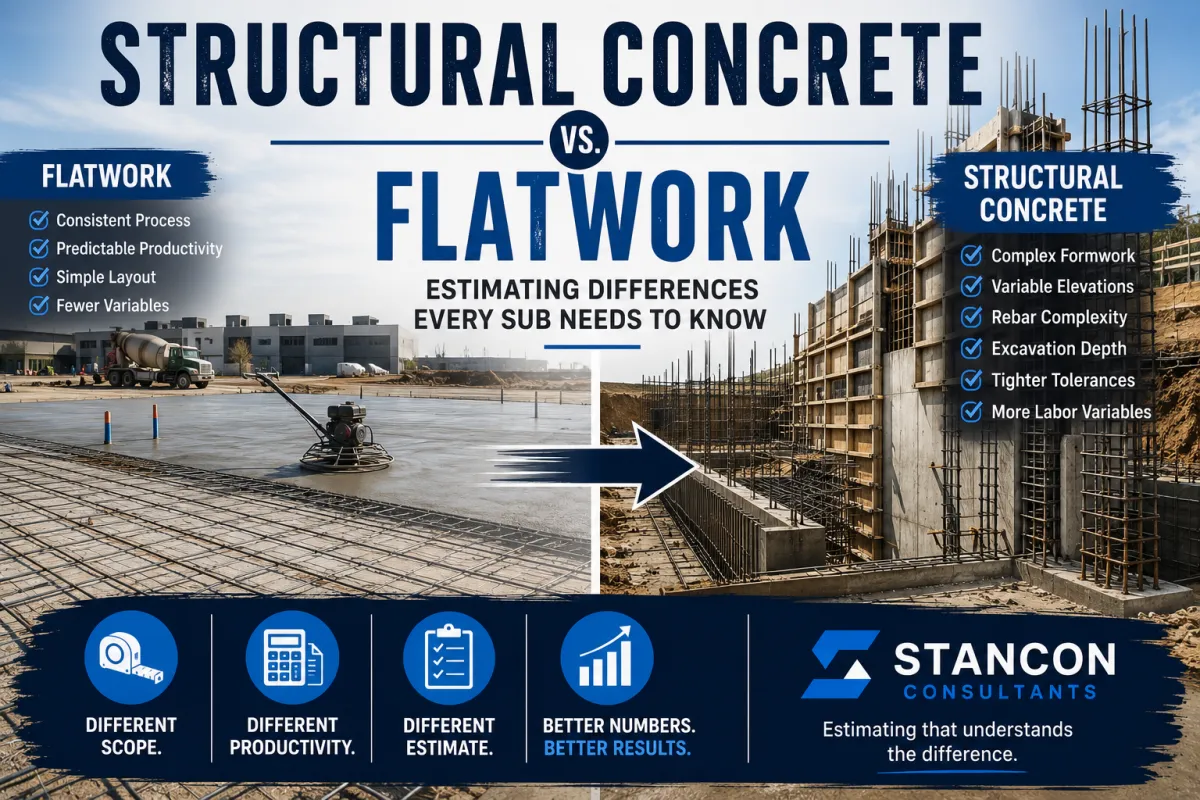
Structural Concrete vs. Flatwork: Estimating Differences to Know
Flatwork estimating is something most commercial concrete subcontractors get comfortable with over time. You know your crew. You know roughly how many yards they can place in a day on a standard slab. You understand what thickness changes, reinforcement type, and finish requirements do to your number. After enough jobs, the process becomes intuitive enough that you can build a competitive flatwork estimate without much second-guessing.
Structural concrete doesn't work that way. And the difference between the two isn't just a matter of scope complexity. It's a fundamentally different estimating exercise, with different cost drivers, different labor productivity assumptions, and different consequences when those assumptions are wrong.
The structural concrete vs. flatwork estimating distinction is one that catches concrete subs off guard more often than most would admit, specifically when they step into a structural scope carrying the productivity assumptions that work reliably on slabs. The result is predictable. The number comes in lean. The job gets awarded. Work starts. And somewhere around the second week of forming, the crew is behind schedule and the margin is already gone, not because they aren't capable, but because the estimate wasn't built for the work in front of them.
This article breaks down exactly where structural concrete estimating diverges from flatwork, why it matters, and what to get right before a structural bid goes out. Our concrete estimating services cover both scope types, and the structural vs. flatwork distinction is something we work through carefully on every structural package we price.
The Root Problem: Pricing Structural Concrete by the Yard
The most common mistake concrete subs make when they move from flatwork to structural is pricing by the cubic yard. It's an understandable approach. On flatwork, crew output per day is relatively predictable. You know your crew size. You know their pace on a standard slab. You can look at the total cubic yards, divide by what your crew typically produces in a day, and land on a labor number that's in the right range most of the time.
Structural concrete is different because the labor isn't driven by volume alone. On a slab, the main variables are thickness and reinforcement type. Both affect cost but neither fundamentally changes how the crew works or what they're doing. Set forms, place reinforcement, pour, screed, finish. That consistency is what makes productivity-based estimating work on flatwork.
On structural work, that consistency disappears. A wall pour with a special ledge shape, complex rebar detailing, and changing excavation depths along the footing line is a fundamentally different exercise from a clean flatwork placement at the same cubic yardage. The crew isn't doing the same work. They're doing different work that happens to involve the same material. Pricing it by the yard, using a flatwork productivity assumption, produces a number that looks right until the work starts. If you're just beginning to understand the full estimating process, the distinction between a takeoff and an estimate matters more on structural packages than almost anywhere else in concrete work, because the quantity detail required is significantly more granular than what flatwork demands.
What Changes: The Key Cost Drivers in Structural Concrete Estimating

The cost drivers that separate structural concrete estimating from flatwork aren't subtle. They're specific, significant, and each one can materially change the labor and forming cost on a package if they're not accounted for before the number goes to a GC.
Excavation depth and accessibility
Footing depths vary by structural requirement, soil condition, and frost depth. A footing that needs to go four feet below finish grade in a location with limited equipment access is a fundamentally different operation from the same linear footage at a shallower depth with clear access. Excavation depth affects how long forming takes, how long rebar placement takes, and how the crew works around the excavated material during the pour. None of this appears in a flatwork estimate because flatwork doesn't have it.
Wall layout and forming systems
The entire wall layout depends on how you form the walls and lay out the footers. Forming system selection, whether conventional panel forming, a proprietary system, or site-built forms for a specialized shape, affects both the forming labor rate and the stripping cycle that follows. A wall with an unusual cross-section or an integrated ledge detail requires custom forming solutions that take more time to set and strip than a standard rectangular section. That time has to be in the estimate before the job starts.
Vertical level accuracy and structural consequence
Structural concrete needs to be at proper levels because the entire building structure depends on it. A footing that's off in elevation affects every structural element above it. A wall that's out of plumb creates problems for the steel erector and the floors above. Maintaining accurate vertical levels requires layout time, checking time, and correction time that flatwork simply doesn't demand to the same degree. That additional activity has a real labor cost, and it has to be priced in.
Rebar complexity
Flatwork reinforcement is relatively straightforward. Structural rebar is not. Multiple bar sizes in close spacing, horizontal bars with vertical dowels at specified spacings, ties at required intervals, epoxy-coated bar where specified: all of these add placement time that a simple slab mat doesn't require. Rebar complexity has to be read from the structural drawings and factored into the labor hours, not estimated from a general rule of thumb. The concrete estimating guide for starting a concrete business covers reinforcement estimating fundamentals that apply directly here.
Changing footing and wall elevations
On a commercial project with sloping grade or varying structural requirements, footing elevations can change along the length of a continuous footing run. Each step in elevation requires additional forming work, additional rebar lap and splice coordination, and additional checking against the structural drawings. These transitions add time that's invisible in a yard-based estimate but very visible in the field.
Understanding how these cost drivers affect your overhead costs and budget planning is part of building a structural estimate that holds up, because the indirect costs tied to a longer, more complex structural scope are different from what a flatwork package of the same dollar value generates.
How Labor Productivity Works Differently in Structural Concrete Estimating
This is the technical center of the structural concrete vs. flatwork estimating distinction, and it's where most pricing errors actually originate.
On flatwork and slabs, productivity is relatively consistent because the work is relatively consistent. The labor hours needed to place and finish a thousand square feet of six-inch slab don't vary dramatically from job to job under similar conditions. That consistency allows experienced flatwork estimators to develop reliable productivity rates they can apply across projects with reasonable confidence.
Structural concrete productivity doesn't work that way. On structural scopes, the productivity is calculated after seeing the heights of walls, depths of footings, rebar complexity level, elevation changes, and formwork planning, not before. A ten-foot wall with straightforward rebar and clean access is not the same labor exercise as a ten-foot wall with a special ledge, complex dowel patterns, and limited equipment clearance. The cubic yardage might be identical. The hours will not be.
The practical implication is that labor productivity rates in structural concrete estimating need to be developed scope by scope, not applied from a general rule. Wall forming productivity depends on wall height, forming system, and reinforcement complexity. Footing productivity depends on depth, access, and the number of elevation changes. Pier and pedestal productivity depends on size, depth, and reinforcement configuration. Each scope type within a structural package needs its own productivity assumption, built from what the drawings actually show.
Tracking actual hours against estimated hours on every structural job you run is how you build reliable benchmarks over time. Without that tracking discipline, every structural bid involves more uncertainty than it should. The construction data collection and management practices that support this kind of historical tracking are worth putting in place before you've priced enough structural work to make the comparison meaningful.
What Underestimating Structural Work Actually Costs
When a concrete sub prices a structural scope using flatwork productivity assumptions, the most probable result is a bid that comes in at break-even at best and a loss at worst, not a dramatic failure, but a slow bleed. The crew isn't underperforming. The foreman isn't making mistakes. The job just takes longer than the estimate said it would, and the margin bleeds away day by day until the job finishes and the numbers don't make sense.
That pattern is more damaging than a single bad bid because it's hard to see clearly from the inside. You don't always know during the job that you're underperforming against the estimate. You know things feel tight. You know the schedule is stretching. But the full picture doesn't emerge until the job is done and the cost-to-complete analysis shows what actually happened.
This is also one of the bid management errors that quietly costs concrete subcontractors margin across a full year of work: not on any single catastrophic job, but on a pattern of structural scopes that were consistently underestimated by 15 to 20 percent. The top bid management process errors that hurt profits covers this pattern in more detail alongside other preconstruction decisions that compound over time.
The fix isn't complicated. Every structural scope needs to be estimated from the drawings, not from a productivity assumption carried over from flatwork. Wall heights, footing depths, rebar details, forming system requirements, and elevation changes all have to be quantified and translated into specific labor hours before a number goes to a GC. That process takes more time than pricing flatwork. But it's the only process that produces a structural estimate you can actually stand behind.
What to Get Right Before You Bid Your First Structural Scope
For a concrete subcontractor who has mostly done flatwork and wants to start pursuing structural work, the single most important adjustment is allowing enough time in the schedule for layout, forming, rebar placement, and maintaining accurate vertical levels. These activities simply don't exist in flatwork experience. They take real time, and that time has to be in the estimate before anything else.
Beyond the scheduling reality, the right move on the first structural bid is to get the estimate reviewed by someone who has been doing it. Not because the sub isn't capable of learning structural work, but because the first bid is not the place to discover that your productivity assumptions were off by 40 percent. A structural estimate reviewed by an experienced eye before it goes to a GC is the kind of risk management that keeps a first structural job from becoming a cautionary story.
Pairing a sound structural estimate with a clear concrete bid strategy that targets the right structural opportunities is how subcontractors expand their scope without overextending their estimating process. And understanding what GCs want to see in a concrete bid on a structural package, specifically, is worth reading before you submit a structural proposal for the first time, because the documentation expectations are higher than most flatwork subs expect.
This is exactly where Stancon Consultants works with concrete subcontractors who are expanding their scope. Whether you're pricing structural concrete for the first time or you've been doing it for years and want tighter numbers, our fractional estimating support is built around making sure your number is safe without costing you the job. If you want to understand how to vet the right estimating partner for structural work specifically, the guide to choosing the right estimating service covers what to look for before you hand over a structural drawing set.
Frequently Asked Questions
What is the difference between structural concrete and flatwork estimating?
Flatwork estimating is relatively consistent because crew productivity across similar slab placements doesn't vary much. The main variables are thickness and reinforcement type. Structural concrete estimating is more complex because productivity varies by scope: wall heights, footing depths, rebar complexity, forming system selection, elevation changes, and vertical level accuracy all affect labor hours in ways a flatwork productivity rate doesn't capture.
Why is structural concrete harder to estimate than flatwork?
Because the cost drivers in structural work, forming systems, excavation depth, rebar complexity, vertical level requirements, and changing footing elevations, simply don't exist in flatwork estimating. Applying a flatwork productivity assumption to a structural scope systematically underestimates the labor required, which shows up as a break-even or loss result on the job.
How do you estimate labor productivity for structural concrete?
Structural labor productivity is determined after reviewing the drawings, not before. Wall height, footing depth, rebar complexity, forming system selection, and elevation changes all feed into scope-specific productivity assumptions. Each structural scope type, walls, footings, piers, elevated decks, needs its own labor rate rather than a single rate applied across the package.
What should a concrete sub do before bidding structural work for the first time?
Allow enough schedule days for layout, forming, rebar placement, and maintaining vertical levels, activities that don't appear in flatwork experience. And get the estimate reviewed by someone with real structural concrete estimating experience before it goes to a GC. The first structural bid is not the place to find out your productivity assumptions were significantly off.
Can you estimate structural concrete using flatwork production rates?
Not reliably. Structural concrete involves different labor activities, forming systems, rebar complexity, elevation changes, and layout requirements that make flatwork productivity assumptions inaccurate for most structural packages.