
Choosing the Right Estimating Service: A Contractor's Buyer's Guide
Your bid is among the most important documents your business produces. It determines what work you win, at what margin, and whether the job you worked hard to land actually puts money in your pocket when it's done. So why do so many commercial concrete subcontractors spend less time vetting their estimating partner than they spend choosing a ready-mix supplier?
The short answer is that most contractors don't know what to look for. And because estimating happens before the job, the consequences of a bad choice don't always show up until you're three weeks into forming and the numbers aren't adding up.
This guide is built to change that. It covers everything you need to evaluate, select, and work effectively with a construction estimating service built for commercial concrete work, including what questions to ask, what the relationship should look like in practice, and how to know early when something's not working.
At Stancon Consultants, we offer concrete estimating services built specifically for commercial concrete subcontractors. But this guide isn't a pitch. It's a framework you can use to evaluate any provider, including us.
Why Choosing the Right Estimating Service Matters More Than Most Contractors Realize
Here's the number that puts everything in context: 32% of all construction cost overruns trace back directly to estimating errors. Not procurement problems. Not labor disputes. Not weather. Errors made before the first truck rolled. And those errors don't announce themselves at bid time. They wait until you're mid-project, committed to a GC, and out of leverage.
The right estimating service reduces that risk while the wrong one multiplies it.
This isn't a vendor decision. It's a preconstruction infrastructure decision. And for commercial concrete subcontractors specifically, where the complexity of forming systems, pour sequencing, post-tension layouts, and labor productivity assumptions can swing a number by hundreds of thousands of dollars, the stakes are higher than in most other trades.
Step 1: Understand What You Actually Need
Before you evaluate anyone, you need to be clear on what gap you're filling. Concrete subcontractors typically come to an estimating service for one of three reasons, and the right fit depends on which one applies to you.
I. Capacity. You're winning enough work but your preconstruction team can't keep up with bid volume. You're turning down opportunities or rushing estimates to hit deadlines. You need more bandwidth without adding a full-time estimator to payroll.
For some subcontractors, that means outsourcing estimating entirely. For others, it means combining internal staff with estimating software or a hybrid workflow. If you're still evaluating those options, it's worth understanding what to look for in an online concrete estimator before deciding which direction makes the most sense for your operation.
II. Expertise. You have someone doing estimates internally, but the scope complexity on certain project types, elevated decks, post-tensioned structures, tilt-up panels, exceeds their experience. You need trade-specific depth on specific scopes.
III. Consistency. Your estimates are inconsistent. Sometimes the number is tight, sometimes it's soft, and you're not always sure which one you submitted until the job is running. You need a documented, repeatable process you can rely on bid after bid.
Most concrete subcontractors are dealing with some combination of all three. But knowing which one is most urgent helps you ask the right questions and evaluate the right things.
Step 2: Know What Concrete-Specific Experience Actually Looks Like
This is the single most important filter in the entire selection process. Not company size, not price, not turnaround time. Trade-specific experience comes first.
Commercial concrete estimating isn't a transferable skill from other trades. A company that's spent years pricing MEP work or residential framing brings a different set of assumptions, unit prices, and risk models than one that's priced cast-in-place structures or post-tensioned podium decks.
The forming systems are different. The labor productivity curves are different. The way you account for pour sequencing, stripping cycles, and reshoring costs is different. None of that transfers automatically.
Experience relevant to your company's work is a baseline requirement, not a bonus. The skill of the individual estimators performing the work is just as crucial as the company's overall credentials.
So when you're evaluating a potential estimating partner, ask for specific examples. What commercial concrete projects have they estimated in the last 12 months? What was the scope type and contract value? What forming systems are their estimators familiar with? What software do they use for concrete takeoffs?
If the answers are vague or they pivot to general construction experience, that tells you something important before you've spent a dollar.
Step 3: Evaluate the Deliverable, Not Just the Promise
Every estimating service will tell you they produce accurate, detailed estimates. The question is what that actually looks like in their hands.
Ask to see a sample before you commit. A credible, concrete estimating service should be able to share a redacted deliverable from a past commercial concrete project. When you look at it, here's what you're checking for.
Quantity detail. Cubic yards broken out by pour and location. Linear footage of formwork by system type. Square footage of elevated slab vs. slab on grade. Rebar tonnage with bar size and spacing assumptions. These shouldn't be rolled up into single line items. They should be traceable back to specific drawing references.
Labor structure. Labor hours are broken out by activity, not just a lump labor percentage applied to material cost. Forming and stripping hours are separate from placement and finishing hours. Crew composition assumptions stated explicitly.
Scope clarity. A clear written statement of what's included and what's excluded. This isn't optional on a commercial concrete estimate. If a GC comes back with a scope question, you need to be able to answer it in 30 seconds without re-reading the drawings.
Cost code alignment. The output should map to how you actually run your jobs. If their CSI structure doesn't match your cost codes, you're reorganizing every deliverable before it's usable, and that cost in time and risk of error comes out of your hide.
If their sample doesn't show you all of that, the real deliverable won't either.
Step 4: Stress-Test Their Process Before a Live Bid
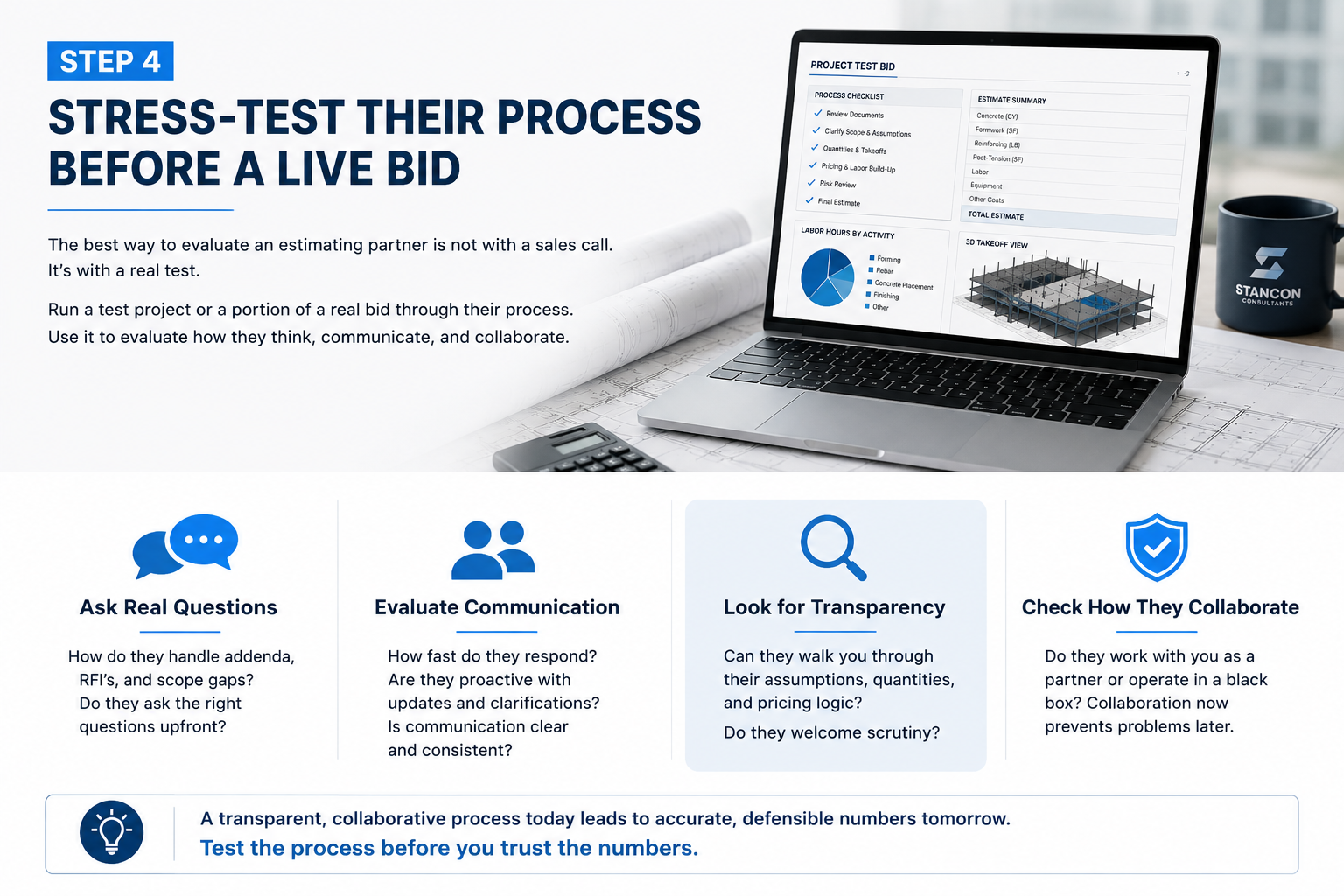
The best way to evaluate an estimating partner isn't through a sales conversation but through a trial project.
Pick a completed job where you already know the actual quantities and final cost. Send them the drawings, give them your standard scope parameters, and see what they produce. Then compare their takeoff to your actual quantities line by line. The variance will tell you more than any reference call.
During the trial, pay attention to more than just the numbers. How did they communicate during the process? Did they flag drawing conflicts or ambiguities without being prompted? How quickly did they respond when you had a question? Did they ask you the right things before starting, or did they dive in and make assumptions?
Information that the estimating service learns about the project while preparing the estimate, including planned materials, construction methods, and problems with the construction documents, needs to be transferred back to you. A service that does their work in a black box and hands you a PDF at the end isn't a partner. They're a vendor. And vendors don't call you when something in the drawings doesn't add up.
Step 5: Understand the Real Cost
Price matters, but it's not the first filter and it's rarely the most important one. Here's how to think about it clearly.
For most concrete projects in the U.S. market, outsourced estimating services typically price at 0.5% to 1.5% of project value, or a flat fee of $300 to $1,500 depending on scope complexity and drawing set size.
On a $2M commercial concrete package, that's $10,000 to $30,000 in estimating cost across a full year of outsourced bids, assuming reasonable bid volume. Compare that to the fully loaded cost of an in-house estimator, including salary, benefits, software licenses, and the overhead of managing that position, and the math often favors outsourcing for subcontractors in the $3M to $15M revenue range.
But the real cost calculation isn't salary vs. service fee. It's cost of a bad estimate vs. cost of a good one.
An estimate that wins a job at a number you can't execute costs you not just margin on that project, but relationship capital with the GC, bonding capacity, and the opportunity cost of your crew being locked into a money-losing job while better work sits on the table. That's a number no one puts in a spreadsheet, but every contractor who's been through it knows exactly what it costs.
Choose based on value, not rate. The cheapest estimating service is almost never the least expensive option when you factor in the full exposure.
Step 6: Structure the Relationship Before Work Starts
Even a capable estimating partner will underdeliver if the engagement isn't set up correctly. Most problems in outsourced estimating relationships aren't about skill. They're about undefined expectations.
Before the first drawing set goes over, get the following in writing.
Turnaround commitments. Not a general promise, a specific delivery window based on the project type and drawing set size. For a complex cast-in-place package, that might be eight to ten business days. For a simpler flatwork scope, four to five. Bid windows are sometimes unforgiving and you need to know exactly when your number will be ready.
Addendum protocol. Who's responsible for monitoring for addenda? How quickly will revisions be incorporated into a live estimate? What happens if a drawing change comes in 48 hours before bid day? These scenarios happen constantly in commercial concrete bidding, and you need a documented process before they do.
Error correction policy. What happens when a mistake is found? A good estimating partner corrects errors quickly, communicates clearly, and doesn't charge you for rework caused by their error. Make sure that's explicit in the service agreement, not assumed.
Scope of review. Who on your side reviews the estimate before it goes out? A deliverable from an external estimating service should never go to a GC without an internal review pass. Even the best estimating service can miss a project-specific condition that someone on your team would catch immediately.
When you outsource estimating, you're relinquishing some control over how and when the work is performed, which is why setting firm procedures and expectations before work starts is critical. Treat it the way you'd treat bringing on a new subcontractor. Document expectations, communicate clearly, and build in checkpoints.
Step 7: Watch for the Signs That It's Not Working
Even a relationship that starts well can drift. Here's what to watch for once you're underway.
Numbers that can't be explained. If your estimator can't walk you through a line item clearly and quickly, something is wrong with the process behind it. Every number in a concrete estimate should be traceable to a quantity, a unit price, and a source.
Missed scope items that should have been caught. A missed pour, a forming system that wasn't priced, a finish spec that didn't make it into the labor hours. One miss is a conversation. A pattern is usually a sign of a deeper process or experience problems, many of which show up in the same warning signs contractors overlook when hiring an estimating company in the first place.
Reactive communication. Your estimating partner should be reaching out to you, not the other way around. If you're consistently chasing status updates or finding out about addenda only after you've flagged them yourself, the service model isn't built around your success.
Defensive responses to questions. A confident estimating service welcomes scrutiny of their numbers. That's how trust is built. If asking a direct question about a line item produces defensiveness or vague answers, that's a character tell worth paying attention to.
What the Right Relationship Actually Looks Like
When it's working, outsourced estimating doesn't feel like outsourcing. It feels like having a preconstruction partner who understands your scopes, anticipates your questions, flags issues before they become problems, and hands you numbers you can take to a GC with confidence.
Firms working with professional estimating services see 22% more bids accepted on average, with error rates dropping significantly when specialized teams handle trade-specific scopes. That's what happens when the right expertise is applied consistently. You bid more work, you win more of it, and you win it at numbers that actually hold up in the field.
By this point, you should have a much clearer picture of what separates a reliable estimating partner from a risky one. You should also know what questions to ask, what warning signs to watch for, and what a professional deliverable should actually look like in practice.
At Stancon Consultants, we work exclusively with commercial concrete subcontractors. Per-project estimating, fractional estimating support, takeoffs, and proposal writing: all of it built around your scope, your cost structure, and your bid calendar.
If you want to see what a concrete-focused estimating partnership actually looks like before committing to anything, we're happy to walk you through our process, deliverables, and workflow. Reach out.
Frequently Asked Questions
How is an estimating service different from hiring an in-house estimator?
An in-house estimator is a fixed cost on your payroll regardless of bid volume. An estimating service is a variable cost you pay per project or on retainer, which makes it easier to scale up during busy bid seasons and scale back when volume is lower. For concrete subcontractors in the $3M to $15M revenue range, the economics of outsourcing typically compare favorably once you account for full salary, benefits, and software costs.
What should I expect to pay for outsourced concrete estimating?
For most commercial concrete scopes, professional estimating services price at 0.5% to 1.5% of project value, or flat fees ranging from $300 to $1,500 depending on scope size and drawing set complexity. Larger, more complex packages with extensive forming systems or post-tension work typically sit at the higher end of that range.
Should I use the same estimating service for every bid?
Consistency generally works in your favor once you've found the right partner. A service that's familiar with your cost structure, your markup model, and your typical scopes will produce better, faster estimates over time than one you're onboarding fresh on every project. That said, some contractors use a primary service for core scopes and a specialist for project types outside their usual range.
How do I know if my estimating service is actually performing well?
Track your bid hit rate by service provider over time. Compare their quantities against your actuals on jobs you win. Pay attention to how often their deliverables require significant revision before you're comfortable submitting. A good service should be improving your hit rate, not just producing faster numbers.
What's the difference between a takeoff service and a full estimating service?
A takeoff service quantifies materials only: cubic yards, square footage, linear footage, tonnage. A full estimating service converts those quantities into a priced bid, incorporating labor rates, equipment costs, subcontractor allowances, overhead, and markup.
Some concrete subcontractors use takeoff-only services when they have internal estimators who handle pricing. Others outsource the full process. Which model fits depends on where your internal capacity actually sits.
Can I outsource estimating if I'm a smaller concrete subcontractor?
Yes, and smaller operations often benefit most. You don't have the overhead to justify a full-time estimator, but you still need competitive, defensible numbers to win work. Per-project pricing means you only pay when you're actively bidding, which keeps your cost structure lean while your preconstruction quality stays high.
Should my estimating service understand my cost codes and CSI structure?
Absolutely. If an estimating service can't align their deliverables with your internal cost codes and CSI structure, your team ends up spending additional time reorganizing estimates before they can actually be used operationally. Good estimating support should reduce administrative friction, not create more of it.