
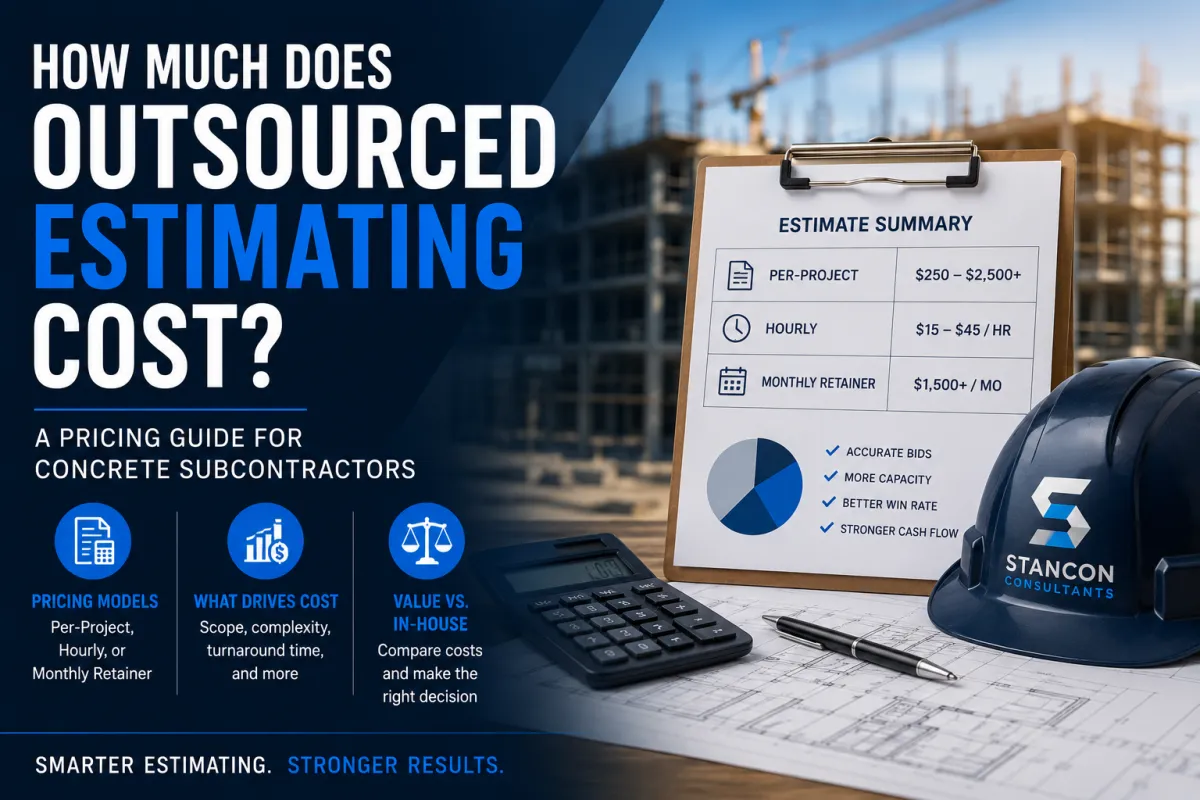
How Much Does Outsourced Estimating Cost? A Pricing Breakdown for Concrete Subcontractors
Price is usually the first question concrete subcontractors ask when they start exploring outsourced estimating. It's also one of the harder questions to answer cleanly, because outsourced estimating isn't a commodity with a fixed price list. What it costs depends on the service model, the scope of work, the provider's expertise, and how the relationship is structured.
That said, there are market ranges, and understanding them gives you a useful baseline for evaluating whether a provider's pricing is reasonable and whether the model makes financial sense for your operation. This article breaks down what outsourced concrete estimating actually costs across the main service models, what drives pricing up or down within those models, and how to think about the cost relative to the alternative of keeping estimating in-house.
One note before getting into numbers: pricing in this market varies meaningfully by provider, by scope type, and by geography. The ranges below reflect current U.S. market data as a general guide, not guarantees. What you'll pay for any specific engagement depends on the details of your project and the service model you're using.
The Three Main Pricing Models for Outsourced Estimating
Outsourced construction estimating is generally available through three pricing structures. Each suits a different type of buyer, and understanding which model fits your situation is as important as understanding the price range within it.
Per-project pricing. You pay a fixed fee per estimate, based on the scope, drawing set size, complexity, and turnaround time required. This is a common structure for concrete subcontractors who need occasional support or who want to test an outsourced estimating relationship before committing to an ongoing arrangement.
Hourly pricing. Some providers charge by the hour for estimating work, which gives you more flexibility on smaller or ambiguous scopes where the work effort is hard to define upfront. Outsourced estimating services typically run $15 to $45 per hour depending on the provider's location, experience level, and whether the team is domestic or offshore.
Monthly retainer or fractional model. You pay a fixed monthly fee for a set number of dedicated estimating hours per month. This model suits concrete subcontractors with consistent bid volume who want ongoing support, pipeline management, and the institutional knowledge that builds over time rather than a transactional per-bid relationship.
Each model has tradeoffs. Per-project pricing is flexible but doesn't build consistency across your bid program. Hourly pricing offers flexibility in scope but can make budgeting difficult. Monthly retainer pricing commits you to a regular cost but delivers the kind of ongoing partnership that produces better results over time as the estimator learns your operation.
Per-Project Estimating: What It Typically Costs
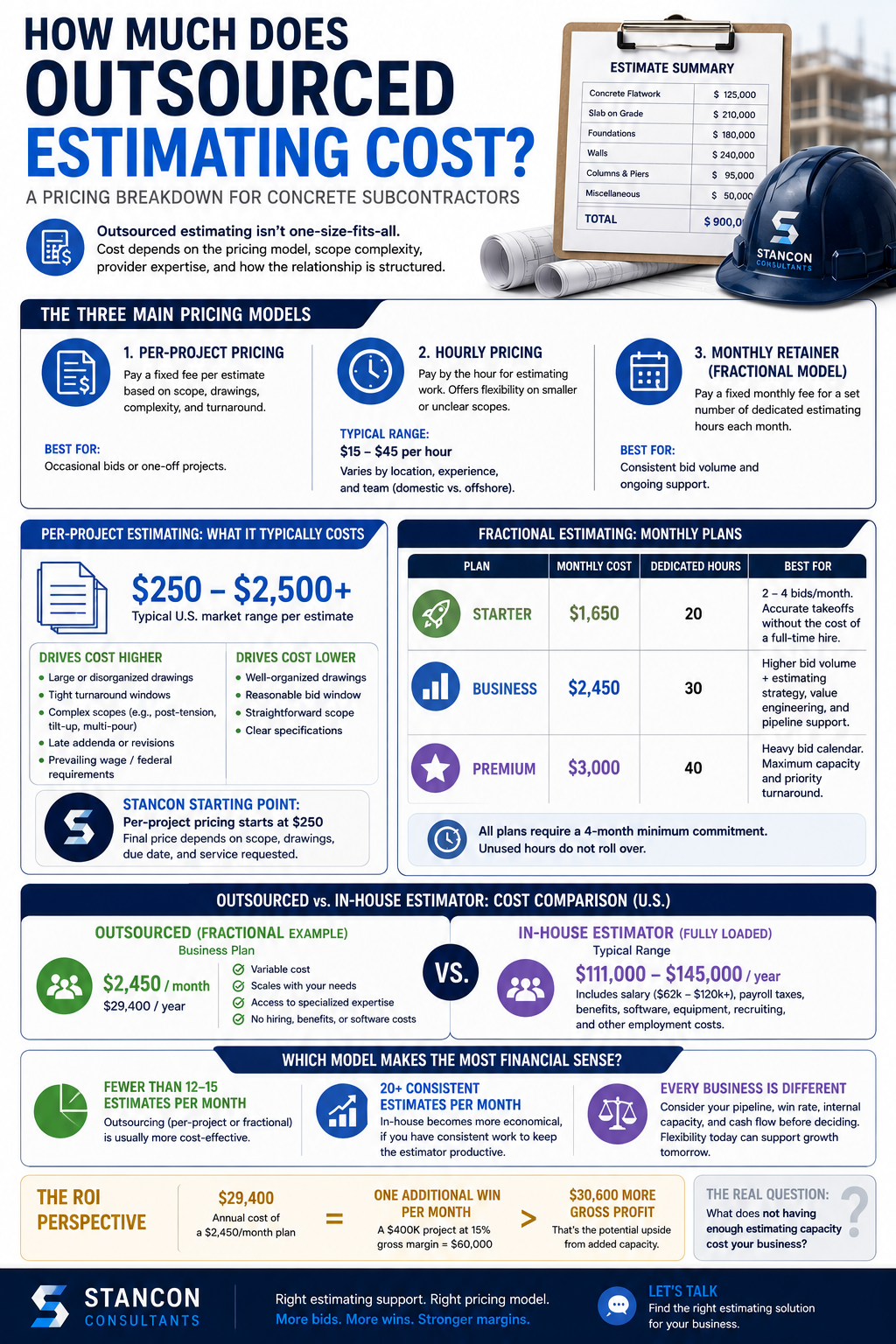
For concrete subcontractors who need on-demand support for specific bids, per-project estimating is the most accessible entry point. Pricing varies based on several factors, but the published pricing from U.S. estimating providers generally ranges from $250 at the low end for simpler single-trade scopes, up to $2,500 or more for complex multi-division commercial packages.
For commercial concrete specifically, the scope and complexity of the work is the primary cost driver. A straightforward flatwork package with a clean drawing set and reasonable turnaround time sits toward the lower end of that range. A complex structural concrete scope with cast-in-place walls, elevated decks, multiple pour locations, and a tight deadline pushes toward the higher end or above it.
At Stancon Consultants, per-project pricing starts at $250 and moves from there depending on the service requested, the scope of the project, the size of the drawing set, the due date, and the nature of the work. Our pricing isn't universal. It reflects the specifics of each project rather than a flat rate applied regardless of complexity. If you want to understand what a specific project would cost, the right starting point is a direct conversation rather than a general range.
The factors that consistently drive per-project costs higher across the market include:
Large or disorganized drawing sets that require more time to navigate
Tight turnaround windows that require priority scheduling
Complex scope types such as post-tensioned elevated decks or tilt-up panels
Projects with late addenda that require mid-estimate revisions
Federally funded or prevailing wage work with additional documentation requirements
On the other side, a well-organized drawing set, reasonable bid window, and clean specification section allow for more efficient takeoff work and generally sit at a lower cost point.
Fractional Estimating: Monthly Retainer Pricing
For concrete subcontractors with a consistent bid calendar, a monthly fractional estimating arrangement delivers more value than per-project pricing in most cases. The relationship builds over time, the estimator learns your cost structure and GC preferences, and the output gets sharper with each billing cycle.
The monthly retainer model for outsourced construction estimating typically starts around $1,500 per month for a base level of dedicated hours, with pricing increasing as the number of dedicated hours per month increases.
Stancon Consultants' fractional estimating plans are structured around three tiers, each designed for a different stage of bid volume and operational need:
Starter Plan at $1,650 per month provides 20 dedicated estimating hours per month and is best suited for subcontractors actively bidding two to four projects per month who need consistent, accurate takeoffs without the overhead of a full-time hire.
Business Plan at $2,450 per month provides 30 dedicated hours per month and adds weekly review calls. It's designed for subcontractors managing higher bid volume who want regular visibility into their estimating pipeline and bid strategy alongside the estimate work itself.
Premium Plan at $3,000 per month provides 40 dedicated hours per month with weekly review calls and is built for commercial concrete subcontractors with a heavy bid calendar who need maximum estimating capacity and hands-on strategic support.
All plans include color-coded blueprints, proposal writing as an optional add-on, project pipeline management, a dedicated project folder, access to the Stancon client app, and a detailed estimating worksheet on every project. All plans also require a four-month minimum term, for reasons worth understanding: it takes time to fully integrate with your business, learn your labor rates, production benchmarks, GC relationships, and margin expectations. Four months is also enough runway to not just submit bids but to see results: awarded contracts, pipeline movement, and real feedback on how your numbers are landing in the market.
If bid volume in a given month exceeds the plan's dedicated hours, additional hours can be purchased through an extra hours package rather than being delayed or deprioritized. Full details are on the fractional estimating plans page.
What Drives the Cost Difference Between Providers
Not all outsourced estimating services are priced the same, and price differences reflect real differences in what you're getting. Understanding what drives those differences helps you evaluate whether a lower-cost option is a genuine value or a corner being cut.
Trade specialization.
A service that focuses exclusively on commercial concrete, like Stancon Consultants, carries pricing that reflects deep trade knowledge. General estimating services that cover multiple trades may price lower, but the output quality on a complex concrete scope may not be equivalent. The questions to ask before hiring any estimating provider help you evaluate whether a lower price reflects efficiency or inexperience.
Domestic vs. offshore teams.
Offshore estimating services can be significantly less expensive than domestic providers, but the tradeoff is often in communication turnaround, familiarity with U.S. commercial construction standards, and the ability to have a real-time conversation about scope questions or drawing conflicts. For commercial concrete subcontractors submitting to GCs who expect professional-grade documentation and responsive communication, that tradeoff deserves careful consideration.
Included deliverables.
Some providers deliver a takeoff only. Others deliver a complete estimate with pricing, a formatted proposal, and scope documentation. The price difference between those two deliverables is significant, and comparing providers on price without comparing what's included in that price produces a misleading picture.
Turnaround time.
Rush fees are standard across the outsourced estimating market. A bid that needs to go out in 48 hours on a complex structural package costs more than the same scope with a week of runway. Building realistic bid timelines into your workflow, rather than routinely needing rush delivery, is one of the practical ways to manage outsourcing costs over the course of a year.
Comparing Outsourced Estimating Cost to an In-House Hire
The clearest way to evaluate whether outsourced estimating is financially sensible for your concrete operation is to compare it honestly against the real cost of the alternative.
Current 2026 salary data puts U.S. construction estimator compensation broadly in the $62,000-$120,000+ range, with experienced estimators and higher-cost markets reaching well beyond that. Once payroll taxes, benefits, software, equipment, recruiting, and other employment costs are included, the fully loaded cost can be substantially higher than base salary.
Against that number, a fractional estimating arrangement at $1,650 to $3,000 per month, or $19,800 to $36,000 annually, represents a meaningful cost difference, often 60 to 75% less than the fully loaded in-house alternative, with a variable cost structure that adjusts with your bid volume rather than running at full cost through slow seasons.
For contractors with uneven bid volume or fewer than roughly 12 to 15 estimates per month, outsourcing can be more economical than carrying a fully loaded in-house estimator. At 20 or more consistent estimates every month, an in-house hire becomes more likely to make financial sense, particularly when the company has strong historical cost data and enough work to keep the estimator productive. The full comparison is detailed in the in-house estimator vs. outsourcing breakdown.
How to Evaluate Whether the Cost Is Worth It
Price is only one side of this calculation. The more important number is what the service produces relative to what it costs.
A fractional estimating arrangement at $2,450 per month costs $29,400 annually. If that arrangement enables you to bid four additional projects per month that you were previously declining for lack of capacity, and your average project value is $400,000 with a 15% gross margin, one additional win per month at that margin produces $60,000 in gross profit. That means the annual service cost could be recovered by a single additional award well below the full value of the example project.
The benefits of outsourcing construction estimating for commercial concrete subcontractors aren't primarily about reducing cost per estimate. They're about what becomes possible when preconstruction capacity is no longer the ceiling on bid volume. More bids pursued, stronger submissions, higher win rates, and GC relationships maintained consistently because the capacity to show up at every opportunity is there. That compounding return is what makes the cost evaluation look different from a simple line-item comparison.
For concrete subcontractors considering a trial before committing to an ongoing arrangement, on-demand per-project estimating is the lowest-risk entry point. One project at the starting price tells you more about quality, turnaround, and deliverable format than any sales conversation. If the output holds up, the case for a longer arrangement tends to become self-evident.
At Stancon Consultants, we work exclusively with commercial concrete subcontractors. Every estimate we produce is built on your actual cost structure, not generic assumptions, and backed by a team with real concrete industry experience. If you want to understand what the right model looks like for where your business is right now, that conversation starts here.