
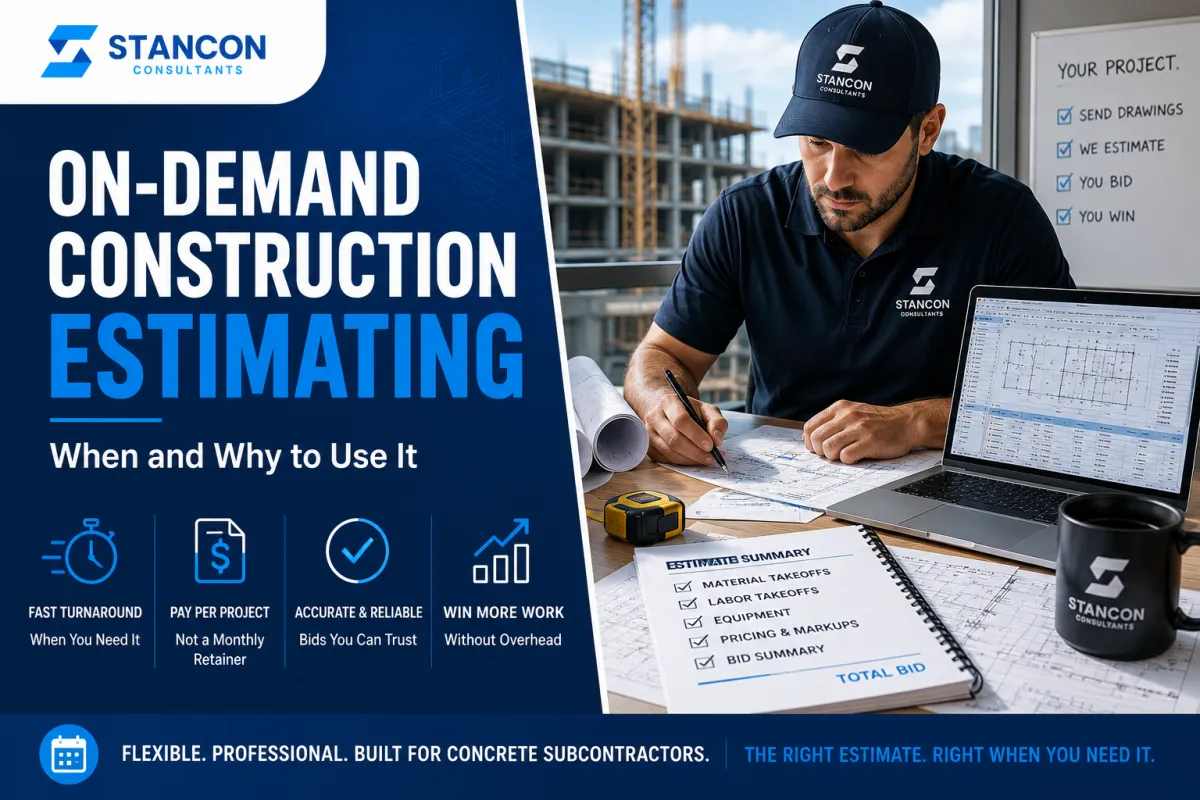
On-Demand Construction Estimating: When and Why to Use It
Not every concrete subcontractor needs a full-time estimator on payroll. Not every one needs an ongoing retainer with an outsourced estimating service either. Sometimes the need is simpler than that: a specific project lands on your desk, the bid window is tight, your internal capacity is maxed out, and you need a clean, accurate number without the overhead of a permanent arrangement.
That's exactly what on-demand construction estimating is designed for. It's per-project estimating support, engaged when you need it and not carried as a fixed cost when you don't. And for a specific type of concrete subcontractor at a specific point in their growth, it's often the most practical and cost-effective move available.
This article breaks down what on-demand estimating actually means, when it makes sense to use it, and when it probably doesn't. If you've been wondering whether fractional estimating plans or a per-project arrangement is the right fit for where you are right now, this is worth reading before you decide. Our concrete estimating services cover both models, so this isn't a pitch for one over the other.
What On-Demand Construction Estimating Actually Means
The term gets used loosely, so it's worth being precise. On-demand estimating, sometimes called per-project estimating, is an arrangement where you engage an estimating service for a single bid or a defined set of bids without committing to an ongoing relationship or monthly retainer. You send the drawings. You get back a detailed estimate. The engagement ends there, unless you choose to send more work.
It's the most flexible model available. No monthly minimum. No long-term contract to negotiate. No onboarding process that takes three weeks before a single takeoff is produced. You need a number, you send the package, you get a deliverable. That simplicity is also the reason it suits certain situations very well and others not at all.
When On-Demand Estimating Makes the Most Sense
Your Bid Volume Is Low but the Stakes Are High
A concrete subcontractor bidding two or three projects a month doesn't have the volume to justify a fractional estimating retainer. But that doesn't mean those two or three bids are low-stakes. If anything, they're higher stakes, because each one represents a larger percentage of the work that's actually going to run through your business that month.
On-demand construction estimating fits this scenario well. You're not paying for capacity you're not using, and you're still getting professional-grade takeoffs and proposal documentation on every bid that matters. The cost structure aligns with the reality of the business rather than forcing a fixed overhead commitment onto a variable activity.
You've Hit a Temporary Capacity Wall
Some of the best use cases for per-project estimating have nothing to do with company size. They're about timing. Your estimator is buried on three competing deadlines. A project you didn't expect just got invited to bid. The GC moved the deadline up by four days and your internal team can't absorb the additional load without something slipping.
On-demand estimating gives you a release valve. Rather than rushing a takeoff and submitting a number you're not confident in, you send the package out and get a professional deliverable back on time. One bad estimate on a concrete project of any real size can cost more than most subcontractors spend on estimating support in an entire year. The capacity gap is temporary. The consequences of a rushed number often aren't.
You Need a Specialist for a Scope Outside Your Lane
Not all concrete work estimating is the same. A subcontractor whose team excels at flatwork and slab-on-grade has a different estimating skill set than what a post-tensioned elevated deck or a tilt-up panel job requires. Sometimes an invitation arrives for a project type you want to pursue but don't have the internal estimating depth to price accurately.
Per-project estimating lets you bring in trade-specific expertise for that scope without committing to an ongoing arrangement that extends beyond the bid. It's essentially renting the right skill set for the right opportunity rather than stretching an internal generalist across something that needs a specialist. And getting the specialty scopes priced right is often exactly what opens the door to larger GC relationships you've been trying to build. Understanding your overall bid strategy before you engage helps you identify which invitations are worth spending this way.
You're Testing Whether Outsourcing Works for Your Business
This one often gets overlooked. On-demand estimating is one of the lowest-risk ways to evaluate whether outsourced estimating is something your operation can actually integrate. You're not locked into a retainer. You're not committing to a relationship before you understand the deliverable quality or how the communication works. You run one project through the service, review what comes back, compare it against your own numbers, and decide whether it's worth continuing.
For concrete subcontractors who are curious about outsourcing but skeptical based on past experience or second-hand stories about estimating services that missed the mark, this is the honest starting point. One project tells you more than any sales conversation.
When On-Demand Estimating Is Probably Not the Right Fit
The flexibility that makes on-demand construction estimating useful in some situations is also what limits it in others.
When your bid volume is high and consistent. If you're regularly bidding eight to fifteen projects a month, per-project pricing adds up quickly and the lack of an ongoing relationship means you're re-onboarding your cost structure, crew setup, and scope preferences on every engagement. The service doesn't build institutional knowledge of your business across individual projects. That knowledge accumulation is one of the main things that makes a longer-term arrangement more valuable over time, and you lose it entirely in a purely transactional model.
When consistency across your bid program matters. A strong outsourcing construction estimating arrangement produces consistent methodology, consistent formatting, and consistent scope language across every submission. On-demand engagements produce consistent quality on individual projects, but there's no institutional continuity tying one bid to the next. GCs who receive multiple proposals from you over time will notice that consistency, or its absence.
When you need preconstruction support beyond the estimate. On-demand estimating delivers a bid. It doesn't deliver addendum follow-up, GC communication support, or proposal writing on an ongoing basis. If those are gaps in your operation, a more structured arrangement, like what's covered in our full breakdown of fractional estimating, probably serves you better than a per-project model.
What On-Demand Estimating Should Actually Deliver
Whether you're using a per-project service once or using it regularly, the standard for what you get back shouldn't change based on the engagement structure. A single project still deserves a complete deliverable.
That means cubic yards broken out by pour and location. Forming labor separated from placement and finishing labor. Material unit pricing with backup. A clear scope breakdown stating what's in and what's excluded. Bid form completion where required. And ideally, proactive communication if the drawings have conflicts, missing details, or addenda that affect the scope.
What it should not deliver is a lump-sum number on a one-page sheet with no backup. That's not an estimate. It's a guess with a dollar sign attached, and it won't hold up when a GC asks you to walk through your scope in a leveling meeting.
The U.S. construction industry spent an estimated $280 billion on the direct and indirect costs of slow or inaccurate payment flows in 2024, a number tied directly to inaccurate initial pricing, missed scope items, and underdocumented bids that create disputes downstream. The estimate is where that risk either gets managed or created. A professional on-demand estimating service manages it. A cheap, underdocumented one creates it.
The Cost Comparison That Matters
Here's a number worth sitting with. According to the Birmingham Group's 2025 Construction Salary Benchmark, senior estimators with multi-trade commercial experience command $125,000 to $160,000 in base salary in competitive U.S. markets, with fully loaded costs frequently running $130,000 to $150,000 annually. On top of that, the average time-to-hire for a senior estimator stretches three to six months in most markets right now.
On-demand estimating sidesteps both problems. You're not carrying a salary through slow periods. You're not waiting three months while invitations pile up. You pay for the estimate when you need it, and the cost of a professionally executed per-project engagement on most commercial concrete bids is a fraction of what a single misbid job costs you in lost margin.
That math doesn't make on-demand estimating the right choice for every concrete subcontractor. But it does make it the right choice for more of them than currently use it.
Frequently Asked Questions
What is on-demand construction estimating?
On-demand construction estimating, also called per-project estimating, is a model where you engage an estimating service for a single bid or defined set of bids without committing to an ongoing retainer. You pay for the work produced rather than for a standing arrangement, which makes it a flexible and cost-effective option for contractors with variable or lower bid volumes.
When should I use on-demand estimating instead of a retainer?
On-demand estimating tends to make the most sense when your bid volume is low, when you've hit a temporary capacity wall internally, when you need specialist expertise for a specific scope type, or when you want to test an outsourced estimating relationship before committing to something longer-term.
Is on-demand concrete estimating worth it for smaller subcontractors?
Often yes. Smaller concrete subcontractors typically don't have the volume to justify a retainer but still need professional-grade bids to compete for the work they want. Per-project pricing means you're only spending when there's a specific opportunity in front of you, which fits the financial reality of a business that's still building its bid pipeline.
What's the difference between on-demand and fractional estimating?
On-demand estimating is transactional: one project, one deliverable, no ongoing relationship. Fractional estimating is a continuous engagement where the service builds institutional knowledge of your business over time and is available on an ongoing basis across your full bid calendar. Fractional arrangements typically serve higher-volume contractors who benefit from consistency and continuity across their full bid program.
What should a professional on-demand estimating deliverable include?
Quantities broken out by pour, location, and scope type. Labor hours separated by activity. Material unit pricing with backup. A clear scope statement covering inclusions and exclusions. Bid form completion where applicable. And proactive communication if the drawing set has conflicts or late addenda that affect the number. A lump-sum total with no documentation behind it is not an acceptable deliverable regardless of how the engagement is structured.
How do I know if my on-demand estimating service is actually good?
Review the deliverable against the drawings yourself before submitting it to a GC. Trace key quantities back to the drawing source. Compare their labor assumptions against your own historical actuals. If something doesn't add up, ask for an explanation. A confident estimating service welcomes that scrutiny. One that gets defensive when you ask questions is telling you something important about the quality of what's behind the number.