
Top 5 Benefits of Outsourcing Construction Estimating for Concrete Subcontractors
When concrete subcontractors reach out to Stancon Consultants for the first time, the stated reason is almost always the same: they don't have enough time. But time is rarely the actual problem.
When you dig beneath the surface, what's really happening is more layered than that. They're receiving more invitations to bid than their preconstruction capacity can handle, so projects are getting declined before anyone's even looked at the drawings. Their relationships with GCs are fraying quietly because they're not showing up consistently at bid time. And the kind of projects they actually want to be chasing, the ones that fit their scope, their crew, and their growth trajectory, keep slipping by because there's no structured process for sourcing and filtering them.
Time is the symptom. Bid capacity, project targeting, and GC relationship management are the actual gaps. And those three things are precisely what outsourcing construction estimating is designed to address when it's set up correctly.
When estimating capacity is thin, a contractor isn't just slow. They're structurally limited in how much work they can chase, and that ceiling is invisible until someone starts counting the invitations that got declined.
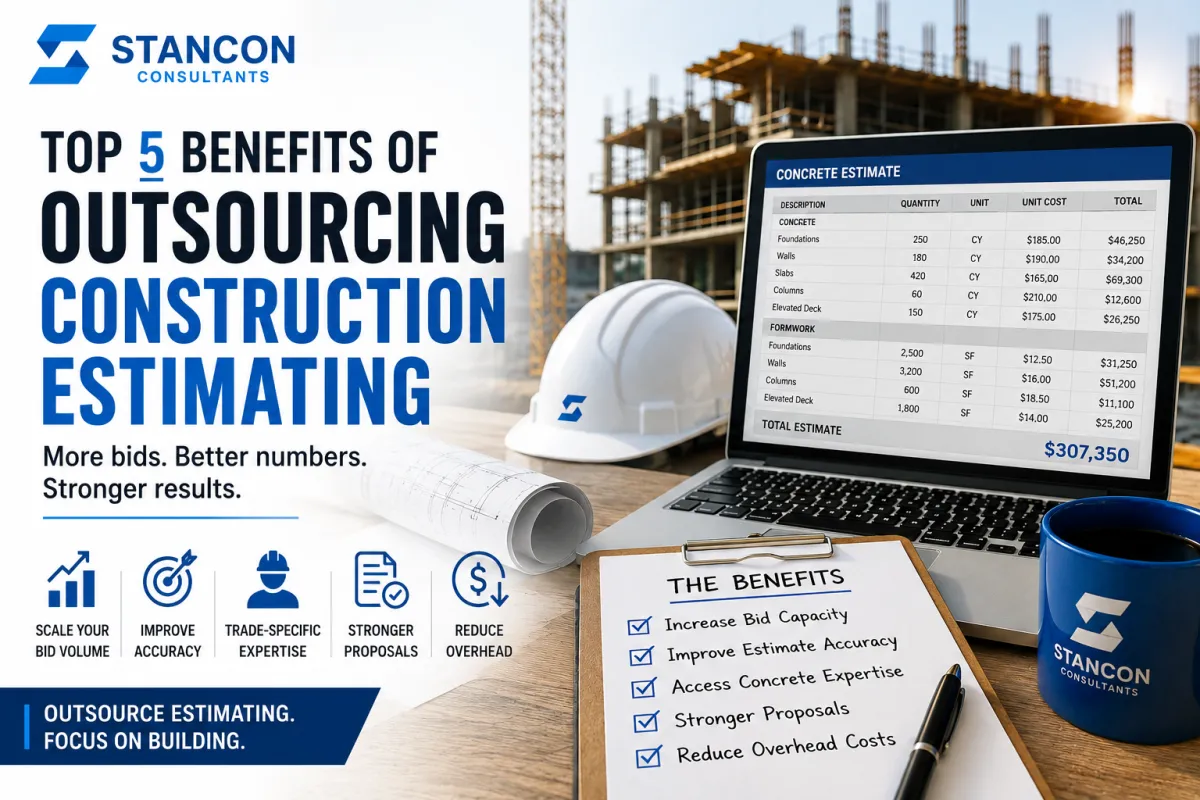
This article breaks down the five benefits concrete subcontractors actually experience when they make the shift.
Benefit 1: You Bid More Work Without Expanding Your Payroll
The most immediate change clients notice when they start outsourcing their estimating is volume. Not marginally more bids. Significantly more. Projects that were previously never being pursued because there wasn't enough internal bandwidth to price them properly start going out the door as clean, competitive submissions. Most of our clients are bidding more work in a single month than they ever managed before, and doing it without adding a single person to their payroll.
This is the structural advantage that outsourcing construction estimating has over the traditional in-house model. You pay only for the estimating services you need, when you need them, rather than maintaining full-time estimating capacity at a fixed cost regardless of how active your bid calendar actually is. When bid season accelerates, the service absorbs the volume. When things slow down, you're not carrying idle overhead. That flexibility alone changes the economics of how a concrete subcontractor pursues work.
But the operational shift is only part of what changes. The subtler benefit is the confidence that comes with it. There's a real difference between a subcontractor who's scrambling to respond to ITBs and one who knows that every opportunity landing in their inbox is going to get a professional, thorough response. That confidence affects how you pursue work, how GCs perceive you over time, and ultimately how competitive your pipeline becomes. Understanding how to pair this capacity with a smarter concrete bid strategy is what turns higher volume into higher wins.
Benefit 2: Your Win Rate Climbs Because Your Submissions Get Stronger
Bidding more is only worthwhile if the quality of what you're submitting is there to support it. Volume without accuracy is just a faster way to lose. So the second benefit, and arguably the more important one, is that outsourced estimating services, when done properly, produce stronger submissions than most concrete subcontractors are able to put together internally under deadline pressure.
Dedicated estimating teams typically produce more consistent, thoroughly documented estimates than internal teams trying to balance estimating with active project management responsibilities.
GCs are evaluating more than price. They're looking at scope clarity, exclusion language, whether your numbers are organized in a way they can actually level quickly, and whether what you've submitted reflects that you read the documents carefully. A well-structured bid from a concrete sub that's done their homework communicates competence before the job has even started. That's worth understanding in the context of what GCs actually want to see in a concrete bid before assuming price is the only variable that matters in an award decision.
Benefit 3: You Get Detail and Accuracy That Rushed Internal Estimating Can't Match
One of the things that genuinely surprises clients when they first work with Stancon Consultants is the depth of the deliverables. They expected a takeoff. What they got was something different: every page of the project specifications had been read in full, every addendum had been tracked and incorporated including the ones that arrived the night before the bid was due, site photos and existing conditions had been reviewed, the bid form had been completed correctly, and a proactive follow-up was waiting in their inbox when a new requirement came in after the drawings were already in progress.
That level of attention is what separates a professional outsourced estimating service from a transactional one. It's also what separates a bid that holds up in scope leveling from one that generates a string of clarification questions from the GC's team. External estimators focus exclusively on cost analysis rather than dividing their attention between site management, field issues, and documentation. That dedicated focus enables contractors to submit competitive bids without sacrificing the margin protection that accurate scope documentation provides.
When the person building your estimate isn't simultaneously managing three active jobs, reviewing submittals, and fielding field calls, the estimate gets the attention it deserves every time.
The worksheets are detailed enough to withstand scrutiny but formatted so your team can review them quickly before submission. Nothing goes to a GC without your sign-off. That should be the standard for every bid. It rarely is when estimating is being squeezed in between everything else a concrete subcontractor is carrying.
Many of the most damaging mistakes in preconstruction aren't about numbers at all. They're process failures, and the bid management errors that quietly hurt your profits are worth understanding before assuming the problem is just capacity.
Benefit 4: Your GC Relationships Strengthen and Your Project Sourcing Gets Smarter
This is the benefit most concrete subcontractors don't anticipate, and for many, it turns out to matter more than any of the others for long-term growth.
The hesitation most contractors have about concrete estimating outsourcing comes from a familiar fear: an outside firm won't understand my pricing, my process, or how I run my business. That's a legitimate concern, because familiarity with how you operate does directly affect the quality of the estimates. But when the relationship is set up correctly, that concern resolves faster than most people expect. And what replaces it isn't just familiarity. It's consistency. You're now showing up at every bid opportunity professionally and on time instead of going quiet when things get heavy internally. GCs notice that. Over time, it changes how they think about you when they're putting together their bid lists.
At Stancon Consultants, our Pipeline Growth Program (PGP) takes this further. Beyond producing the estimate, we handle direct communication with GCs, actively nurture those relationships on your behalf, source project opportunities that align with your crew type and capacity, and follow up on submitted bids. Most concrete subcontractors are leaving significant relationship capital on the table simply because they don't have the bandwidth to tend to it between running jobs and pricing the next round of bids. That gap compounds quietly until a GC you used to work with regularly has replaced you on their list with a sub who shows up more consistently.
Market knowledge developed across multiple contractors and project types gives a professional estimating partner insight into regional competitive positioning that a single in-house estimator working only within your company simply doesn't accumulate at the same rate. That broader view, applied specifically to your scope and your target GCs, is what turns outsourced estimating from a capacity solution into a genuine business development tool.
Benefit 5: The Cost Pays for Itself Faster Than Most Contractors Expect
Most concrete subcontractors who are on the fence about outsourcing their estimating haven't run the full cost comparison against the alternative. When they do, the numbers tend to land differently than expected.
Commercial construction estimators with meaningful experience command between $75,000 and $110,000 in base salary. Once payroll taxes, benefits, software licenses, paid time off, and onboarding costs are factored in, a mid-level estimator who looks like a $90,000 hire frequently runs $130,000 to $150,000 in total annual expenditure. The average time-to-hire for a senior estimator in competitive markets stretches three to six months, which means you're turning down bid opportunities and losing momentum for half a year before the person is even in the seat.
Outsourcing construction estimating through a service like Stancon Consultants operates on flexible, hour-based pricing tiers. You're paying for work being done, not for capacity sitting idle between bid cycles. The pricing scales with your volume. For many concrete subcontractors, the value of one profitable project secured with stronger estimating support can outweigh several months of outsourced estimating costs.
That recovery happens faster than most contractors expect because the math compounds in their favor. The ITBs that were previously passed over are now becoming competitive submissions. Win rates improve because every estimate is more accurate, complete, and professionally presented. At the same time, GC relationships stay active because you're consistently responding to opportunities instead of going quiet when workloads increase. And unlike a full-time hire, outsourced estimating gives you the flexibility to scale support up or down without carrying fixed overhead through slower periods.
If you find yourself needing ongoing estimating capacity rather than occasional project-by-project support, fractional estimating may be a better fit. Our fractional estimating plans explain how that model works and how it helps concrete subcontractors build a dedicated extension of their preconstruction team.
The One Thing to Get Right Before You Start
The most common concern we hear from concrete subcontractors considering outsourced estimating is that an outside firm won't understand their pricing or how they operate internally. It points to a real failure mode in estimating partnerships that aren't set up correctly, so it's worth addressing directly rather than dismissing it.
The answer isn't to find a service that promises they'll figure it out. It's to find one that asks the right questions before they touch a single drawing. Your labor rates, crew structure, markup model, union or open shop status, and typical scope breakdown all need to be understood before the estimating work begins. When that foundation is established properly, the familiarity concern tends to disappear within the first few submissions. The clients who were most skeptical going in are consistently the ones telling us months later that they can't imagine going back to doing it internally.
For a full framework on how to evaluate and select the right estimating partner for your concrete operation, the guide to choosing the right estimating service covers the complete decision process. And if you want to know what separates a service worth hiring from one that will cost you more than it saves, start with the red flags to watch for when hiring an estimating company before you sign anything.
Frequently Asked Questions
Does outsourcing construction estimating mean losing control of my bids?
Not when the relationship is structured correctly. A good outsourced estimating partner keeps you informed throughout the process, flags scope issues before they become problems, and delivers completed estimates that your team reviews before anything goes to a GC. You're delegating the mechanical takeoff and documentation work. The final judgment on pricing and strategy stays with you.
How does outsourced estimating work for a concrete subcontractor specifically?
You provide drawings, cost structure details, and scope parameters. The estimating service reads every project file in full, including specs, addenda, bid forms, and site photos. They produce a detailed takeoff and priced estimate formatted for your review, and a properly structured service follows up proactively when addenda or new requirements come in after handover. Nothing goes to a GC without your approval.
Will an outsourced estimator understand my market and labor rates?
A qualified one will collect that information before starting. Your actual labor rates, crew composition, union or open shop status, and regional cost factors all need to be established upfront. If a provider isn't asking those questions before the first estimate, they're working off generic assumptions that won't reflect how you actually run jobs.
Is outsourcing construction estimating worth it for a smaller concrete subcontractor?
Often yes, and smaller operations tend to benefit most clearly. Without the overhead to justify a full-time estimating hire, outsourcing gives you access to professional-grade preconstruction support on a cost structure that scales with your actual bid volume rather than sitting as a fixed expense.
How quickly does the cost of outsourcing construction estimating pay off?
For most concrete subcontractors, the cost of several months of outsourced estimating support is recovered on the first project won with that support in place. The combination of higher bid volume, stronger submissions, and improved win rate means the return tends to show up faster than most contractors expect going in.