
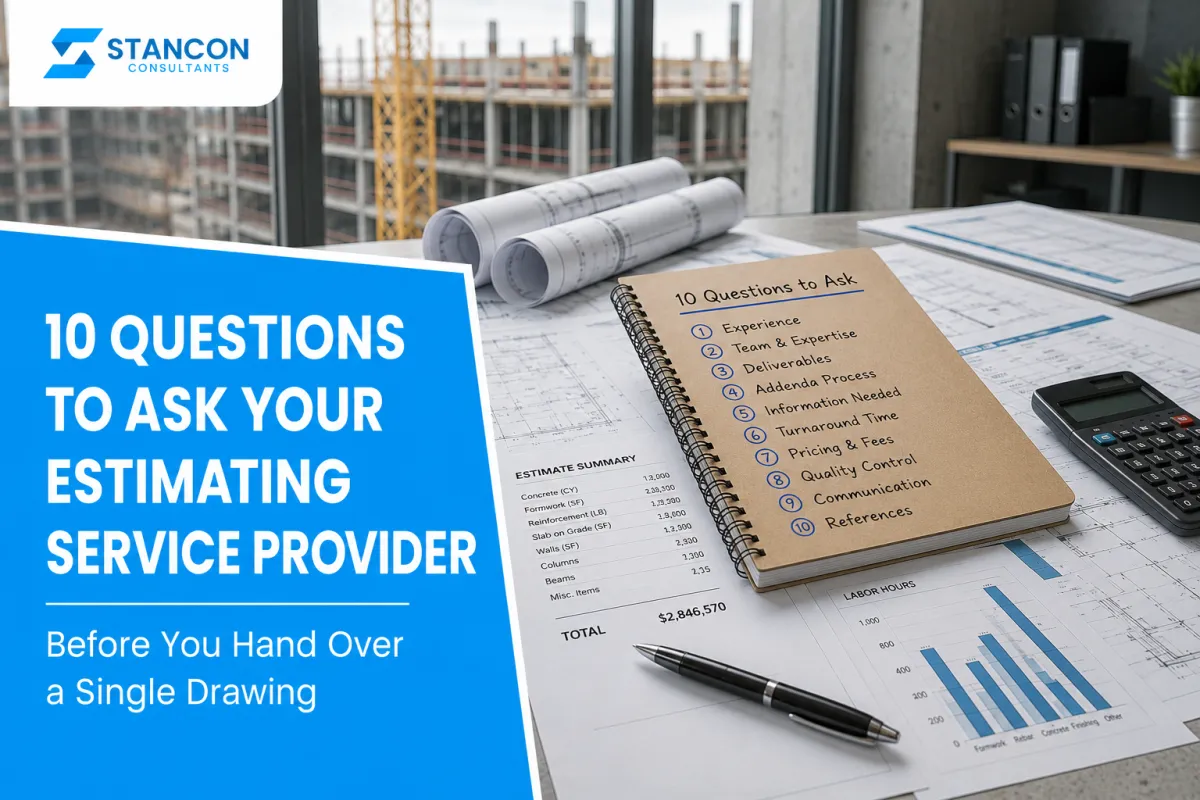
10 Questions to Ask Your Estimating Service Provider Before You Hand Over a Single Drawing
Most concrete subcontractors don't vet their estimating partners nearly as hard as they vet their forming crews or their ready-mix suppliers. And that's a problem.
Your estimating service provider isn't just a vendor. They're touching the most critical number in your business: the bid. Get it right and you're winning commercial work at margin. Get it wrong and you're either sitting on the bench because your number came in too high, or you're on the job losing money on every pour. Research consistently shows that estimating errors account for 32% of all construction cost overruns, and the consequences don't stay on paper. They follow you into the field.
So before you send over a single drawing set to a construction estimating service provider, here are the ten questions to ask, and what a solid answer actually looks like.
1. "Have you estimated commercial concrete scopes specifically?"
This is the first question. Not "how long have you been in business" or "what's your turnaround time." Those matter, but they're secondary to whether this company actually understands your trade.
Commercial concrete work isn't interchangeable with MEP, framing, or sitework. Cast-in-place structures, post-tensioned decks, tilt-up panels, elevated slabs: the forming systems are different, the labor productivity assumptions are different, and the way you sequence pours affects your total cost in ways that a generalist estimating company won't always catch. Push for specific examples. Ask what type of concrete scope they've priced in the last 12 months and at what contract value. Their answer will tell you everything you need to know.
2. "Who specifically will be working on my estimate?"
This question catches a lot of companies off guard, and it should. Many outsourced commercial concrete estimating services sell you on the firm's overall experience and then assign your project to whoever's available in the queue that week.
The experience and skill of the individual estimators performing the work are just as critical as the company's overall credentials. A company with 20 years in business doesn't mean much if the person handling your package has two years of experience and has never touched a concrete scope. You want to know who's assigned to your project, what their trade background is, and whether they'll stay on your account consistently. If they can't tell you that before work starts, the answer is probably "whoever's free."
3. "What does your deliverable actually look like?"
Don't assume. Ask to see a sample before you commit to anything.
A properly structured concrete estimate should show cubic yards broken out by pour location, square footage of formwork by system type, labor hours with crew composition assumptions, material unit pricing with backup, and a clear scope breakdown of what's in and what's excluded. That's what a solid deliverable from a construction estimating partner looks like. It should be something your PM can open, follow line by line, and use to build a cost-to-complete if conditions change mid-job.
If their sample is a one-page summary with a total at the bottom, that's a number, not an estimate. And a number without documentation isn't something you can defend in a scope leveling meeting with a GC who's already been through three rounds of bid analysis.
4. "How do you handle addenda and mid-estimate plan revisions?"
This is the question most contractors forget to ask until it's already cost them.
Addenda are a fact of life in commercial concrete bidding. Drawings change, structural engineers revise slab specifications, and GCs routinely issue two or three addenda in the final 48 hours before bid day.
According to the World Bank's Global Construction Outlook, construction cost overruns average 27% globally, with inaccurate initial estimates and poor cost monitoring listed as the primary drivers. A lot of that inaccuracy starts with plans that changed and estimates that didn't.
Ask how they track and log revisions in a live estimate. Ask who's responsible for flagging addenda. Ask whether they'll proactively notify you if a plan change materially shifts your scope or cost. A company that's handled volume bids at pace will have a real answer. One that hasn't will get vague fast.
5. "What information do you need from us before you start?"
A construction estimating company that dives into your drawings without asking you anything isn't being efficient. They're making assumptions, and those assumptions become your problem when the numbers are wrong.
A qualified estimating service needs to know your labor rate and whether it's union or open shop. They need to know if you self-perform your forming crews or sub that work out. They need your equipment burden, your overhead structure, your target markup, and whether the project carries prevailing wage requirements.
They also need clarity on which scopes you're covering and which you're walking away from. If your outsourced estimating partner organizes their takeoff using a different cost-coding structure than you use internally, you could end up doing the reorganization work yourself after every single deliverable.
Ask upfront whether they'll work within your CSI divisions and cost codes, or whether you're the one cleaning that up after the fact.
6. "What's your realistic turnaround time for a project of this size?"
Realistic is the operative word.
Bid windows in commercial concrete can be punishing. Two weeks from invite-to-bid on a multi-million dollar package isn't unusual, and late addenda sometimes don't pause the clock. You need an estimating service provider that gives you an honest timeline based on the actual drawing set in front of them, not a sales pitch they'll walk back once work starts.
Ask how they determine turnaround time. Ask what happens when a project scope is larger or more complex than it looked in the initial review.
A credible concrete estimating company will quote you a delivery window after reviewing the drawings, not before. If they're promising 24 hours on a complex cast-in-place package without seeing a single sheet, that number is designed to close you, not deliver to you.
7. "How do you price labor, and how current is your data?"
Labor is typically the biggest variable in any commercial concrete estimate, and it's the one that moves most. Crew productivity rates, wage rates, and burden factors vary significantly by region, project type, and union status.
A company working off national averages or a database that hasn't been updated in 18 months is going to hand you a number that doesn't reflect your market.
Ask where their labor pricing data comes from. Ask how frequently it's updated. Ask whether their rates are adjusted for your specific region and crew setup. A concrete estimating service that's doing this seriously will answer those questions without hesitation. One working off stale unit data won't want to get into specifics.
8. "What software do you use for takeoffs, and can I see the file?"
This isn't a brand loyalty test. It's a transparency check.
Professional estimating firms that handle concrete and structural scopes typically work in tools like Bluebeam, PlanSwift, Procore or On-Screen Takeoff for quantity takeoffs. What matters isn't which platform they're on. It's whether their output integrates with how you work, and whether they'll share the actual takeoff file, not just the formatted report.
Being able to trace a cubic yard number back to the drawing is a basic quality control step. A confident estimating partner won't have any issue with you doing it. One that hesitates when you ask for the file should make you wonder what's in there.
9. "What happens when there's an error in the estimate?"
This question reveals a company's character faster than any other.
Mistakes happen in estimating. A missed scope item, a transposed unit price, a forming system that was misread on the drawings: these things occur even with experienced estimators. The question isn't whether an error will ever show up. The question is how they respond when one does.
A partner worth keeping corrects mistakes without charging you extra, communicates as soon as an issue surfaces, and works with you to understand the impact on your bid position before it costs you a job or a margin.
A company that points to contract language the moment accountability becomes inconvenient is one you'll regret trusting with a live opportunity. Read the service agreement in full before you sign it. All of it. And if the contract structure looks more like a liability shield than a service agreement, trust that read.
For a closer look at how the contract conversation fits into the broader vetting process, the warning signs to watch before hiring are worth revisiting before you get to the signature stage.
10. "Can you give me references from concrete subcontractors specifically?"
Not GCs. Not residential builders. Not MEP subs. Commercial concrete subcontractors doing the type and scale of work you're pursuing.
If this company has done solid work for people in your position, they can name them. Two or three references is a completely reasonable ask. If they stall, deflect, or offer references from unrelated trades, you already have your answer. You don't need a long explanation for why that matters. It just does.
What to Do With the Answers
These questions aren't a test designed to trip anyone up. They're a baseline. Any estimating service that genuinely knows what they're doing will walk through all ten of them clearly, confidently, and without getting defensive. The ones that get vague or pivot to sales language under straightforward questioning are telling you something important before you've spent a dollar with them.
Choosing the right concrete estimating service is just as important as hiring a good estimator or key subcontractor. One bad estimate can put your company's financial position at serious risk. That's not an exaggeration. It's why this conversation deserves more than 15 minutes on a call.
When you're ready to go deeper on the full decision framework, including how to structure the relationship once you've chosen a partner and what to put in writing before work starts, the complete guide to choosing the right estimating service covers all of it.
At Stancon Consultants, we work exclusively with commercial concrete subcontractors, and we're comfortable answering every one of these questions before you commit to anything. Start that conversation here.
Frequently Asked Questions
Should I talk to more than one estimating service before deciding?
Yes, talk to at least two or three. Not because you need a formal RFP, but because the comparison is genuinely useful. You'll understand what good looks like a lot faster once you've heard different answers to the same questions.
Is it reasonable to ask for a sample estimate before committing?
Completely. Most credible construction estimating services will share a redacted sample from a past project. It gives you a real look at the format, detail level, and how they organize their takeoffs. If they won't share one, note that.
Should I run a trial project before committing to a service provider?
If your timeline allows it, yes. A smaller, lower-stakes bid is a practical way to evaluate turnaround, communication, and deliverable quality before you hand them your most important opportunities.
What's the most important question on this list?
Question three: what does your deliverable actually look like? If their output isn't detailed enough to review, verify, and defend in a scope meeting, nothing else about the relationship will make up for that.
How do I know if a concrete estimating service is pricing labor correctly for my market?
Ask for the source of their labor data and when it was last updated. Then compare their unit rates against what you're actually paying your crews. That gap will tell you quickly whether their numbers live in your market or in a generic database.
Should an estimating company understand CSI divisions and cost codes?
Yes. A qualified commercial concrete estimating company should be able to organize takeoffs around your CSI structure and internal cost codes. If they can't, your PM team ends up spending additional time reorganizing estimates before the project even starts.