
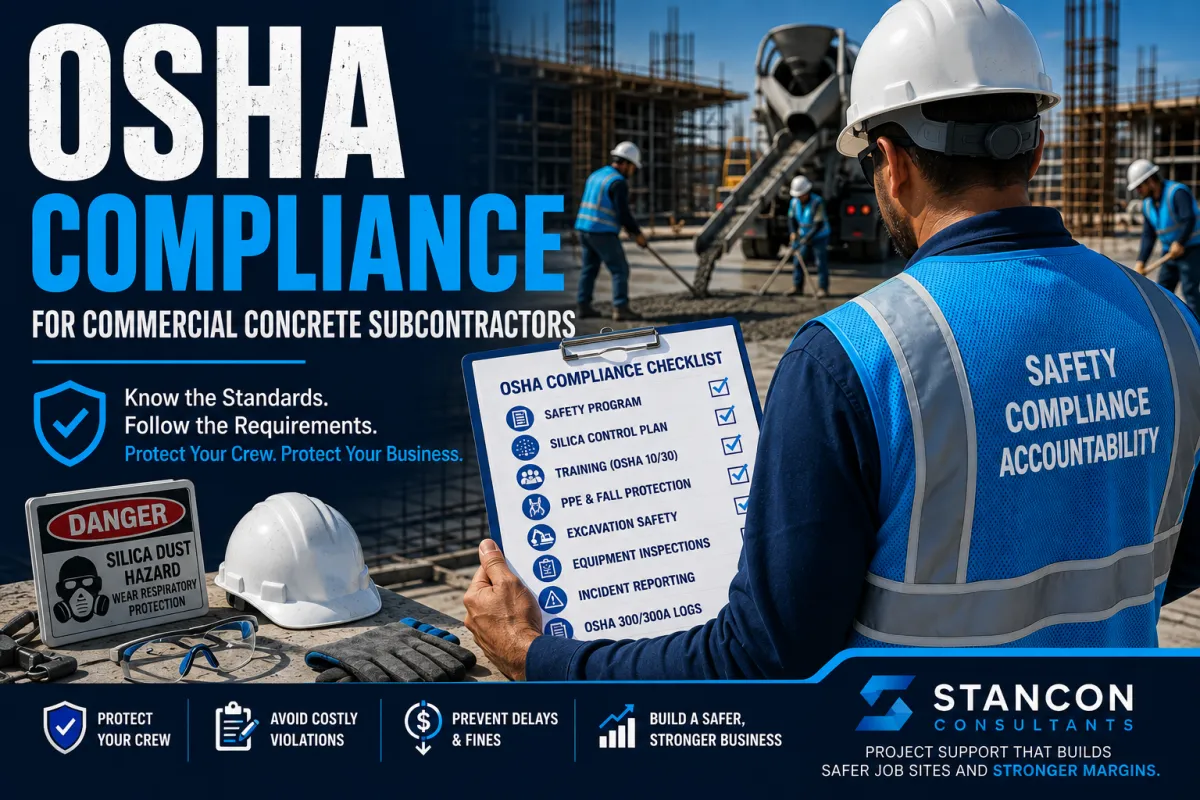
OSHA Compliance for Commercial Concrete Subcontractors: What You Need to Know
OSHA compliance in commercial concrete work isn't a back-office concern. It's a field reality. The hazards that show up on a concrete job site, silica dust from cutting and grinding, excavation cave-ins, falls from elevated work, struck-by incidents from equipment and concrete trucks, are among the most consistently cited and most seriously penalized violations in the construction industry. And for a commercial concrete subcontractor operating under a GC's site safety program, understanding what OSHA requires of you specifically, not just what the GC's safety manual says, is the difference between a program that actually protects your crew and one that looks functional until an inspector arrives.
Joseph Toppi built a commercial concrete operation to 46 employees before transitioning to consulting. Running a crew of that size on commercial and industrial jobs, the safety exposure is real and constant. Payroll, equipment, production targets, and GC relationships all compete for attention. But an OSHA violation, depending on its severity, can generate fines that rival months of labor cost, trigger stop-work orders that idle your crew on the GC's dime, and create liability exposure that follows the company long after the citation is resolved.
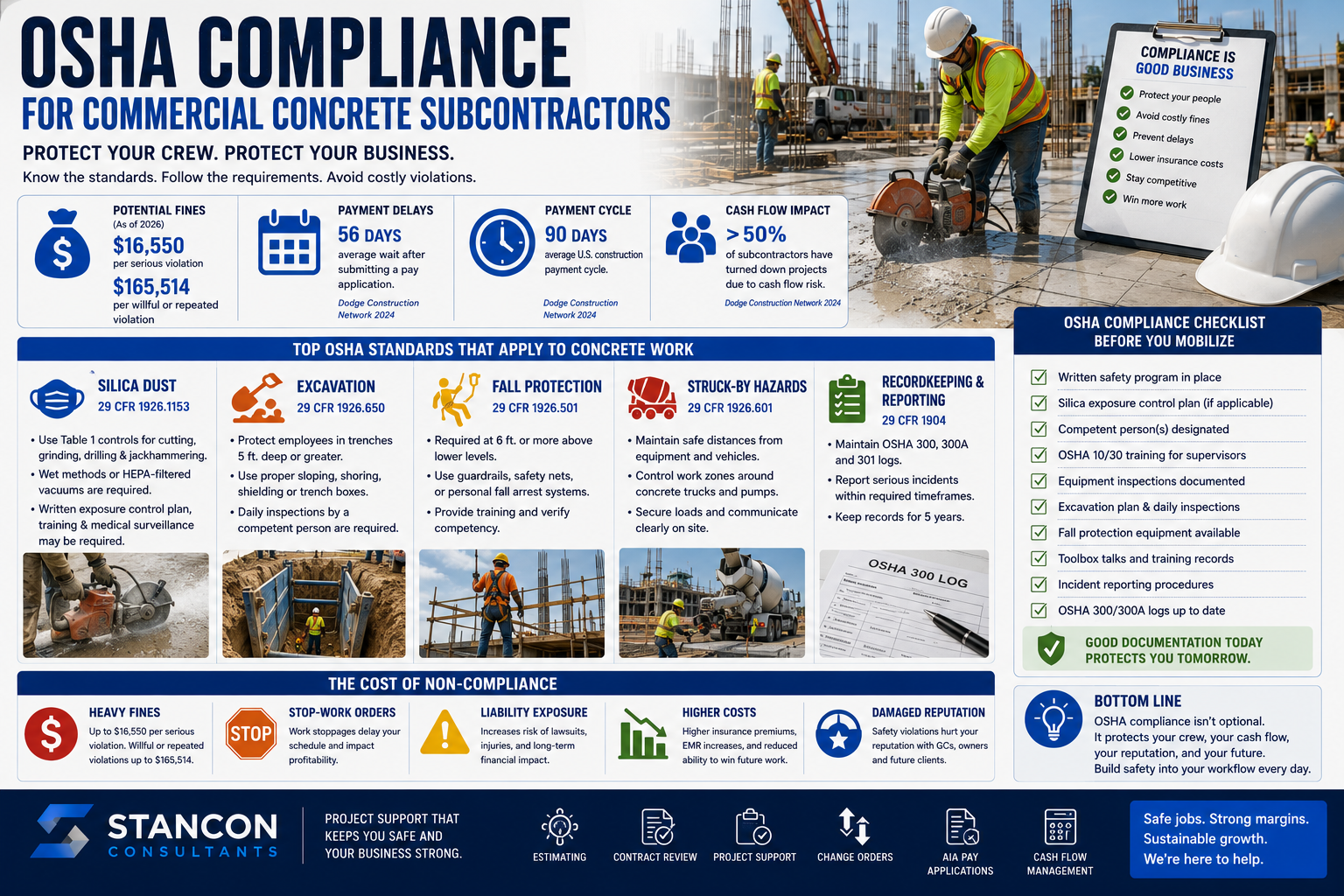
As of 2026, OSHA can fine up to $16,550 per serious violation and up to $165,514 per willful or repeated violation. Those aren't theoretical numbers. In 2025, Sound Construction Inc., a concrete and earthwork contractor, was hit with $1.22 million in proposed penalties following an inspection. Single inspections routinely produce multiple citations across related standards, which means the cost of non-compliance compounds quickly on a single job. This article covers the OSHA standards that apply most directly to commercial concrete subcontractor operations and what you need to have in place to stay protected.
How OSHA Authority Works for Subcontractors
Before getting into the specific standards, it's worth being clear on how OSHA jurisdiction applies to concrete subcontractors specifically, because the relationship between GC responsibility and subcontractor responsibility is one that many subs misunderstand.
Under OSHA's Multi-Employer Citation Policy (CPL 02-00-124), general contractors are classified as controlling employers on most job sites, which means OSHA can cite the GC for hazards created by subcontractors on their site. But that citation authority doesn't replace your own. As a subcontractor, you're directly responsible for the safety of your own employees regardless of what the GC's safety program says. The GC being cited doesn't protect you from being cited simultaneously for the same hazard.
This distinction matters for two reasons. First, your subcontract almost certainly includes safety compliance language that requires you to follow OSHA standards and the GC's site safety plan, and to indemnify the GC for violations arising from your work. Understanding that language before you sign is part of the subcontract review process that protects your business before the job starts. Second, the concrete-specific hazards covered below are your responsibility to manage regardless of whether the GC is watching. An OSHA inspector on site will look at your crew's work practices, your equipment, and your documentation, not just the GC's safety binder.
Silica Dust: The Most Significant Concrete-Specific OSHA Standard
Silica is the hazard most uniquely associated with commercial concrete work, and 29 CFR 1926.1153 is the standard every concrete subcontractor needs to understand thoroughly. Respirable crystalline silica is generated any time concrete is cut, ground, drilled, jackhammered, or otherwise disturbed. It's invisible, it accumulates in the lungs without immediate symptoms, and it causes silicosis, lung cancer, and other serious diseases that develop over years of repeated exposure.
The standard establishes a permissible exposure limit of 50 micrograms per cubic meter as an 8-hour time-weighted average, and an action level of 25 micrograms per cubic meter. But most concrete subcontractors don't comply through air monitoring. They comply through Table 1, which lists 18 common construction tasks, including concrete sawing, grinding, drilling, and jackhammering, paired with specific engineering controls and work practices for each. Contractors who fully and properly implement the Table 1 controls don't need to conduct air monitoring or separately comply with the PEL. That's the practical compliance path for most commercial concrete operations.
What Table 1 compliance requires in practice varies by task. Cutting concrete with a walk-behind saw requires a wet cutting method or a vacuum system with a HEPA filter. Using a handheld grinder on concrete requires water delivery to wet the cutting surface or a shroud and HEPA-filtered vacuum. Jackhammering requires water spraying or a HEPA-filtered vacuum attached to the tool. The controls are specific to the task and the equipment type. Knowing which controls apply to your specific operations before the work starts, not after an inspection, is the standard.
Beyond the engineering controls, the standard requires a written exposure control plan that identifies tasks involving silica exposure and the controls used for each, a designated competent person to implement and oversee the plan, medical surveillance for employees who are required to use respirators 30 or more days per year, and training for all employees who may be exposed. OSHA typically cites silica violations in bundles across exposure controls, written plan, medical surveillance, and training, which means a single inspection can produce four or more citations on the same underlying deficiency.
Excavation and Trenching: The Standard With the Highest Fatality Rate
For concrete subcontractors doing foundation work, footings, or any underground scope, 29 CFR 1926 Subpart P is the standard governing excavation and trenching safety. Excavation collapses are among the most consistently fatal incidents in construction, and OSHA enforces this standard aggressively through a National Emphasis Program on Trenching and Excavation.
The requirements are straightforward in principle but require active management in the field. Any excavation five feet or deeper requires a protective system, either sloping and benching the excavation walls to a stable angle, using a trench box or shielding system, or shoring the excavation walls. Excavations four feet or deeper require a ladder or other safe means of egress every 25 feet. A competent person must classify the soil type before any protective system is selected, because the required slope ratio and shoring specifications depend on whether the soil is Type A, Type B, or Type C.
The competent person requirement here is specific and meaningful. The person classifying soil and overseeing the excavation must have training and the authority to take corrective action. On a concrete job where your crew is digging footings and the foreman doesn't have documented competent person training for excavation, you're exposed. That's a citation waiting to happen on any project where an inspector walks the site.
Daily inspection of excavations by the competent person is required before crew entry and after any event that could change conditions, including rain, vibration from nearby equipment, or any indication of soil movement. Documenting those inspections protects you both from regulatory penalties and from liability in the event of an incident.
Fall Protection: The Most Cited Standard in Construction
29 CFR 1926 Subpart M covers fall protection and is consistently the most cited OSHA standard across all of construction. For concrete subcontractors, fall protection exposure exists on elevated formwork, on the edges of elevated slabs before guardrails are installed, on scaffolding used for wall forming, and anywhere your crew is working at heights of six feet or more above a lower level.
The standard requires fall protection at six feet for most construction activities. Acceptable methods include guardrail systems, safety net systems, and personal fall arrest systems. For concrete subcontractors working on elevated decks or in areas where conventional fall protection isn't feasible, a written fall protection plan prepared by a qualified person may be required.
The most common fall protection citations on concrete jobs involve employees working on the edges of elevated slabs or on formwork without adequate fall protection in place, and inadequate or improperly installed guardrail systems. Both are preventable with planning that happens before the crew is in the field, not after someone is already working at height.
Struck-By Hazards: Concrete Trucks, Formwork, and Equipment
Struck-by incidents are the second most common cause of construction fatalities, and on a commercial concrete job site, the hazard sources are specific. Concrete truck chutes and pump hoses under pressure, formwork panels being moved by equipment, rebar bundles being lifted by crane or forklift, and vehicle traffic in tight site conditions all create struck-by exposure that requires active management.
29 CFR 1926 Subpart G and the general duty clause both apply to struck-by hazards where no specific standard addresses the exact scenario. High-visibility vests are required for anyone working in an area where they could be struck by equipment. Spotters are required for equipment operating in areas with limited visibility. Exclusion zones around crane lifts and equipment moves are a basic site management requirement on any project where concrete is being placed by pump or crane bucket.
For concrete subcontractors managing their own crew on a GC's site, these requirements don't go away because the GC's superintendent is also on site. Your foreman is responsible for your crew's compliance within your scope. Knowing what the site-specific hazards are on each project and briefing your crew before they start is part of the pre-task planning discipline that OSHA expects and that GCs increasingly require documentation of before they allow subs to mobilize.
What OSHA Compliance Documentation You Need to Have
This is the part of OSHA compliance that concrete subcontractors most consistently underprepare. The standards require not just safe practices in the field but documented evidence that those practices are in place, that training has been conducted, and that required plans and programs exist in writing.
The baseline documentation a commercial concrete subcontractor should have in place before mobilizing on any commercial project includes a written safety and health program covering your scope-specific hazards, a written silica exposure control plan naming a competent person and identifying controls by task, documented OSHA 10 or OSHA 30 training cards for supervisory personnel, competent person documentation for excavation and fall protection, equipment inspection records, and OSHA 300 and 300A logs maintained and current.
GCs are increasingly requiring this documentation as part of prequalification before a subcontract is awarded. An incomplete prequalification package can cost you an invitation to bid before your price is ever reviewed. And if OSHA conducts an inspection on a project where you're working, the inspector will ask for documentation of your safety program, your silica plan, and your training records. Not having them in hand is itself a citation.
The risk management and project documentation support that protects concrete subcontractors on commercial projects includes understanding what documentation you're required to maintain and ensuring it's current before the job starts. OSHA compliance isn't separate from the broader project support discipline of managing documentation throughout the life of a commercial concrete job.
The Connection Between OSHA Compliance and Your Bottom Line
OSHA violations affect more than the fine amount on the citation. A stop-work order idles your crew while the GC's schedule keeps running, and the cost of idle time on a concrete crew is real and immediate. A serious injury on site generates workers' compensation claims that affect your Experience Modification Rate, which in turn affects your insurance premiums for years. A high EMR makes you less competitive on prequalification and limits which GCs will invite you to bid.
And the financial exposure from a significant OSHA penalty has the same effect on cash flow as a major payment delay. A $100,000 fine on a business doing $3 million in revenue is a number that shows up in your financial picture in a way that cash flow management on concrete jobs can't easily absorb unless reserves are in place. Prevention, in the form of a functioning safety program and documented compliance, costs a fraction of what enforcement costs after the fact.
The business case for OSHA compliance is straightforward: it's cheaper than the alternative. And for commercial concrete subcontractors who want to build lasting relationships with GCs who award quality work at fair margins, a clean safety record and a professional safety program are part of what separates a credible subcontractor from one who gets removed from bid lists after a preventable incident.
Stancon Consultants' broader business advisory work with commercial concrete subcontractors includes guidance on the operational systems, safety programs, employee handbooks, and documentation infrastructure that support a professional, sustainable concrete operation. If you want to understand how that fits alongside our estimating and project support services, that's a useful conversation to start.