
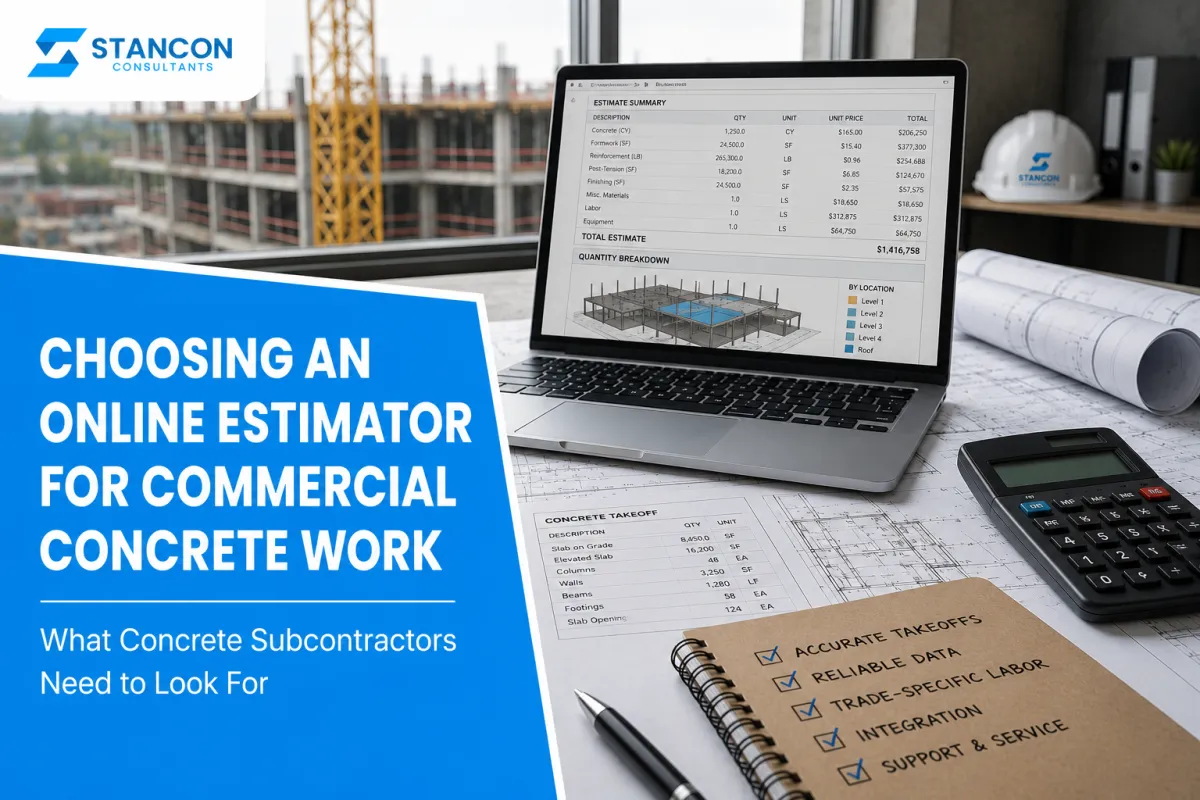
Choosing an Online Estimator: What Concrete Subcontractors Need to Look For
The market for online construction estimating tools has exploded. Type "online estimator" into a search engine and you'll get dozens of platforms promising faster bids, tighter numbers, and more work won. Some of those promises are real. Some aren't. And for a commercial concrete subcontractor, the gap between a tool that actually fits your scope and one that doesn't can show up as a lost job, or worse, a job won at the wrong number.
Before you commit to any online concrete estimator, whether that's a software platform your team runs internally or an outsourced estimating service handling your takeoffs remotely, here's what to actually look for.
First, Know What You're Actually Choosing Between
"Online estimator" isn't a single thing. It covers two fairly different models, and they're not always interchangeable.
The first is estimating software: a cloud-based platform your team uses to produce takeoffs and price bids in-house. Tools like STACK, Bluebeam, PlanSwift, and On-Screen Takeoff fall into this category. You're buying access to the platform and doing the estimating work yourself.
The second is an online estimating service: a company you send drawings to, and they produce the estimate and hand it back to you. This is outsourced estimating delivered through a digital workflow; no in-person meeting required.
Both can work well for commercial concrete subcontractors. Both can also go sideways quickly if you choose the wrong fit. The criteria for evaluating each overlap more than you'd think, so it's worth understanding what good looks like before you make a call.
Concrete-Specific Capability Is Non-Negotiable
This is where most contractors make the first mistake. They find a well-reviewed online estimating tool, see that it covers "commercial construction," and assume that includes their scope. It often doesn't, not meaningfully.
Commercial concrete work involves forming systems, rebar and post-tension layouts, pour sequencing, slab thickness variations, finishing specs, and labor productivity assumptions that are trade-specific. A general construction estimator, software or human, that doesn't have those parameters built in is going to produce a number that looks complete on paper and falls apart under scrutiny.
General estimating software provides basic calculation tools but lacks the specialized databases and trade-specific features needed for concrete construction. Concrete-specific tools include specialized databases for concrete materials, rebar configurations, formwork systems, and trade-specific labor rates that general software simply can't replicate.
The same principle applies to estimating services. If you're evaluating an online concrete estimator, ask directly what concrete scopes they've handled, what forming systems they're familiar with, and whether their labor unit database is built for your trade. If the answer is vague, keep looking.
The Quality of the Labor Database Determines the Quality of a Concrete Estimate
Here's the thing most platform demos won't lead with: the estimate is only as good as the data behind it.
Labor is typically one of the highest and most variable costs in a commercial concrete bid. Crew productivity on flatwork is different from elevated deck work. Forming labor on a jump-form structural core is different from conventional wall forming. Union rates differ from open shop. Regional burden factors differ by market. An online estimating tool or service that uses generic national labor unit data, or worse, data that hasn't been refreshed in 18 months, will produce numbers that don't reflect your actual cost structure.
Problems with infrequent database updates can result in an outdated pricing database, leading to unreliable estimates that leave money on the table. When you're evaluating any online concrete estimator, ask how often their labor and material data is updated, how it's sourced, and whether it's adjustable for your specific region and crew setup. A platform or service that can't answer those questions specifically is working off stale numbers.
Concrete Takeoff Detail and Output Format Have to Match How You Work
A concrete takeoff that can't be traced back to the drawings isn't a takeoff. It's a summary. And a summary isn't something you can use to review your own number, respond to a GC's scope leveling questions, or build a cost-to-complete when conditions change mid-job.
Whether you're looking at estimating software or an online service, ask what the actual deliverable looks like.
For software: does it break quantities out by pour, by location, by system type? Can you export in a format that maps to your cost codes?
For a service: do they hand you the takeoff file, or just a formatted report? Can you open the model and trace a cubic yard figure back to the drawing it came from?
This matters more than most contractors realize until they're in a scope meeting with a GC and can't quickly answer a specific question about Level 3 flatwork. The ability to navigate your own estimate quickly is a competitive advantage. Make sure whatever tool or service you're using actually supports it.
Concrete Estimating Turnaround Time Has to Be Realistic
Fractional estimating services that are overloaded with projects can miss bid deadlines, making their backlog your problem when your bid date doesn't move. The same issue shows up with software: a platform that's slow, glitchy, or requires significant manual cleanup before it's usable eats up time you don't have.
Ask about a realistic turnaround. For a service: what's the actual delivery window on a complex cast-in-place package? What happens when addenda drop two days before bid day?
For software: how long does a typical concrete takeoff take in the platform once your team is trained? How does it handle mid-estimate plan revisions?
Any online concrete estimating tool that can't give you specific, honest answers to those questions before you commit to it is probably going to disappoint you on a live bid.
Integration Matters More Than Features
The most common mistake contractors make when choosing estimating software is buying for features they'll never use. The second most common mistake is buying a platform that doesn't connect to anything else they're already running.
Research from FMI and PlanGrid found that construction professionals spend more than 14 hours per week dealing with avoidable rework, poor project data, and workflow inefficiencies.
Most failed software implementations trace back to integration gaps and adoption friction, not technical capability. If your online estimator can't export into your accounting system, doesn't map to your CSI cost code structure, or requires your team to reformat every takeoff before it's usable, you've added work rather than removed it.
Before you commit to any platform, run a test with a real past project. Import the drawings, run the takeoff, export the output, and see how much cleanup it requires before it's actually usable. That process will tell you more than any demo.
For Online Services: The Human Behind the Estimate Still Matters
Software is a tool. An online estimating service is a relationship, and the quality of that relationship comes down to who's actually doing the work.
The experience and skill of the individual estimators doing the work are just as important as the company's overall reputation. An online service that assigns your commercial concrete package to a generalist estimator with limited trade experience will produce a weaker number than one that keeps a concrete specialist on your account consistently.
When you're vetting an online concrete estimating service, ask who specifically handles your work, what their trade background is, and whether you'll have consistent access to the same estimator across projects. If they can't answer that, the model probably isn't built around quality control. It's built around volume, and your job is just another ticket in the queue.
If you want a checklist of everything to ask before hiring, the 10 questions to put to any estimating provider are worth working through before you sign anything.
What the Price Tag Actually Tells You
Cost matters, but it's not the first filter.
Construction estimating software is typically priced per user per month, starting around $275 for basic functionality, with mid-tier platforms running around $650 for teams of six to ten users. For online services, pricing is usually per project based on scope and drawing set complexity.
The question isn't whether a tool is cheap or expensive. It's whether the cost is justified by the accuracy and time savings it actually delivers. An online estimating service that charges more per project but produces numbers you can defend without cleanup is cheaper in practice than one that saves you $200 and costs you three hours of rework before every bid.
Think about what your estimating time is actually worth relative to the cost of the tool or service. That math usually makes the right answer clear.
Frequently Asked Questions
What's the difference between estimating software and an online estimating service?
Estimating software is a platform your team uses to produce takeoffs in-house. An online estimating service is a construction estimating company you outsource to, sending them your drawings and receiving a completed estimate back. Both can work for commercial concrete subcontractors, but they suit different operational setups and capacity levels.
Can I use general construction estimating software for concrete work?
You can, but you'll likely hit limitations. General platforms often lack the trade-specific databases for forming systems, rebar configurations, and concrete labor productivity that commercial concrete scopes require. Concrete-specific tools or services tend to produce more defensible numbers with less manual adjustment.
How often should estimating software update its pricing data?
At a minimum, quarterly. Material prices and labor rates shift frequently enough that a database refreshed once a year will produce stale numbers on current bids. Ask any platform or service vendor how often their data is updated and where it's sourced before you commit.
Is it better to use estimating software or hire an online estimating service?
It depends on your bid volume, your internal capacity, and the complexity of your typical scopes. If you're bidding frequently and have estimating staff, software may give you more control. If you're trying to scale bid volume without adding headcount, an outsourced service often makes more financial sense. Many concrete subs use both.
What should I test before committing to an online estimating platform?
Run a takeoff on a completed past project using the trial version. Compare the output to what you know the actual quantities were. Look at how long it took, how much manual adjustment was required, and whether the export format works with your cost codes. That test will tell you more than any sales demonstration.
Can estimating software replace an experienced concrete estimator?
No. Software improves speed and organization, but it still depends on accurate labor assumptions, scope interpretation, and trade knowledge. Most commercial concrete subcontractors still rely on experienced concrete estimators to validate quantities, sequencing, productivity assumptions, and bid strategy.
The Bottom Line
There's no universal best online concrete estimator. The right choice depends on your company size, your bid volume, the complexity of your typical scopes, and how much internal estimating capacity you're starting with.
But the criteria don't change. Concrete-specific experience, current and adjustable labor data, clean output formats, realistic turnaround, and transparent accountability are the baseline regardless of whether you're evaluating software or a service.
If you want a deeper breakdown of how to evaluate and choose the right estimating partner for your concrete operation, our Contractor’s Buyer’s Guide walks through the full process, including what to look for, what questions to ask, and how to structure the relationship before work starts.
And if you've already been through the vetting process and want to know what warning signs to watch for before signing anything, the red flags to know before you hire are worth a read first.
At Stancon Consultants, we work exclusively with commercial concrete subcontractors. If you want to talk through whether outsourced estimating or a hybrid model makes sense for where your operation is right now, that conversation starts here.