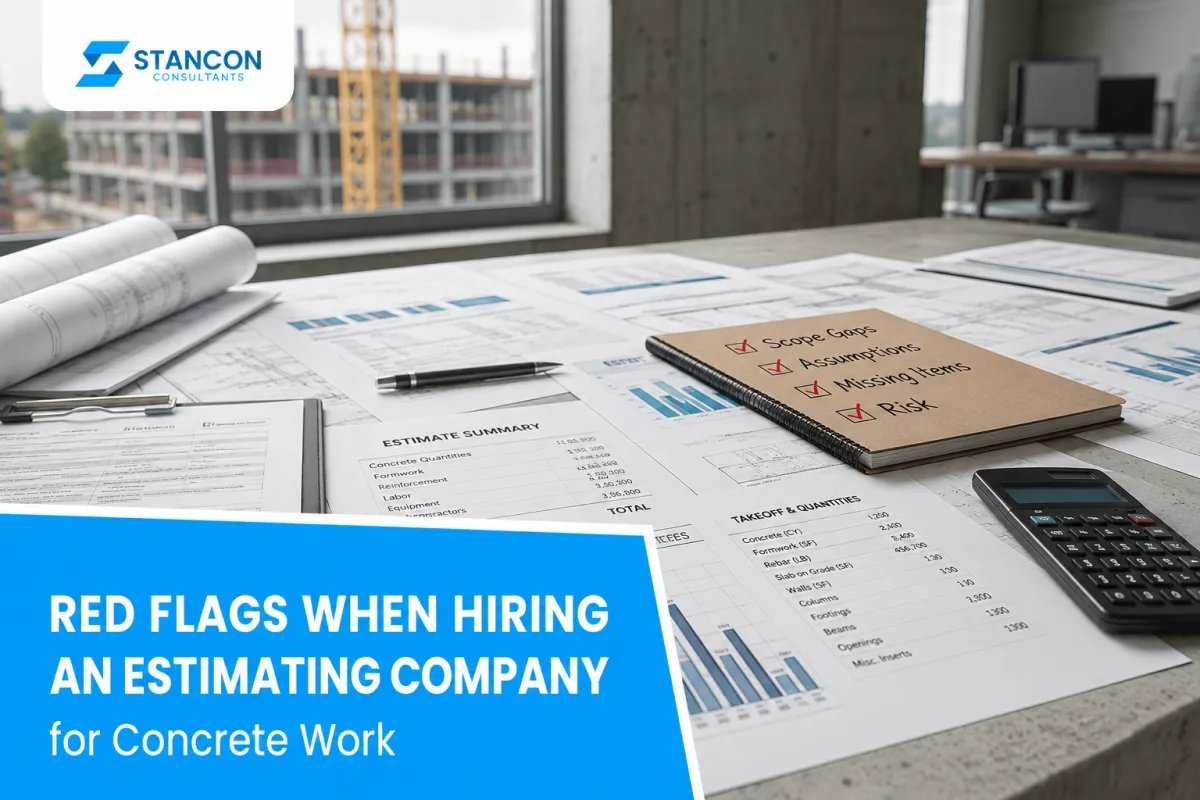
Red Flags to Watch Out For When Hiring an Estimating Company for Concrete Work
Outsourcing your estimating can be one of the smartest moves a commercial concrete subcontractor makes. It frees up your time, tightens your numbers, and lets you chase more work without burning out your field leadership. But it only works if you hire the right partner.
The wrong estimating company will cost you more than their fee. You hand over your drawings, trust someone with your numbers, and submit a bid to a GC who has already decided you're a serious contender. Then the job gets awarded, work starts, and somewhere around the third week of forming, you realize the estimate missed something significant. The labor hours are off. A pour sequence wasn't accounted for. There's no contingency for the deck flatwork on Level 3.
And the GC is not calling your estimating company. They're calling you.
According to McKinsey research, 98% of megaprojects experience cost overruns of more than 30%, showing how damaging inaccurate planning and estimating can become once construction begins.
That's the part nobody talks about when they pitch you on outsourcing your estimating. The upside is real. Done right, outsourced concrete estimating frees up your preconstruction bandwidth and puts tighter numbers in front of GCs who are already watching your hit rate. But done with the wrong company, it puts your reputation and your margin on the same chopping block.
So before you sign anything, here's what to watch for.
1. They Can't Show You Concrete-Specific Experience
This is the first question to ask and the first place most contractors don't push hard enough.
Estimating is not a universal skill. A company that's spent the last five years pricing MEP scopes or residential framing is not automatically equipped to handle a cast-in-place structural package, a post-tensioned podium deck, or a tilt-up panel job. The forming systems are different. The labor productivity assumptions are different. The way you break out your CSI divisions matters. The pour sequence affects your cost. None of that transfers from another trade.
Ask them directly, what commercial concrete projects have you estimated in the last 12 months? What was the scope? What was the dollar value? A credible company will answer that without flinching. If they pivot to general construction experience or tell you concrete is "similar to what we do," that's your answer right there.
2. They Give You a Number Without Showing Their Work
A lump sum on a one-page sheet is not an estimate. It's a guess with formatting.
Any estimating company worth hiring should hand you a deliverable that breaks down linear footage of formwork, square footage of slab on grade, cubic yards of concrete by pour, labor hour assumptions, equipment burden, and subcontractor line items where applicable. That's what a bid proposal that actually holds up looks like when it lands on a GC's desk.
If you can't open their takeoff and trace every number back to the drawings, you can't review it. You can't defend it in a scope meeting. And you definitely can't build a cost-to-complete off it when a change order lands mid-job.
Transparency isn't a premium feature. It's the baseline.
3. They're Not Asking You Enough Questions
Here's a red flag that's easy to miss because it feels like efficiency: they take your drawings and get to work without asking much.
That's not efficiency. That's an estimate built on assumptions that have nothing to do with how you run your business.
A good estimating partner needs to know your labor rate and whether it's union or open shop. They need to know if you self-perform your forming crews or sub it out. They need to know your equipment burden, your overhead structure, and what markup you typically carry to stay competitive in your market. They need to know if this is a prevailing wage job. They need to understand your company before they touch your drawings.
If they don't ask, they're plugging in generic numbers. And generic numbers on a commercial concrete bid will either price you out of the job or win it at a number you'll regret.
4. Their Turnaround Promises Don't Add Up
Bid windows in commercial concrete are tight. You already know this. Invite-to-bid to due date can be two weeks on a $3M package, sometimes less. And GCs are not interested in your vendor's backlog.
So when an estimating company promises you a 48-hour turnaround on a complex cast-in-place scope before they've even seen the drawing set, slow down. Speed and accuracy don't always travel together. Rushed estimates from outside providers are one of the more common ways contractors end up submitting numbers they can't stand behind.
Ask them how they determine turnaround time. Ask what happens when addenda drop late. Ask what the process looks like if the drawing set is incomplete. If they can answer those questions specifically and clearly, they've been around long enough to have dealt with them. If they can't, they haven't.
5. No Clear Process for Addenda and Plan Revisions
This is where a lot of estimating partnerships quietly fall apart.
Drawings change. A structural sheet gets revised. The slab edge shifts. The GC issues two addenda in the last 72 hours before bid day. If your estimating company doesn't have a documented process for tracking, logging, and incorporating those changes into the live estimate, your number is built on a foundation that's already moving.
Studies on construction rework estimate that correcting preventable mistakes can consume between 5% and 10% of total project costs, especially when scope revisions are poorly managed.
Ask them specifically: how do you manage mid-estimate plan revisions? What does your addendum log look like? Who is responsible for flagging scope changes? The absence of a structured process for handling project modifications is one of the clearest signs that a company hasn't built real preconstruction infrastructure. It's also one of the fastest ways to submit a bid that's already wrong before it leaves your desk.
6. Accountability Is Buried in the Contract
Read the service agreement before you sign it. All of it.
Some estimating companies write contracts that effectively limit any recourse you have when something goes wrong, while leaving you fully exposed to the GC when a number is off. That's not a partnership. That's a transaction where the risk flows in one direction.
The reality is that when you outsource your estimating, you remain responsible for the numbers you submit. That's the nature of the subcontract relationship, and it doesn't change because you used a third party. But a company that stands behind its work should still offer corrections without nickel-and-diming you, communicate openly when an error is found, and not structure its contract to make accountability impossible. If the fine print reads like a liability shield more than a service agreement, trust that instinct.
7. They Can't Produce Concrete Sub References
This one's simple. If they've done good work for commercial concrete subcontractors, they can name some.
Not general contractors. Not residential builders. Not MEP subs. Concrete subcontractors specifically, doing the kind of commercial work you're pursuing.
If they can't produce two or three, one of two things is true: they haven't worked in your trade type before, or the relationships didn't end well enough to be references. Either way, that's information you needed before you handed over your drawings, not after.
8. They're Running Volume Over Quality
Some estimating companies are built around a high-output model. They take on as many projects as possible, spread the work across a large pool of estimators, and optimize for throughput. That works in some trades. It doesn't work well for specialized commercial concrete scopes where the difference between a sharp number and a soft one comes down to someone who actually knows what a jump form cycle costs, or how to read a post-tension shop drawing.
Ask how many active projects they're managing right now. Ask how many estimators will be assigned specifically to your scope. Ask about their QC process before a deliverable goes out. If the answers are vague or they seem surprised you're asking, the model probably isn't built around quality control. It's built around volume, and your job is just another ticket in the queue.
What Good Actually Looks Like
The right estimating partner doesn't feel like a vendor. They feel like an extension of your preconstruction team. They understand your scope, they communicate before problems surface, and they hand you numbers you can defend in a scope leveling meeting with a GC who's already picked your estimate apart.
If you want to go deeper on how to vet and choose the right partner for your concrete operation, the full framework is in our guide: Choosing the Right Estimating Service: A Contractor's Buyer's Guide. It covers what to look for, what questions to ask, and how to structure the relationship so it actually works.
And if you want to understand what a clean construction bidding process looks like from the inside, that's worth reading too before you put any estimating partner to work on a live opportunity.
Quick Checklist Before Hiring an Estimating Company
Before handing over your drawings or relying on an outside estimate for a live bid, make sure you can confidently answer yes to these questions:
Have they estimated commercial concrete projects similar to yours recently?
Can they provide detailed takeoffs and transparent cost breakdowns?
Do they understand your labor structure, production rates, and market conditions?
Is there a documented process for handling addenda and plan revisions?
Can they realistically explain their turnaround timelines?
Do they have references from commercial concrete subcontractors?
Is there a clear quality control and review process before delivery?
Does the service agreement outline accountability and correction procedures clearly?
Will you be able to review and trace every number back to the drawings?
Do they communicate like a preconstruction partner instead of just a vendor?
A reliable estimating partner should help you submit more competitive bids with confidence, not leave you uncovering missed scope after the job has already started.
If you want estimating support built specifically for commercial concrete subcontractors, Stancon Consultants can walk you through our process, documentation standards, and QC workflow before you ever submit a live bid. Lt's talk.
Frequently Asked Questions
What's the most important question to ask an estimating company before hiring them?
Ask for examples of commercial concrete projects they've estimated in the last year, including scope type and contract value. That one question will tell you more than any sales conversation.
Can an estimating company be held responsible if the estimate is wrong?
In most cases, you remain responsible for the numbers you submit to a GC regardless of who produced them. That's why vetting your estimating partner thoroughly isn't optional. Review the service agreement carefully and make sure there's a defined correction process before you sign.
How do I know if a commercial concrete estimating company actually understands concrete work?
Ask them about forming systems, pour sequencing, labor productivity rates for flatwork versus elevated decks, and how they handle concrete waste factors. Their answers will confirm or rule out real trade knowledge quickly.
Is outsourcing estimating worth it for a concrete sub?
It can be one of the best moves you make, when it's the right partner. The capacity to bid more work without adding full-time overhead is real. But that upside only exists if the company you hire understands your trade, your market, and your numbers.