
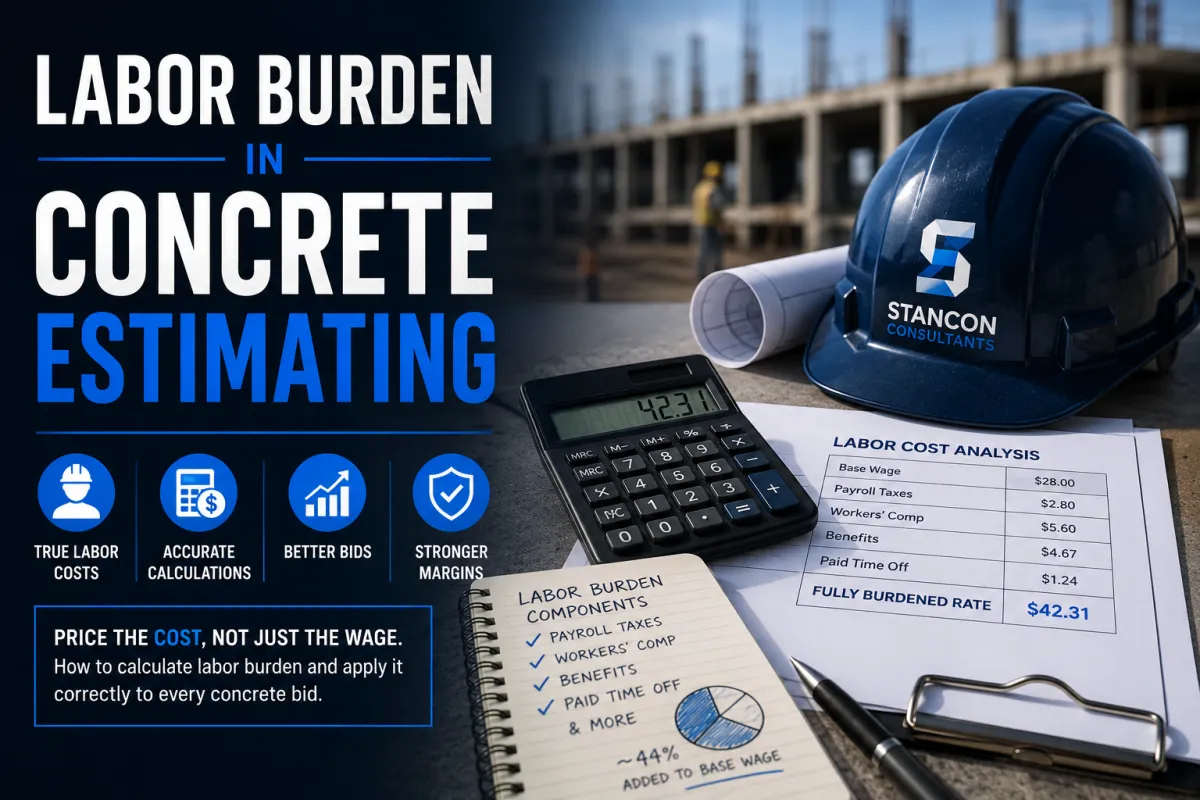
How to Calculate Labor Burden for Commercial Concrete Estimating
During his years running a commercial concrete operation, Joseph Toppi had the same conversation with contractors repeatedly. Ask a concrete subcontractor what an employee costs, and they'll usually give you the hourly wage. Push a little further and they might add payroll taxes. Push harder and a few will mention workers' comp. Almost none will give you a number that reflects what the employee actually costs to employ.
That gap is one of the most common and most expensive miscalculations in commercial concrete estimating. When the hourly rate you're pricing against doesn't reflect the full cost of the employee, every bid you build on that number understates your true labor cost. The estimate looks complete. The proposal goes out. The job gets awarded. And the margin bleeds from day one because the labor calculation was wrong before the first form was set.
Joseph built his concrete operation to 46 employees and reached a 54% gross profit margin by understanding this distinction clearly and building his estimating process around it. That process started with knowing the actual, fully loaded cost of every crew member, not the wage on the timesheet.
This article covers what labor burden is, what goes into it for a commercial concrete subcontractor specifically, how to calculate your fully burdened labor rate, and how to apply it correctly in your estimates. It's designed to be read alongside the overhead costs guide for concrete subcontractors, since labor burden and overhead are related but distinct concepts that both feed the same estimate.
What Labor Burden Actually Is
Labor burden is the difference between what you pay an employee and what that employee actually costs you to employ. It's the sum of all the additional employer costs that sit on top of the base wage: payroll taxes, workers' compensation, health insurance, retirement contributions, paid time off, and any other benefits or liabilities tied to that employee's employment.
The base wage is what shows on the timesheet. The fully burdened labor rate is what actually comes out of your business every time that employee is on the clock. And in commercial concrete subcontracting, those two numbers can be meaningfully far apart.
According to the U.S. Bureau of Labor Statistics' March 2026 Employer Costs for Employee Compensation data, workers in the construction, extraction, farming, fishing, and forestry occupational group cost employers an average of $47.06 per hour in total compensation, including $31.81 in wages and salaries and $15.25 in benefits. Benefits therefore added roughly 48% to base wages in this broad occupational group. For a concrete subcontractor, the actual labor burden can differ significantly based on workers' compensation classification, benefits, payroll taxes, paid leave, and other employment costs.
The distinction between labor burden and overhead matters for how you structure your estimate. For estimating purposes, labor burden is generally treated as part of the direct labor cost when it can be assigned to the employees and hours working on a specific project. Overhead is different because it represents the broader cost of running the business. Both have to be recovered through your bids. But they're calculated separately and applied differently, which is why the two topics are covered in separate articles rather than one.
What Goes Into Labor Burden for a Concrete Subcontractor
The components of labor burden for a commercial concrete operation fall into four categories. Each one adds to the gap between base wage and true employment cost, and each one needs to be calculated from your actual numbers rather than approximated.
Payroll Taxes.
Every employer in the U.S. pays a mandatory share of payroll taxes on each employee's wages. These include:
FICA Social Security at 6.2% of wages up to the annual wage base
FICA Medicare at 1.45% of all wages, with an additional 0.9% on wages above $200,000
Federal Unemployment Tax (FUTA) at 6% on the first $7,000 of each employee's wages, though most employers receive a credit that reduces this to 0.6% in most states
State Unemployment Tax (SUTA), which varies by state and by your company's claims history, typically ranging from 1% to 5% or more
Employer payroll taxes add to the base wage, with Social Security and Medicare alone accounting for 7.65% of applicable wages, while FUTA and state unemployment taxes vary based on wage bases, state rules, and the employer's specific rate.
Workers' Compensation Insurance.
This is where concrete subcontractors diverge significantly from other trades. Workers' comp rates are set by trade classification and adjusted by your Experience Modification Rate. Concrete subcontractors can carry significant workers' compensation costs because their field classifications and claims experience can produce materially different rates from office or lower-risk classifications. Your actual rate should come from your current workers' compensation policy, payroll classifications, and EMR rather than a generic industry percentage.
Because workers' comp is such a significant burden component for concrete work specifically, it's worth calculating the exact dollar impact on your fully burdened rate rather than rounding to an estimate. A 2 to 3 percentage point error in your workers' comp assumption can represent meaningful dollars per hour on a large crew over the life of a project.
Health and Other Benefits.
If you provide health insurance to your employees, the employer's contribution is a labor burden cost. According to the 2025 KFF Employer Health Benefits Survey, employers contributed an average of approximately $7,885 per year toward single coverage and $20,143 toward family coverage for covered workers. Retirement contributions, life insurance, short-term disability, and any other voluntary benefits add to this category.
Not every concrete subcontractor provides the same benefits package. The burden calculation has to reflect what your business actually pays, not an industry average, because a subcontractor offering full family health coverage and a retirement match carries a fundamentally different burden structure than one offering no benefits beyond the legal minimums.
Paid Time Off and Other Paid Non-Productive Time.
Vacation pay, paid holidays, and sick time represent hours you're paying for that aren't producing billable work. These are a burden cost that's easy to overlook because they're built into the salary or hourly rate structure rather than appearing as a separate invoice. If an employee earns $25 per hour and takes two weeks of paid vacation annually, that's approximately $2,000 per year in pay for hours that don't generate project revenue, which works out to roughly $1.00 per productive hour in additional burden.
How to Calculate Your Fully Burdened Labor Rate
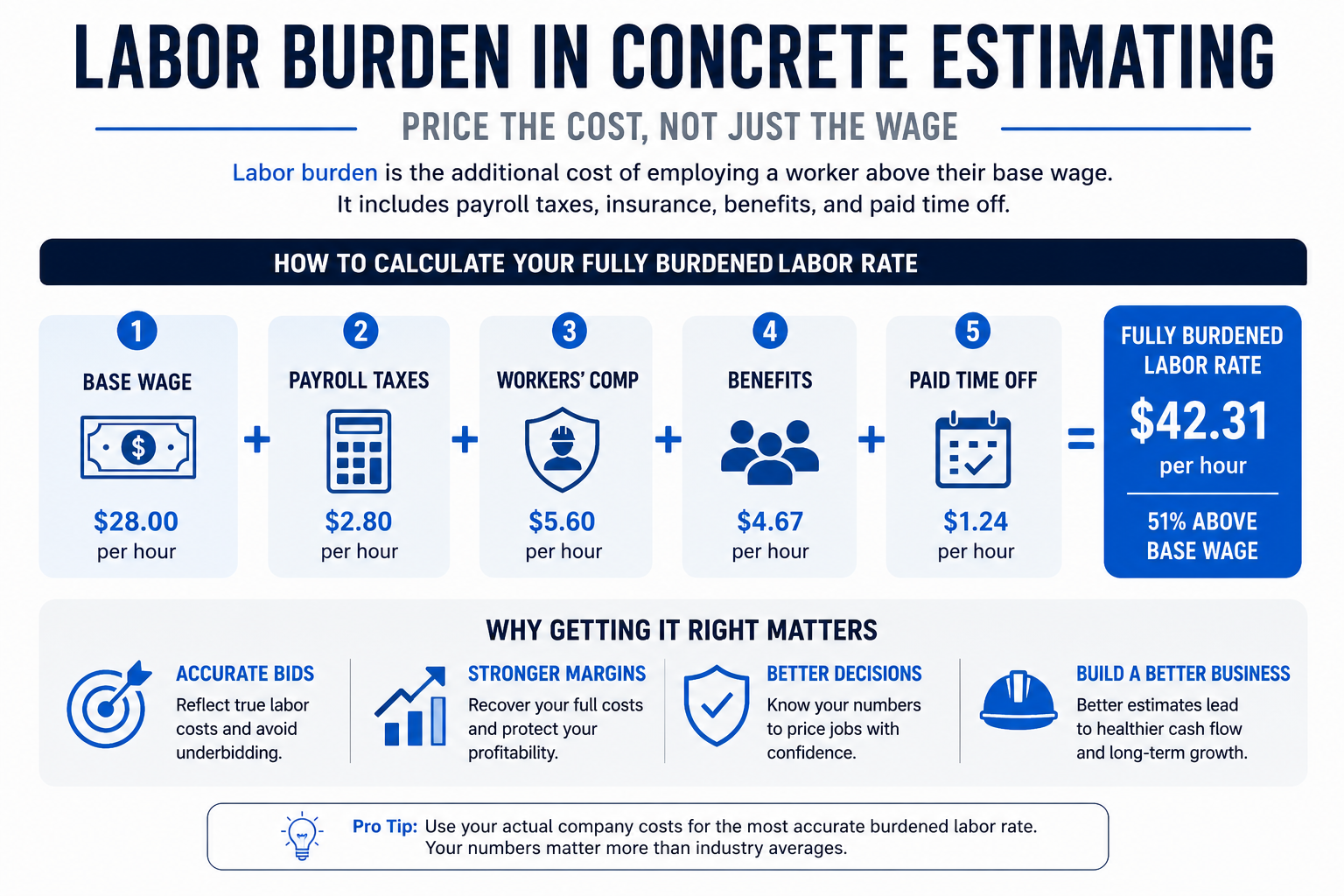
Once you've identified the burden components that apply to your operation, the calculation is straightforward. The goal is to arrive at a fully burdened hourly rate that reflects the true cost of each crew member for every hour they're working on a project.
Step 1: Start with base wage.
Take the employee's hourly wage. For a concrete finisher earning $28 per hour, that's the starting point.
Step 2: Add payroll taxes.
Apply your combined payroll tax rate to the base wage. At a combined rate of roughly 10%, that adds $2.80 per hour.
Step 3: Add workers' compensation.
Apply your workers' comp rate to the base wage. At a 20% rate, that adds $5.60 per hour.
Step 4: Add benefits.
Convert annual benefit costs to an hourly figure by dividing by productive hours worked per year. If the employee works approximately 1,800 productive hours per year and you contribute $8,400 in annual benefits, that adds roughly $4.67 per hour.
Step 5: Add paid time off.
Divide annual PTO pay by productive hours. Ten days of paid vacation on a $28 per hour wage represents approximately $2,240 annually, or roughly $1.24 per productive hour.
Step 6: Sum to the fully burdened rate.
$28.00 base + $2.80 payroll taxes + $5.60 workers' comp + $4.67 benefits + $1.24 PTO = approximately $42.31 per hour fully burdened.
That's 51% above the base wage in this example. The gap between $28 and $42.31 is the labor burden, and employment costs can add 24 to 70% on top of base wages depending on the company's benefit structure, workers' comp classification, and state requirements. For commercial concrete subcontractors with higher workers' comp rates, the upper end of that range is not unusual.
The important qualifier here is that these are illustrative numbers. Your actual fully burdened rate will differ based on your specific workers' comp classification and EMR, the benefits you provide, your state's SUTA rate, and your actual PTO policy. The calculation above gives you the structure. Your real numbers are what fill it in.
Crew-Level vs. Individual Burden Rates
Most concrete subcontractors operate with crews rather than individual employees on any given project. The crew-level burden calculation adds another layer of complexity because different crew members carry different burden profiles.
A foreman earning $45 per hour carries a different dollar amount of workers' comp than a laborer earning $20 per hour, even at the same percentage rate. A salaried superintendent who receives family health coverage carries a different benefit burden than an hourly finisher with single coverage. When you roll these up to a crew cost, using a single blended rate can misrepresent the true cost of that specific crew on that specific project.
For most small to mid-size concrete operations, calculating burden at two or three crew tiers, a foreman rate, a skilled laborer rate, and a general laborer rate, gives enough precision without requiring individual calculations for every employee. That tiered approach was part of how Joseph structured his concrete operation's cost model: fixed crew cost tiers that could be applied to estimates quickly while still reflecting the actual burden structure of the business rather than a rough approximation.
Misclassification of trade codes can create 10 to 15 percentage point errors in burdened labor rate calculations. For a crew working 2,000 hours on a project at $30 per hour base, a 12-point error in burden calculation represents $7,200 in unrecovered labor cost on that single job.
How Labor Burden Interacts With Productivity
Calculating the fully burdened rate is only half of the labor cost equation. The other half is productivity: how many units of work that crew produces per hour, and whether the productivity assumption in your estimate reflects the actual scope in front of them.
Labor costs typically make up 30 to 50% of total project cost for structural concrete and related trades, which means errors in both burden and productivity assumptions compound quickly on any meaningful concrete package. A burden rate that's 10% understated combined with a productivity assumption that's 15% too optimistic produces an estimate that's materially off before a single cost code is tracked.
This interaction is one of the clearest reasons why structural concrete estimating differs from flatwork estimating in ways that go beyond scope complexity. The productivity assumptions that work reliably on flatwork, where the work sequence is relatively consistent, don't transfer directly to structural work where wall height, rebar complexity, and forming system selection all change the labor hours required per unit of production. Both the burden rate and the productivity rate need to reflect the actual scope being priced.
Applying Labor Burden in Your Concrete Estimate
Once you have your fully burdened crew rates established, applying them to an estimate is the straightforward part. For each activity in the estimate, you multiply the estimated hours by the applicable burdened rate for the crew type performing that activity.
The estimate structure that follows from this is: quantity from takeoff × labor hours per unit × fully burdened hourly rate = labor cost for that activity. Stack those calculations across all scope items, and the total represents your fully burdened labor cost for the project.
This is the step where understanding the difference between a takeoff and an estimate becomes directly relevant. The takeoff provides the quantities. The estimate applies the burdened labor rate and the productivity assumption to those quantities to arrive at a dollar figure. One feeds the other, and accuracy at the takeoff stage is the foundation for accuracy in the labor cost calculation.
The fully burdened labor cost, combined with material costs, equipment costs, and your correctly calculated overhead rate, produces your total direct plus indirect cost. From there, your markup for profit gets applied to arrive at the bid price. How that markup is calculated and what profit margin it actually produces is covered in the markup vs. margin breakdown that's worth reading alongside this article if the relationship between those two numbers isn't already clear.
Why Getting This Right Matters More Than Most Subs Realize
The financial consequence of an understated labor burden rate runs quietly through every project where it's applied. It doesn't show up as a single visible error. It shows up as margin that's consistently thinner than the estimate suggested, jobs that pencil out on paper and grind in execution, and a business that's working hard without building the financial cushion it should be building for the volume of work it's doing.
Joseph saw this pattern repeatedly in contractors he worked with before and after building Stancon Consultants: a concrete sub who genuinely believed they were making 20% gross margin on their work, because that's what the estimate said, and was actually making 11% or 12% because the labor burden wasn't fully accounted for. The difference between those two numbers, on $3 million in annual revenue, is roughly $240,000 to $270,000 in margin that existed on paper and not in the bank.
Getting the labor burden calculation right doesn't require sophisticated software. It requires knowing your actual costs, building the calculation from your real payroll, workers' comp, and benefits numbers, and applying those numbers consistently to every estimate rather than relying on a rule of thumb that someone told you was industry standard years ago.
That discipline is part of what Stancon Consultants brings to the commercial concrete subcontractors we work with. Our concrete estimating services start from your actual cost structure, including your burdened labor rates, before a single quantity from the takeoff gets priced. And if you want to build out the ongoing estimating infrastructure that keeps those numbers current as your crew and benefit structure evolves, our fractional estimating plans are built around exactly that model.
The cash flow implications of consistently understated labor burden are direct: the margin you thought the project was generating isn't there, which means the cash you expected to retain from the job isn't there either. And that gap is harder to close mid-project than it is to prevent in the estimate. If you're not confident your labor burden is being calculated and recovered correctly, contact Stancon Consultants to review your estimating process and make sure your labor costs are working for your bottom line.